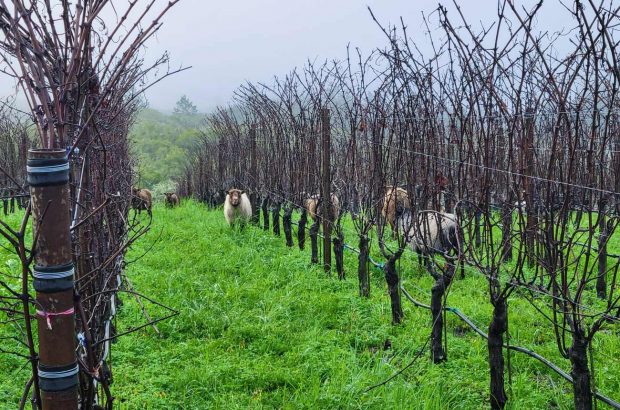
Photo: Terrace Heights Estate, Wairau [thewine.co.nz]
Forrest’s call came in the context of overproduction and consequent erosion of Marlborough’s image over the last half-decade. Maybe the pressure is off: it would seem as if nature has stepped in to rectify matters for the 2012 harvest. A projected crop of around 300,000 tonnes will slice much of the fat off New Zealand’s once-trim belly. Forrest’s reflection, though, remains timely, not just in New Zealand but throughout the wine-growing world outside Europe.
The definition of wine regions outside Europe has been underway for over a quarter of a century. American Viticultural Areas date from 1980; Australia’s Geographical Indications date from the 1993 amendment of the Australian Wine and Brand Corporation Act. New Zealand’s own system is more recent; the relevant Geographical Indications legislation was passed in 2004 and 2006. There are exceptions, but in general if you see a regional name on a label you can assume that 85 per cent or more of the grapes which made the wine in that bottle came from the stated region.
But, as yet, nothing more than that. There are no rules regarding choice of variety, yield, pruning system, harvesting method, or any of the other stipulations common in Europe. This ‘freedom’ has been much vaunted by GI and AVA users. Quite right, too: in the early evolutionary stage in which most GIs and AVAs find themselves, to attempt to impose more restrictive regulations would be senseless. They need the freedom to evolve.
Sooner or later, though, comes the moment to begin drawing economic lessons from all this freedom. Some regions prove more successful than others. Within the most profitable regions, some varieties command a higher price than others. Leading producers are likely to be responsible about yield, and to have learned which vineyard and winery practices are appropriate for the varieties most suited to that location; their wines will sell at the highest prices. Perennial value begins to be created. That value becomes the basis of domestic reputation and, sometimes, world renown.
With reputation, though, comes the risk to reputation. That’s when assiduous producers like John Forrest are likely to want tighter regulation. Marlborough has something to loose if sub-standard wine bearing that name reaches the market. Much the same is true of Coonawarra or Margaret River, Napa Valley or the Willamette Valley. It’s what the growers of Champagne and Chablis learned to their cost in the chaos which came with post-phylloxera replanting in Europe. It is, in fact, why appellations exist.
If GIs, AVAs and their equivalents in South Africa, Chile and Argentina are to continue to bring benefits to wine growers and consumers alike, they can’t simply ossify in infancy. Further meaning must accrue for each. Standards must rise; the focus must tighten. If this is left to individual brands alone, the only benefit will be to those brands, and any reputation held in common will be eroded. The meaning which clings to those communal, geographical names will be lost.
The problem for those administering ‘appellations’ in the world’s developing wine nations is that every GI or AVA has different needs. The weakest, indeed, are liable to need abolition or amalgamation. Even in the strongest, any unilateral imposition of regulation is likely to meet with resistance from producers with economic strategies based on volume rather than quality.
It’s important to do something, though. Dr Forrest’s suggestion of a voluntary syndicate is probably the only workable one in the first instance. Later in the evolutionary process, of course, those who go it alone in agreeing higher or tighter standards may find others wish to join them. This is how you build a future for terroir.

Decanter World Wine Awards


Have your say!
Kent Benson
March 27 00:59
Dr. Forrest is pursuing precisely the right course in calling for a voluntary quality syndicate. The codification of European-style production laws would do little to achieve the desired result and would only stifle innovation and future growth. The German VDP has shown that such an association can serve as a reliable guide for quality-seeking consumers.
Marlborough wine producers are experiencing the inevitable business cycle every industry has encountered throughout the history of commerce. Quality products, once popularized, are soon imitated by inferior products. In some cases, new methods of production are developed whereby innovative newcomers are able to equal or even exceed the value represented by the originators. Does anyone remember how bad the early Japanese 35mm cameras were?
The answer does not lie in legal protection for quality producers in the form of barriers to entry for less quality-minded competitors. Every industry needs “sub-standard” products. They play an important role in every industry’s health and growth, providing a low-risk entry point for consumers.
Producers with “economic strategies based on volume rather than quality” are important to the future of any region. Does anyone but the most ardent elitist believe that high volume, low cost producers have not been good for the overall health of the wine industry? Millions of people are enjoying wine on a regular basis today due to the efforts of high volume producers who provide consistently drinkable wines at low prices. Quality producers owe their future sales to them.
The quality producers who popularize a region will always enjoy a premium price for their superior product. Will that premium experience erosion as inferior, lower cost products enter the market? Yes, as has been the case in every industry. Welcome to the vagaries of open competition.
Why is it necessary to “build a future for terroir”? Must we create a false mystique which ascribes a magical influence of terroir on the vines planted on it? If a terroir’s reputation needs protecting, does it not suggest that the importance of that terroir has been overstated?
Why should a wine’s association with a growing region be artificially translated into an indication of quality? Isn’t it obvious that quality is as much dependent upon the producer as it is the region? Even in Burgundy, where terroir reigns supreme, the producer remains tantamount, as any Burgundy lover will attest.
Any attempts to “impose more restrictive regulations” remains “senseless.” The “freedom to evolve” and innovate, is still needed. To impose restrictions on “variety, yield, pruning system, harvesting method” would stifle innovation. Why restrict producers to currently accepted notions of quality standards? Why prevent the possible success of those willing to risk their capital to challenge conventional wisdom? If someone finds a way to maintain quality while increasing yield, is that a bad thing? Sounds to me like more good wine for all of us.
It’s impractical to attach “further meaning” to an appellation by ascribing a quality claim to it. What’s wrong with an appellation remaining only an indication of geographic origin? Try as they might, no set appellation rules has succeeded in guaranteeing quality. An appellation moniker cannot be a means of protecting the reputation of quality producers. The best protection for any producer is the wine in the bottle with their name on the label. The fact is, for the most part, consumer focus is exactly where it should be – on the producer. No amount of appellation restrictions will change that.
Hugh Ammundsen
March 26 22:58
Calls for regulation, in whatever form, are a frequent response to troubled markets and economics. As you rightly point out, the genesis of the appellation controlee system was just such a response to specific circumstances. However, there is a significant difference between the belt and braces regulation of production and the geographic name controls that passes for the New World equivalent of the European framework. John Forrest's call (and he has not been alone in this) reaches beyond name protection to production controls. Leaving aside whether 2012 delivers compulsory natural restraint, the risk I perceive is of unintended consequences. How might controls extend over different varieties with extremely varied cropping behaviour, for example? My fear is that just as most of the New World has lost sight of the point of geographic name regulation in a manic burst of parochial marketing activity, similarly regulation would most likely serve only to stunt innovation and evolution in new and developing regions. For these reasons I consider private, but preferably inclusive, name protection schemes to be the way of the future.
Kent Benson
March 26 17:50
Dr. Forrest is pursuing precisely the right course in calling for a voluntary quality syndicate. The codification of European-style production laws would do little to achieve the desired result and would only stifle innovation and future growth. The German VDP has shown that such an association can serve as a reliable guide for quality-seeking consumers.
Marlborough wine producers are experiencing the inevitable business cycle every industry has encountered throughout the history of commerce. Quality products, once popularized, are soon imitated by inferior products. In some cases, new methods of production are developed whereby innovative newcomers are able to equal or even exceed the value represented by the originators. Does anyone remember how bad the early Japanese 35mm cameras were?
The answer does not lie in legal protection for quality producers in the form of barriers to entry for less quality-minded competitors. Every industry needs “sub-standard” products. They play an important role in every industry’s health and growth, providing a low-risk entry point for consumers.
Producers with “economic strategies based on volume rather than quality” are important to the future of any region. Does anyone but the most ardent elitist believe that high volume, low cost producers have not been good for the overall health of the wine industry? Millions of people are enjoying wine on a regular basis today due to the efforts of high volume producers who provide consistently drinkable wines at low prices. Quality producers owe their future sales to them.
The quality producers who popularize a region will always enjoy a premium price for their superior product. Will that premium experience erosion as inferior, lower cost products enter the market? Yes, as has been the case in every industry. Welcome to the vagaries of open competition.
Why is it necessary to “build a future for terroir”? Must we create a false mystique which ascribes a magical influence of terroir on the vines planted on it? If a terroir’s reputation needs protecting, does it not suggest that the importance of that terroir has been overstated?
Why should a wine’s association with a growing region be artificially translated into an indication of quality? Isn’t it obvious that quality is as much dependent upon the producer as it is the region? Even in Burgundy, where terroir reigns supreme, the producer remains tantamount, as any Burgundy lover will attest.
Any attempts to “impose more restrictive regulations” remains “senseless.” The “freedom to evolve” and innovate, is still needed. To impose restrictions on “variety, yield, pruning system, harvesting method” would stifle innovation. Why restrict producers to currently accepted notions of quality standards? Why prevent the possible success of those willing to risk their capital to challenge conventional wisdom? If someone finds a way to maintain quality while increasing yield, is that a bad thing? Sounds to me like more good wine for all of us.
It’s impractical to attach “further meaning” to an appellation by ascribing a quality claim to it. What’s wrong with an appellation remaining only an indication of geographic origin? Try as they might, no set appellation rules has succeeded in guaranteeing quality. An appellation moniker cannot be a means of protecting the reputation of quality producers. The best protection for any producer is the wine in the bottle with their name on the label. The fact is, for the most part, consumer focus is exactly where it should be – on the producer. No amount of appellation restrictions will change that.