
Heitz Cellar: Six decades of a Napa Valley icon
Seven years into its new ownership, decades of commitment to place and a traditional approach at Heitz Cellar continue, reflected in a style and elegance that can be seen and tasted in vintages both old and new.


The road that winds its way to Heitz Cellar and the historic property, which includes a barrel house built in 1898, is a trip back in time. A quiet slice of the old Napa, tucked amid sprawling oak trees away from the tasting room traffic on the Silverado Trail.
Founded by Joe and Alice Heitz in 1961, Heitz quickly established itself among America’s great producers.
A pioneer in many ways, Heitz created America’s first single vineyard-designate, the 1966 Martha’s Vineyard Cabernet Sauvignon, becoming the first to champion terroir in Napa and the US.
‘There have only been three winemakers in Heitz’s history,’ Carlton McCoy MS tells me. ‘Joe, his son David and Brittany Sherwood.’
Joe passed the baton to David in the late 1970s. Sherwood, the current director of winemaking, has been at the helm since 2018, when the property was acquired by Lawrence Wine Estates, of which McCoy is CEO. (She worked for six years alongside David Heitz, taking the lead in the cellar with the 2016 vintage.)
See Jonathan Cristaldi’s pick of Heitz Cellar across six decades
Less about the barrel

The ‘Heitz style’ has always been about flavour from fruit, eschewing extraneous tannin from over-extraction or overt oak.
‘Joe felt that it [overtly tannic wine] was just an excuse, a lazy way of making Cabernet,’ McCoy explains.
‘Oak can give you an illusion of opulence and pedigree, but you’re not assessing the density and length of the wine. So we taste the wines a year after harvest, before they see any oak.
‘That’s when we choose the single-vineyard wines over the Napa Valley designate. It’s also when we decide on ageing regimes and oak to finish the wines, based on what we think they need.’
The single-vineyard Heitz wines are released four years from harvest, and the Napa Valley designate is released three years after harvest.
‘At some point in the transition between Joe and David, I can only imagine as an attempt to “modernise”, they began using a higher proportion of barrique and, more importantly, a much greater proportion of new barrique,’ says McCoy.
‘For us, it was critical to return to the original style, but with larger casks. We have reduced the proportion of barrique and new barrique and now use a much larger percentage of 1,000- to 2,000-litre foudre.
‘We also still use the large casks that are 10,000 to 20,000 litres. We think the wines are fresher, and it allows us to secure density in the mid-palate, which you lose in smaller barriques.’
As the rest of Napa Valley moved towards new oak, and plenty of it in the form of smaller barriques, David Heitz veered Heitz Cellars a little in that direction, before correcting course after a few years.
‘We’ve taken it back even further,’ McCoy explains, in terms of minimising the oak impact.
‘We have to ask the question, if Joe were still here, would he be making the wines the same way? No, he wouldn’t; he’d want to focus on making the wines better.’
For McCoy, Sherwood and the Heitz team, that improvement is mostly gained in the vineyards, through a series of small tweaks to polish what is already renowned as classic.
Freshness in the vineyard

‘We’re making wines now that are closer to the alcohol levels from the 1970s. But we’re not doing it by picking early,’ McCoy clarifies, ‘it’s a combination of factors that help with the maturity of the fruit.’
By moving completely to biodynamics – conversion began after the 2019 vintage and Demeter certification was achieved a few years later – and significantly reducing irrigation, as well as bringing in a reduced- or no-till approach and interplanting between vine rows, the team at Heitz is seeing a concentration married to freshness in the fruit as it’s harvested.
This means that much of the work is done before the winemaking begins.
‘When you irrigate and have a big crop hanging on the vines, it slows down the maturity of the fruit,’ McCoy says.
‘For Cabernet, it’s not about picking earlier; it’s about balancing phenolic, or physiological, ripeness [relating to the grape skins, seeds and stems] with lower sugars [ie, potential alcohol].
‘After 24° Brix [a standard measure of sugar content in solution], it’s no longer sugar accumulation, it’s the concentration of sugar through dehydration and raisination.’
The Heitz team is committed to picking at a level of 24°-24.5° Brix at most, and aiming for full phenolic ripeness at that sugar level.
They achieve fruit concentration through lower yields [quantity of fruit per vine] and largely by dry-farming. This means the fruit comes in balanced yet concentrated.
The Heitz Cellar vertical

If there is a signature of the Heitz wines, it’s that they are shot through with forest character, whether it’s described as bay leaf, pine resin, spearmint or even eucalyptus.
The lively and elegant arboreal essence is the calling card for Heitz, both in the wines made today and indeed back to the 1969-vintage Lot C-91.
As a central part of our preparation for this article, McCoy presented a dazzling array of Heitz wines, 43 in all, for me and Decanter’s Napa correspondent Jonathan Cristaldi (see his tasting notes on a selection of 10 of them, below).
A dramatic case was immediately made regarding Heitz’s freshness as we nosed our first wine, the 1978 Napa Valley Cabernet Sauvignon: remarkable, and still exuberant, 47 years in.
The throughline was pronounced as we tasted a range of vintages, some of them regarded as hot, others rainy, wet and difficult.
Yet a consistency was evident: balanced, fresh and light on their feet, even in hot years; lively throughout, persistent forest elements that framed taut, fresh violets and blue/black fruits in each and every vintage.
In his day, influential US critic Robert Parker would write off an entire vintage, particularly one like 2011, yet today this is a Heitz wine that’s showing dazzingly, overtly floral, fresh and vibrant.
Many of the farming changes at Heitz were initiated in 2019, and McCoy believes this work will be clear to see in the wines moving forward.
The Linda Falls Vineyard Cabernet from that vintage is now tasting focused and precise, with a pronounced clarity and heightened fruit intensity.
And going back, the 1979 Martha’s Vineyard designate bottling is perfect (as per Cristaldi’s 100-point score), showing elegance and structure that is evocative of Barolo, or even Burgundy, with that forest-driven complexity and brilliant tension – a timeless Napa Cabernet that sets a benchmark for the region among the world’s great wines.
Restoring balance

For McCoy, one of the primary missions is to set a course for a return to a classic Napa Valley Cabernet Sauvignon: more honest, authentic and balanced.
Joe Heitz had a notoriously difficult relationship with Robert Parker, famously once sending him a box of handkerchiefs after Parker had described the Heitz wines as lacking in aromatics.
Yet it’s Parker’s outsized impact on Napa’s wines as a whole that McCoy feels as if he’s still pushing back on today.
‘Philosophically, my biggest challenge with so-called modern Napa is that it wasn’t driven by the winemakers, or climate,’ says McCoy. ‘The style that came about in the late 1980s is thanks to one man. It’s a style that is still very much around today.
‘But the fact is, wineries did what they did at the time in order to stay afloat. It may seem hard to believe, but the wrong score from one guy could essentially put you out of business back then.
‘A lot of wines, and this isn’t just in Napa, but throughout the world, were made to cater to one man’s palate. And this is the result: you have a lot of winemakers who don’t like to drink the wines they’re making. That’s a real tragedy, in my opinion.’
McCoy concludes that ‘freshness’ is perhaps an overused term. ‘But we’re talking about a balance between acidity and the rest of the structure of the wine. Your mouth waters, and you want more. That’s been missing in too many wines for too long.’
The team at Heitz wants to remind the wine world why Napa was considered great in the first place.

A taste of Heitz across six decades: Cristaldi’s 10 highlights
Related articles
- Wines of the Year 2025: North America
- Meet the next generation at four legacy Napa Valley wineries
- Mining for value in the Napa Valley: Over 20 of the best wines for under $75
Heitz Cellar, Martha's Vineyard Cabernet Sauvignon, Napa Valley, Oakville, California, USA, 1979
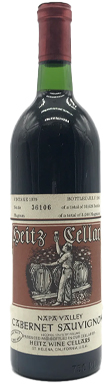

A perfect wine today, more than 46 years after the grapes were harvested. The aromatics here are stunningly pure – currant fruit, spice and tobacco,...
1979
Heitz CellarNapa Valley

Heitz Cellar, Lot C-91 Cabernet Sauvignon, Napa Valley, California, USA, 1969
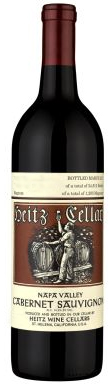
One of only three bottles that remained at the time of tasting, at 56 years old this is remarkable, vibrant and alive – one of...
1969
Heitz CellarNapa Valley
Heitz Cellar, Cabernet Sauvignon, Napa Valley, California, USA, 2021
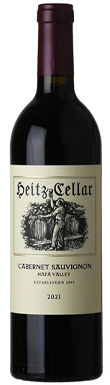
Remarkably pure and fresh. Pristine black cherry and blackberry, layered with beautiful violet aromas. Everything builds with precision and focus, supported by gorgeously firm, taut,...
2021
Heitz CellarNapa Valley
Heitz Cellar, Martha's Vineyard Cabernet Sauvignon, Napa Valley, Oakville, California, USA, 1975
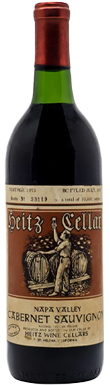
Wonderful aromas of smoky minerals, smoked paprika and sea salt, with dried bay laurel and eucalyptus. Currant fruit and ironstone minerality follow, framed by ripe...
1975
Heitz CellarNapa Valley
Heitz Cellar, Lot C-91 Cabernet Sauvignon, Napa Valley, California, USA, 2021
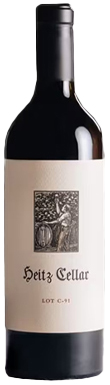
The fruit, aromatic precision and focus of this wine are something to experience. Compact, with firm, taut, mineral-rich tannins and gorgeously pure cherry fruit, underpinned...
2021
Heitz CellarNapa Valley
Heitz Cellar, Cabernet Sauvignon, Napa Valley, California, USA, 2011
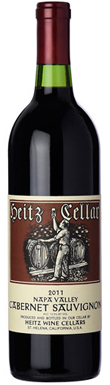
Delivers remarkably beautiful aromatics of spearmint, bay laurel and dried eucalyptus leaves. Vibrant, fresh palate, balanced by a cooling, menthol-like acidity. The tannin profile in...
2011
Heitz CellarNapa Valley
Heitz Cellar, Cabernet Sauvignon, Napa Valley, California, USA, 1978
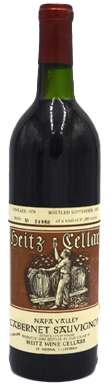
A host of gorgeous aromatics – black truffle, redcurrants, beautiful bay laurel and spearmint – build with real intensity on the medium-bodied palate. There’s remarkable...
1978
Heitz CellarNapa Valley
Heitz Cellar, Linda Falls Vineyard Cabernet Sauvignon, Napa Valley, Howell Mountain, California, USA, 2019
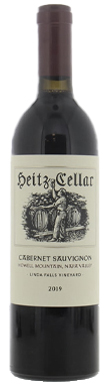
Pretty and focused, laced with bright acidity. Aromas of cherry and blackberry fruit mingle with crushed cocoa nibs, violets and rose petals. The palate builds...
2019
Heitz CellarNapa Valley
Heitz Cellar, Trailside Vineyard Cabernet Sauvignon, Napa Valley, Rutherford, California, USA, 2016
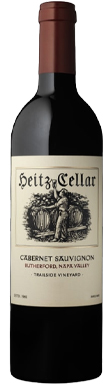
Enticing mulberry fruit notes are complemented by fragrant sagebrush, while blood orange acidity supports the medium- to full-bodied palate. Rich and expressive, with Pinot-like vibrancy,...
2016
Heitz CellarNapa Valley
Heitz Cellar, Martha's Vineyard Cabernet Sauvignon, Napa Valley, Oakville, California, USA, 1997
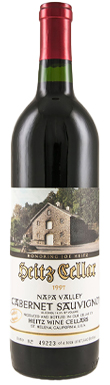
Dark-fruited and savoury, boasting a kind of walnut husk intensity, black olive and olive pit, and expressive tannins that stretch out with a rich, cedar...
1997
Heitz CellarNapa Valley
