
A beginner’s guide to Brazil
The quality of wine produced in Brazil has increased enormously over the past few decades, yet it remains an unknown quantity for many wine lovers in the UK. Native Brazilian Dirceau Vianna Junior MW rounds up the regions


Since the first vines were introduced to Brazil in 1532 the industry has experienced its share of turbulence, but the overall progress has been astonishing given the challenges it has faced over the years. Investment in technology, infrastructure, training and organisation of the wine sector has ensured a remarkable improvement in the quality of Brazil’s wines over the past three decades.
Vines brought into the country by immigrants were first planted in the state of São Paulo. However, climatic conditions, notably heat and excessive humidity, were not ideal for the European varieties and the experiment was swiftly abandoned. Subsequently, Portuguese settlers tried to cultivate vines in several different areas, looking for the most suitable location.The area that responded best to viticulture was Rio Grande do Sul, Brazil’s southernmost state, bordering Argentina and Uruguay. Initially the wine industry had to rely on high-yielding hybrids and American grape varieties such as Niagara, Isabel and Concord, until in the 1970s international companies started to invest, bringing know-how and technology, as well as new cuttings of Vitis vinifera that adapted well to this region.When the Brazilian government eased import barriers in the 1990s, local producers began to face increased competition for their share of the local market, notably from Chile and Argentina. The industry reacted positively and the quality of domestic wines has been improving ever since. However, in June this year the announcement of an agreement between Mercosul (South America’s trade bloc) and the European Union, which eliminated import tax for European wines (previously set at 27%) sent shock waves through the industry.
Challenges ahead
Brazilian wines must now compete directly with European wines in their home market, and high internal taxation, bureaucracy, expensive labour costs and lack of support from the government make this a challenging task. Rather than seeing it as a threat, Brazilian producers should use this as an opportunity to abandon less profitable areas of production – where they will certainly fail to compete with the cheaper wines of Spain, Italy and France – and instead focus on premium segments.
Importantly, there is also an opportunity for local producers to work collectively with other members of the industry to help educate local consumers, to tell their story and work on increasing the per capita consumption of wine in Brazil, which has remained stubbornly low and static at around two litres for a number of years, in contrast to beer consumption, which exceeds 60 litres per capita.
While Brazil is the 15th largest producer of grapes in the world, the majority of its 82,000ha of vineyard is planted with non-Vitis vinifera. Rio Grande do Sul is responsible for about 90% of total wine production, but with interest in wine increasing and with modern techniques being implemented, other areas of Brazil are starting to be explored.
The new frontiers
Ironically, some of the best wines coming out of Brazil today are made in São Paulo state, originally dismissed as being too hot and excessively humid. In the northern part of the state, 200km from São Paulo city, Sauvignon Blanc, Chardonnay and Viognier are capable of producing exciting whites, while Syrah grown at high altitude sites (800m-1,300m) is responsible for exceptional reds. One leading producer to look out for is Guaspari.
Vineyards have also been planted across the border in the state of Minas Gerais, renowned for its coffee plantations. Within a short space of time these new projects have started to demonstrate their suitability for the production of wines, mainly Sauvignon Blanc, Chardonnay and Tempranillo, although Syrah is also a star here. In addition, there are projects expanding throughout the states of Rio de Janeiro, Paraná and Goiás.

Serra Gaúcha
The Serra Gaúcha region has been colonised mainly by Italian settlers, who first arrived in the area in 1875. It is located in Brazil’s southernmost state, Rio Grande do Sul, bordering Argentina and Uruguay, and is responsible for more than 80% of the country’s production. Due to the challenging climatic conditions, American and hybrid varieties were the main focus until the 1970s, when international companies such as Martini & Rossi, Moët & Chandon and Seagram recognised Brazil as an attractive market and began investing. By the early 1990s, varietal wines from Cabernet Sauvignon, Cabernet Franc and Chardonnay were already on the market. The quality of wines, reds in particular, has continued to improve, while sparkling wine production started to gain traction from 2000 onwards.
The undulating topography of the area, with an altitude varying from 300m to 850m, is reminiscent of certain parts of northern Italy. The soil consists mainly of clay over basalt and the climate is humid. Average annual rainfall is about 1,700mm, hence most traditional vineyards were established using the pergola system.
Modern vineyards are planted using vertical shoot positioning (VSP). The main red varieties are Merlot, Cabernet Sauvignon and Pinot Noir, as well as Tannat and Cabernet Franc among others. Chardonnay, Riesling Italico, Moscato and Glera are the principal white varieties. The best producers in the area include Casa Perini, Casa Valduga, Cave Geisse, Lidio Carraro, Luiz Argenta, Miolo, Pizzato and Salton.
Serra do Sudeste
Winemakers started to explore Serra do Sudeste, in the southeast of Rio Grande do Sul, in the 1970s. There is lower rainfall in comparison with other parts of the state and this area has demonstrated great potential over the years. Cold winters combined with dry springs and warm summers are ideal for viticulture. Besides its climate, the area’s gentle slopes, varying in altitude between 200m and 500m, and its granitic soil are able to support many varieties, including reds such as Cabernet Franc, Cabernet Sauvignon, Merlot, Pinot Noir and Alicante Bouschet, and whites such as Gewürztraminer, Riesling, Moscato, Malvasia de Candia and Chardonnay (which is especially well suited to this region).
There are a few small wine-producing facilities in this area, but several of the best producers (including Angheben, Casa Valduga, Chandon and Lidio Carraro) own vineyards here, opting to vinify in Serra Gaúcha because of its proximity to the market.
Campos de Cima da Serra
Situated on the border between the states of Rio Grande do Sul and Santa Catarina, Campos de Cima da Serra is a remote area. The high plateau ranges in altitude from 800m to 1,100m and boasts an exotic beauty in the form of shallow rivers, waterfalls and the unusual – and highly endangered – araucaria trees. It is a cold region, renowned for apple cultivation, where temperatures during the growing season can vary between 6°C and 26°C. Continuous breezes ensure that vines are kept dry, and conditions here are ideal for a long ripening season. Shifts in temperature between day and night can be as high as 15°C, ensuring fresh acidity and lending great structure to the wines.
Since 2000, local businesses have invested heavily in this area. Nowadays there are plantings of Cabernet Sauvignon, Merlot, Pinot Noir, Cabernet Franc, Tannat, Ancellotta and Petit Verdot grown on various types of soil, including clay, loam and basalt. White varieties such as Chardonnay, Sauvignon Blanc, Moscato Bianco, Viognier, Glera and Gewürztraminer are also grown here.

Campanha
Campanha is Brazil’s southernmost growing area and is situated between parallels 28°S and 31°S, the same latitude that cuts across South Africa. It shares a long border with Uruguay. Climate is variable: temperatures can reach 38°C in summer, and in winter can drop as low as -10°C. The temperature during the growing cycle oscillates between 12°C and 24°C, and the seasons are well defined, with hot summers and cold winters.
The gently undulating plains vary in altitude between 100m and 300m and the sandy soils are suitable for many different red grape varieties, including Cabernet Sauvignon, Cabernet Franc, Merlot, Tannat, Teroldego, Pinot Noir, Marselan, Touriga Nacional and Tempranillo. The style of wine from this area tends to be ripe, round, soft and fruit-forward, with a balanced acidity. Chardonnay, Sauvignon Blanc, Viognier, Pinot Gris and Gewürztraminer are the main white grape varieties cultivated here. There are only two producers of note who vinify in this area: Guatambu and Miolo.
Planalto Catarinense
For those who associate Brazil with palm trees, sandy beaches and sunshine, Planalto Catarinense is an unusual region. It is home to one of the coldest cities in Brazil, São Joaquim, where snow, ice and freezing temperatures are not uncommon, and is the source of Brazil’s first ever naturally made ice wine.
Despite harsh winters, conditions during the growing cycle are ideal for viticulture, and are especially suited to Sauvignon Blanc and Pinot Noir. The ripening period is long, which ensures adequate phenolic ripeness for red grape varieties, namely Cabernet Sauvignon, Merlot, Malbec, Cabernet Franc, Tannat, Syrah, Sangiovese, Nebbiolo, Montepulciano and Tempranillo.
This region, where the altitude can reach 1,400m, is quickly becoming a reference point in the domestic wine market. Producers such as Quinta da Neve, Sanjo, Villa Francioni, Villaggio Grando, Vinícola Thera, Vinícola Pericó and Vinícola Villaggio Bassetti are currently working to fulfil the region’s potential for premium wines.
Vale do Rio São Francisco
Situated in the north of the country between the states of Pernambuco and Bahia, Vale do Rio São Francisco is a challenging place for viticulture. The climate here, between parallels 7°S and 9°S, is semi-arid, with an average temperature of about 26°C, 300 days of sun and annual rainfall of less than 300mm. With no winter at this latitude for the vine to rest, producers rely on a combination of the availability of water from the São Francisco river and pruning techniques to control the plant cycle. By withdrawing water the vine becomes dormant, then once the vine is pruned and irrigation re-established the new growing cycle begins and typically lasts for around 120 days.
In the same vineyard it is possible to observe dormant vines alongside those at flowering stage, as well as vines that are at the point of harvest. Red grapes planted in this hot and sunny place include Syrah, Cabernet Sauvignon, Tempranillo, Touriga Nacional and Alicante Bouschet. Moscato, Chardonnay and Chenin Blanc are among the white varieties found here. Since 2000 the region has been boosted by investment from the Portuguese company Dão Sul/Global Wines, and producers of note include Miolo and ViniBrasil.
Check out Dirceau Vianna Junior MW’s mixed dozen from Brazil
Cave Geisse, Terroir Nature, Pinto Bandeira, Serra Gaúcha, Brazil, 2015
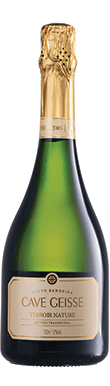

Subtle, seductive nose of apple, grapefruit and fresh dough. The palate has notes of buttered toast, honey, almonds, hazelnut and lovely minerality. Harmonious, with a...
2015
Cave GeissePinto Bandeira

Miolo, Millésime Brut, Vale dos Vinhedos, Serra Gaúcha, Brazil, 2012
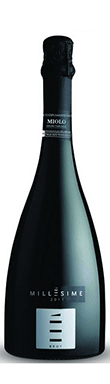
Restrained aromas of grapefruit, green apples and fresh dough. Easy drinking with a pleasant texture. A noticeably high dosage that is offset by balancing acidity.
2012
MioloVale dos Vinhedos
Casa Perini, Método Tradicional Brut, Serra Gaúcha, Brazil
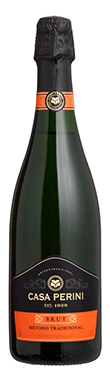
Aromas of grapefruit, yellow plum and brioche are mirrored on the palate, which is weighty and creamy with harmonious acidity. An easy-to-enjoy style of sparkling...
Casa Perini
Cave Geisse, Terroir Rosé Brut, Serra Gaúcha, Brazil, 2014
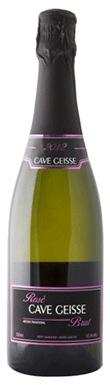
Aromas are refined and seductive with notes of strawberry, cranberry, raspberry, wild flowers, citrus zest and delicate yeasty notes. Exceptional purity of fruit on the...
2014
Cave Geisse
Casa Perini, Brut Rosé, Serra Gaúcha, Brazil
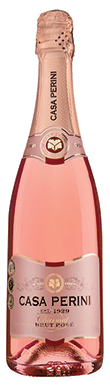
Attractive salmon-pink colour. Graceful aromas of cranberry, red cherry and raspberry. The palate is off-dry with a pleasant texture, followed by a refreshing, balancing finish.
Casa Perini
Pizzato, Legno Chardonnay, Vale dos Vinhedos, Serra Gaúcha, Brazil, 2018
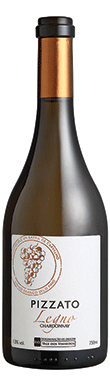
Ripe stone fruits, hints of sweet spice and attractive mineral notes on the nose recall a classy Burgundy. The palate is well defined, sophisticated and...
2018
PizzatoVale dos Vinhedos
Pizzato, DNA 99 Single Vineyard Merlot, Vale dos Vinhedos, Serra Gaúcha, Brazil, 2014
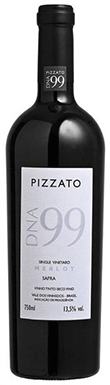
Expressive and enticingly complex aromas of ripe plum, blackberry, cedar, wet earth and dark chocolate are reminiscent of a high-calibre Right Bank Bordeaux. The palate...
2014
PizzatoVale dos Vinhedos
Guaspari, Vista da Serra Syrah, São Paulo, Brazil, 2016
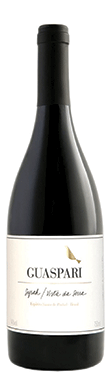
Youthful and vibrant aromas of red forest fruits, white pepper, clove and dried herbs jump out of the glass. The palate is limpid, with excellent...
2016
Guaspari
Lidio Carraro, Grande Vindima Quorum, Vale dos Vinhedos, Serra Gaúcha, Brazil, 2012
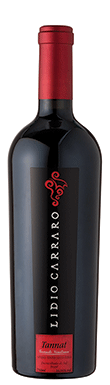
A blend of Merlot, Cabernet Sauvignon, Tannat and Cabernet Franc, this is a sophisticated and intellectual style of wine. Complex aromas of dark fruit, leather,...
2012
Lidio CarraroVale dos Vinhedos
Miolo, Lote 43, Vale dos Vinhedos, Serra Gaúcha, Brazil, 2012
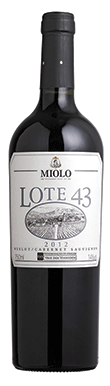
Merlot and Cabernet Sauvignon. Aromas of plums, cassis, black olives and dried Mediterranean herbs. Attractive savoury notes, balancing acidity and grippy tannins.
2012
MioloVale dos Vinhedos
Lidio Carraro, Elos Touriga Nacional-Tannat, Serra Gaúcha, Brazil, 2012
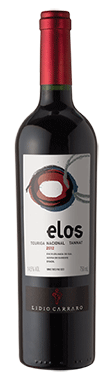
A blend of 75% Touriga Nacional with Tannat. The nose has exuberant aromas of blackberry, dark plum, wet earth and dried herbs. On the palate...
2012
Lidio Carraro
Don Guerino, Traços Gran Reserva, Serra Gaúcha, Brazil, 2017
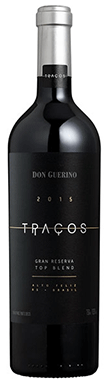
Aromas are elegant with notes of ripe cherry, plum and a hint of spice. On the palate it is ripe and juicy with crisp acidity...
2017
Don Guerino
