
Antinori’s Guado al Tasso and Matarocchio
Aldo Fiordelli looks at the history of Antinori's Guado al Tasso and Matarocchio wines, tastes through the back catalogue and speaks to CEO Renzo Cotarella.

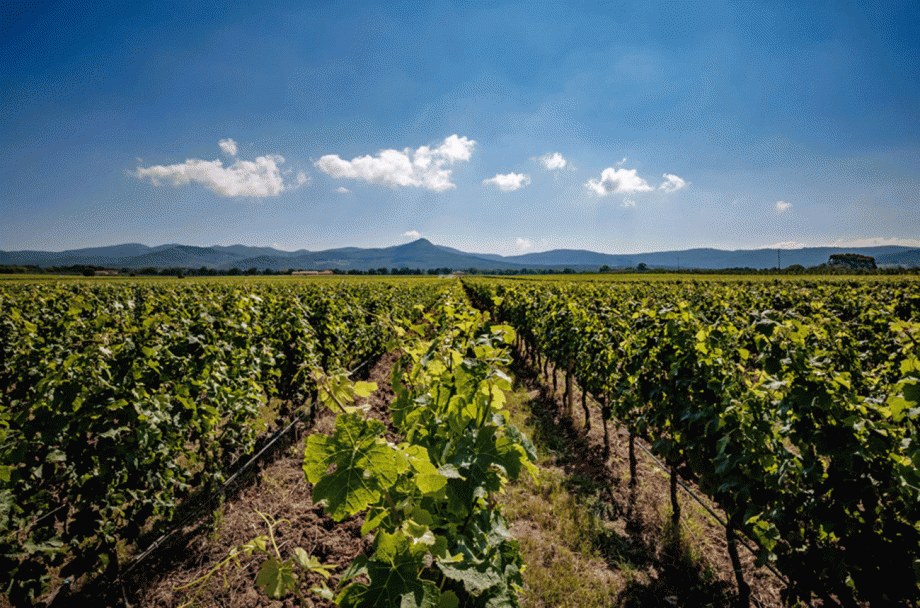
When in 1992 Antinori decided not to produce its flagship Solaia, Tignanello, nor its ‘riserva’ of Chianti Classico due to the terrible harvest in Tuscany, Guado al Tasso was vinified anyway.
There was continued enthusiasm after the first vintage ever produced in 1990, as well as pressure after the 1991 vintage produced too little wine to be bottled. 1992 – despite being labelled as a ‘piccola annata’ (small vintage) – was made possible thanks to Bolgheri’s climate. ‘It’s warmer and more Mediterranean compared to other sub-regions within Tuscany and mostly stabilised by the sea just 5km away,’ explains Renzo Cotarella, CEO of Marchesi Antinori.
This signature effect was demonstrated during two vertical tastings of Guado al Tasso and the extremely rare Matarocchio at the end of August among celebrations of the 25th anniversary of the Bolgheri DOC, commemorated with an exceptional dinner for 750 guests along the tree-lined ‘Viale dei Cipressi’, a Unesco heritage site.
It is here in Bolgheri that the Antinori family spends their summer holidays, an idyllic place that birthed an important part of the contemporary history of SuperTuscans. In the 1970s Piero Antinori stood alongside his cousin Niccolò Incisa della Rocchetta handing out Sassicaia, once a mere ‘vino da tavola’ yet of outstanding quality.
In the ‘80s Piero and his brother Lodovico decided to divide the two different properties which left Guado al Tasso to play the role of the big family estate. Here Antinori planted 320 hectares of vines becoming the biggest estate of the DOC.
Bolgheri’s great potential over the last 25 years is due to two predominant facts: first of all, the majority of the vineyards within the appellation are managed by 3-4 of the most important players of the region. They were able to stick to their guns in poorer vintages steering clear of the temptation of lower prices. Secondly, the definition of SuperTuscan for these wines was useful at the beginning of a such a young DOC, but today the category is becoming slightly too broad for the wines from Bolgheri to be understood property.
The terroir here defines its own identity, turning out Mediterranean-style Bordeaux blends. Vineyards were planted in 1988 with international grape varieties. ‘We came from the production of anemic wines in Tuscany when the market was looking for muscle wines, it was easy to decide on Cabernet Sauvignon, Merlot and Cabernet Franc,’ explains Cotarella.
Possibly it was easy, certainly it was a revolution for Tuscan wines. If today Bolgheri is one of the more consistent brands in Italy, the basis can be found here. Antinori has always been a constant advocate of fine wines intended as wines with personality and longevity, expressing their soil, grape variety and vintage.
Producers are obsessed by the finesse of the tannins. ‘It’s better to drink a bottle of wine one year too soon, than one hour too late,’ says Cotarella.
Surely if one is searching to find a limit to these wines it may be that they appear too groomed in certain vintages. Guado al Tasso is otherwise a perfect example of balance; from its origins as a ‘hermitagée’ blend in 2001 made up of Cabernet Sauvignon, Merlot and Syrah, to its newfound love with Cabernet Franc in 2007 which led to the addition of this grape in the blend.
Matarocchio was launched in 2007 and today Cabernet Franc is becoming one of the flagship grape varieties of Bolgheri due to its fresh ripeness. Guado al Tasso and Matarocchio share a similar refinement in their structure; arguably Guado al Tasso delivers more consistency, while Matarocchio is the more fashionable of the two.
Both show surprisingly great character in the rustic 2011 vintage, a powerful yet emotional year. However, the former seems to be favoured by cooler vintages due to the presence of Merlot in the blend, while the latter is more confident with warmer vintages considering its young vines.
Aldo Fiordelli’s top Guado al Tasso & Matarocchio wines
Guado al Tasso, Bolgheri, Superiore, Tuscany, Italy, 2015

<p>Guado al Tasso sits in the Bolgheri amphitheatre that provides a unique microclimate with significant temperature variations, these were crucial in the warm 2015 vintage....
2015
Guado al TassoBolgheri

Guado al Tasso, Bolgheri, Superiore, Tuscany, Italy, 2011
The 2011 vintage was characterised by a spring and late summer which were warm and registered temperatures above normal. The heat of late August caused...
2011
Guado al TassoBolgheri
Guado al Tasso, Bolgheri, Superiore, Tuscany, Italy, 2007
This year saw Cabernet Franc used in the blend for the first time. Compared to 1998 tasted before, the 2007 is much more balsamic and...
2007
Guado al TassoBolgheri
Guado al Tasso, Bolgheri, Superiore, Tuscany, Italy, 2001
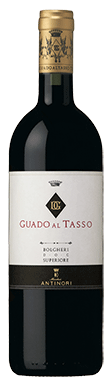
We went a bit over in the 2001 vintage, we still were in the muscular phase', says Renzo Cotarella. The 2001 is concentrated enough to...
2001
Guado al TassoBolgheri
Antinori, Matarocchio, Toscana, Tuscany, Italy, 2015
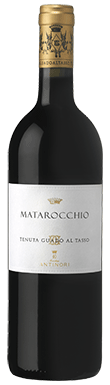
97
Both the bud burst and flowering were early as compared with the preceding year. The summer season initially saw an important rise in temperature, which was then rebalanced during the second half of the month of August. The harvest took place during the final ten days of September, relatively early. A warm powerful vintage without the dryness of 2012 and with great potential. Matarocchio is crimson and super-restrained with straw, clove and oaky aromas on the nose, well balanced with fresh leather, fine herbal aromas, bramble fruit and savoury character in depth. It shows an austere palate; full, firm and chalky yet ripe, however it flows with the grace of the best Cabernet Franc.
2015
AntinoriToscana
Antinori, Matarocchio, Toscana, Tuscany, Italy, 2013
Despite the relatively young age of the vines, planted in 2000, the cool vintage in the mild Mediterranean climate of Bolgheri produced extraordinary ripeness and...
2013
AntinoriToscana
Antinori, Matarocchio, Toscana, Tuscany, Italy, 2011
<p>2011 was a bit of a crazy season; September saw milder weather together with sporadic precipitation, which allowed the Cabernet Franc to complete the final...
2011
AntinoriToscana
Antinori, Matarocchio, Toscana, Tuscany, Italy, 2009
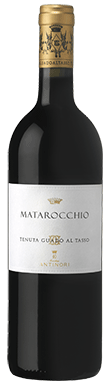
The 2009 vintage was fairly warm all the season, with a couple of days of rain in mid-September, when temperatures fell below seasonal averages. The...
2009
AntinoriToscana
Guado al Tasso, Matarocchio, Toscana, Tuscany, Italy, 2007
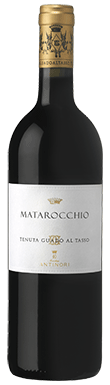
‘Cabernet Franc is a variety which is difficult to be complete,’ says Renzo Cotarella. ‘The pH tends to be higher – a softer entrance but also...
2007
Guado al TassoToscana
