
Tasting Vin de Constance
Andy Howard MW discovers what makes South Africa's famous sweet wine so special as he tastes the latest release plus three older vintages...


At the Mentzendorff portfolio tasting on 3rd March, Hans Anstrom (Klein Constantia’s Managing Director led a masterclass on the iconic Vin de Constance. Under new ownership since 2012, quality at this ultra-historical estate has been on a steep upward curve since then. 2016 is the latest release and is another stunning vintage for Vin de Constance. So, what makes this sweet wine so special?
Many wines claim to have ‘history’ but only a handful worldwide have the credentials of Vin de Constance – the sweet wine from Klein Constantia estate. Founded in 1685 by Simon van der Stel, the 10th Commander of the Cape, the estate is located south of Table Mountain, in a sheltered valley freshened by proximity to the cooling waters of False Bay. From the earliest vintages it was apparent that this was a wonderful location for fine wine, with Constantia (the original name for the sweet wine) renowned around the globe.
By the late eighteenth-century Constantia featured in prestigious courts – Frederick the Great of Prussia’s cellar in October 1777 held 409 bottles, whilst Louis XVI and Marie Antoinette’s recorded 2,634 in November 1782. US Presidents John Adams and Thomas Jefferson were fans, as were Jane Austen, Dickens and Napoleon. However, changes in ownership, the abolition of slavery, the arrival of oidium and falling demand resulted in a decline with production ceasing in 1872.

For almost 100 years, Constantia lived on as a memory. In 1980 the estate was sold to the Jooste family who set out to restore its former glory, with the first wine from the new-era released in 1986. In 2011, Klein Constantia was sold to new owners – businessmen Zdenek Bakala and Charles Harman – and in 2012 the estate merged with Anwilka in Stellenbosch, bringing Bruno Prats and Hubert de Boüard on-board as shareholders. In perhaps the most significant move, young rising star Matt Day was promoted to head winemaker.
New team
Day, viticulturist Craig Harris and Anstrom have presided over the further elevation of Vin de Constance, with the quality (once again) on a par with the world’s best sweet wines. Although Vin de Constance is often favourably compared with Yquem and the greatest Tokaji wines, it is fundamentally different. This is a wine produced exclusively from ultra-late harvested Muscat de Frontignan, with the absence of both botrytis and dried grapes.
Highly selective grape-picking was introduced by the new team in 2012 – the first vintage over which they had total control. In 2015, 15 passes were made through the vineyard with berries picked individually. Some grapes are picked early to add freshness and to initiate natural fermentation, with the majority picked, selectively, over a 90-day harvest ‘window’. Fermentation is often stopped by the addition of Essencia juice with 650g/l residual sugar.
Since the 1986, Vin de Constance has gone through a number of stylistic phases. Vintages from 1993-1997 averaged 120g/l residual with 8.6g/l total acidity. From 2012-2016, the same measures show an average of 167g/l residual sugar and 6.7g/l acidity. Recent vintages have seen maturation in 50% new French foudres and 50% 500 litre barrels. Purity and balance are the essence here, with wines approachable when youthful but with the capability to age 40+ years. At the end of the tasting, Anstrom very neatly summed up Vin de Constance – ‘this is not a dessert wine, it’s a dessert in itself’.
A taste of Vin de Constance wines
Klein Constantia, Vin de Constance, Constantia, South Africa, 2016
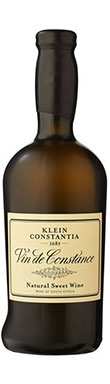

Strikingly pure, fresh and youthful, this is almost like an 'essence of Muscat'. Hints of elderflower and subtle spices on the nose are complemented by...
2016
Klein Constantia

Klein Constantia, Vin de Constance, Constantia, South Africa, 2008
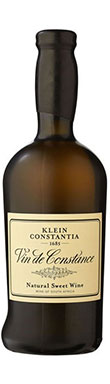
The first wine to be blended by the 'new' team in 2012, further time in bottle has added complexity on the palate. Intensely aromatic with...
2008
Klein Constantia
Klein Constantia, Vin de Constance, Constantia, South Africa, 2007
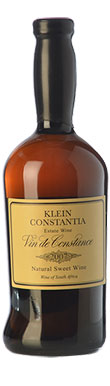
Although released by the new management team, the final blend was put together by the previous owner. This rich, nutty, unctuous sweet wine has less...
2007
Klein Constantia
Klein Constantia, Vin de Constance, Constantia, South Africa, 1996
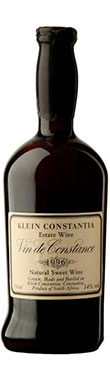
A very different style of Vin de Constance, this has 'only' 112g/l residual sugar, matched with 8.7g/l total acidity. The lower sugar level is noticeable...
1996
Klein Constantia
