
Winemaking innovators: Meet the great disrupters
There are those who accept the status quo and those who challenge it – and it is the latter group of rule-breakers who are driving progress in some of the world’s under-appreciated wine regions. Simon Reilly profiles pioneering winemakers who like to do things differently.

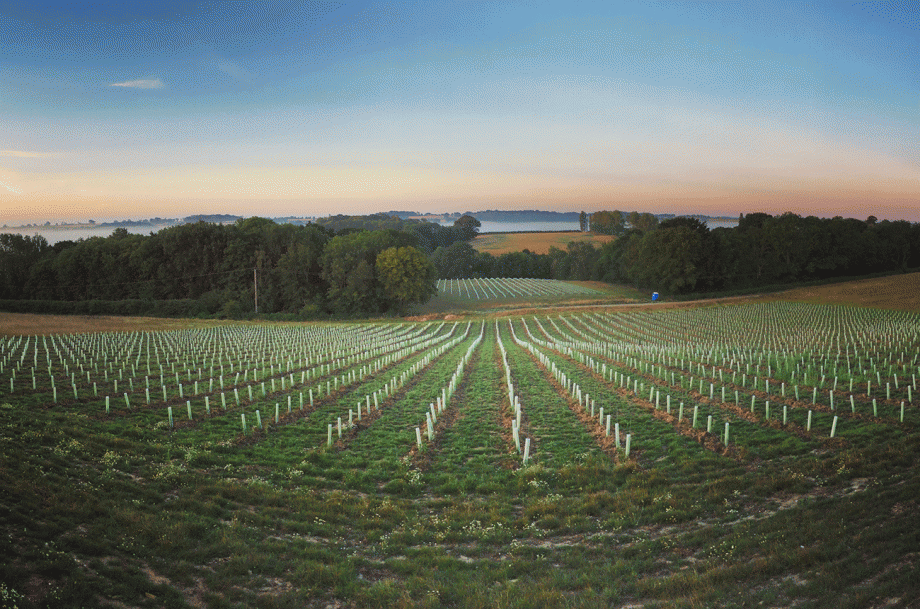
From selling houses to selling mattresses, businesses described as ‘disruptive’ have changed the way we go about everyday transactions.
Disruption in the winemaking world is no different, and is nothing new. Some of the most sought-after wines on the market today started life when a winemaker ripped up the rule book and started doing things differently. When Mario Incisa della Rocchetta planted Bordeaux varieties in Tuscany, downgrading his Sassicaia to a humble IGT, locals probably thought he was mad. When Aimé Guibert planted a vineyard in the Languedoc with varieties from all over Europe, who would have thought that Mas de Daumas would become known as the ‘Lafite of the Languedoc’?
You can add Chateau Musar (posh wine from the Lebanon?), Domaine de Trévallon (Cabernet Sauvignon in Provence, sacré bleu!) and many other disruptive pioneers of the 1970s to the list. These pioneers created iconic wines, which shone light on their respective regions, raising interest and subsequently the focus on quality in the wines of their neighbours and encouraged new winemakers into the fold.
Rather than creating a new world order, these pioneers have inspired others to continue the disruption into under-appreciated wine-growing areas. Fast forward to the present day and many of the more fashionable wine regions owe their growing popularity to the work of a more recent winemaking disruptor.
2Naturkinder, Franken, Germany
Michael Voelker’s winemaking story is an interesting one. Although he has only been making wine for about seven years, his Franken estate has been in the family since 1843. Voelker’s winemaking epiphany came when, working as a publisher in London, he discovered natural wines. This opened his eyes to what could be done using minimal intervention: ‘Just don’t do a lot; that was the discovery.’ Inspired, he moved back to the family estate in 2012 to start his winemaking career.
Having fallen in love with natural wine, the estate’s production of traditional commercial wines didn’t interest him much, so he set up his own label, 2Naturkinder. While Voelker started to make unfiltered, sulphur-free wine, the family’s winemaker continued to make the traditional wines out of the same cellar. The traditional wines sold well locally, but the locals don’t want Voelker’s natural wines. ‘They’re too expensive and too funky for them,’ he says. In an effort to bridge the gap between the traditional wines of Weingut Bernard Voelker and his
2Naturkinder wines, he created a line called Vater & Sohn in 2016, hoping to gently introduce his father’s customers to his minimal approach. They did have some rough filtration and a little sulphur, but rather than enticing the old customers, they sold like hotcakes in the natural wine world. The evolution from commercial to natural has now run its course. The 2018 vintage was the last one for the family’s traditionally made wines. The winemaker has now retired and Voelker’s father will join him once he has sold the 2018 wines.
Meanwhile Voelker has grown his vineyards to 6.5ha and is fully organic and sulphur-free. Following in his footsteps is a new generation of young German winemakers turning traditionally commercial family estates towards quality-driven, minimal intervention winemaking. Locally, Stefan Vetter treads a similar path to Voelker, and further afield in Pfalz the Brand Brothers took over the family vineyard in 2014, transitioning it to the fully organic, sulphur-free production it pursues today.
ENVÍNATE, Tenerife & Spain
Envínate are four friends (Laura Ramos, José Martínez, Roberto Santana and AlfonsoTorrente) hailing from various parts of Spain, who met at the University Miguel Hernández in Elche while studying oenology. In 2008 they bought a vineyard together in Ribeira Sacra. Envínate (meaning ‘wine yourself’) was born.
There are now four projects within the Envínate collective: Lousas in Ribeira Sacra (Torrente), Táganan in Tenerife (Santana), T Amarela in Extremadura and Albahra in Almansa (both by Ramos and Martínez). They saw that the landscape of Spanish wine had shifted, with a commercially driven approach replacing old traditions, and decided to change it. Santana explains: ‘In many parts of Spain there are a lot of old vineyards being abandoned, but we love vineyards that are kept in the traditional way of the region, and saw a great opportunity.’
There are key characteristics that the team look for in a vineyard. ‘We think that the soil is the personality of the wine, so we like vineyards where the soils are alive and have been worked without herbicides. We don’t like warm wines, so we avoid hot microclimates. But the most important thing is the feeling we have when we see a vineyard for the first time,’ says Santana. This ethos has led Envínate to seek out vineyards with unique characteristics. In Tenerife, the vineyards range from 50m-1,200m altitude on volcanic soils. The delicious Benje wines are both grown above 1,000m.
In Ribeira Sacra, the climate varies markedly across the sub-zones of Chantada, Amandi, Quiroga-Bibei, Ribeiras do Sil and Ribeiras do Miño, with soils ranging from broken slate to granite. Although the wines are as varied as the vineyards, from the saline tang of the whites of Tenerife to the tart reds from Ribeira Sacra, refreshment is the common denominator.
Envínate’s success has raised the profile of these relatively unknown wine regions. In Tenerife, producers such as Suertes del Marqués follow a similar approach, using traditional winemaking techniques to make wines from indigenous varieties at altitude. Together these producers and others have put Spain’s forgotten vineyards on the map.
Ganevat, Jura, France
Jean-François Ganevat took over his father’s winery in 1998. Since then, his classically constructed domaine wines have helped elevate Jura to another level, but it is his entrepreneurial spirit in the face of adversity that marks him out from other winemakers. In 2014, after several short vintages, he began a négociant business with his sister Anne, buying grapes from across France. This triggered an exploration of multi-varietal, multi-regional blends. ‘I find it really invigorating to make different styles of wines, often blending several grape varieties from different regions,’ he says.
Dealing only with growers who have the same ethos, working with a minimal intervention approach, the number of concoctions Ganevat creates each year depends on the availability of fruit. Doug Wregg of Les Caves de Pyrene, who imports Ganevat’s wines, explains: ‘It is a complex order with lots of wines, including 10 different Vin de France labels. Each year even the same named wines can be different blends.’ Adopting the Vin de France label to produce delicious, innovative wines that would not exist within the confines of the AP system,
Ganevat has inspired others to do the same. ‘Several neighbours also make Vin de France because it is difficult for people to understand “living” wines and to obtain an AP designation.’
Across France, a combination of short, hail-ravaged harvests and a desire for winemaking freedom has seen others follow Ganevat to the Vin de France label, from De Moor in Chablis to Jacky Blott in the Loire Valley. Once maligned, Vin de France now encompasses some of France’s most exciting wines.
Bentomiz, Malaga, Spain
Dutch couple André Both and Clara Verheij moved to Sayalonga in the Sierra de Tejeda mountains near Málaga about 20 years ago in search of sunshine. He worked as a builder, she in a language school. They bought a property with 1.5ha of decrepit old bush vines and in their spare time they made wine, schooled by the local growers. Through this experiment they saw the potential in those 90-year-old vines, and in a region known for its sweet fortified wines, they packed in their day jobs, built a modern winery and set about producing dry table wines and naturally sweet, unfortified wines.
‘We prefer fresh, elegant wines, not too much alcohol or oak. I always pick a couple of days earlier than the neighbours,’ says Verheij. The dry whites are all unoaked, aged for eight months on the lees. ‘It gives the wines more body, with a creamy texture,’ she says. The biggest challenge comes in the naturally sweet wines: ‘I have to drop the temperature to -2 ̊C or -3 ̊C to stop the fermentation. I want these to be naturally sweet, not fortified.’
Verheij makes the wines, while Both tends to the vines and is also the chef. The couple opened a restaurant above the cellar and during the summer they host music concerts on the terrace overlooking the vines. Creating wine tourism in a place like this seems so obvious, with the Costa de Sol a short drive down the mountain, transforming the region from a vinous backwater into a destination for wine lovers.
And what of the impact on wine- growers in the region? Verheij cites Dimobe, Ordóñez, Telmo Rodríguez’s Molino Real project and Viñedos Verticales as the other progressive winemakers in the region making exciting, naturally sweet, unfortified wines from the dry slate soils of the Sierras de Malaga.
Guillaume Gilles, Northern Rhone, France
Guillaume Gilles took over the vines and cellar of the legendary Robert Michel in 2007, yet the broken old sign bearing Michel’s name still hangs on the wall outside 1 Grand Rue. Even the doorbell on the cellar door has Michel’s name on it. But when Gilles begins to talk, you quickly realise this is either a mark of respect for the great man (Gilles was Michel’s apprentice from 2002-2006), or he has just been too busy making wine.
He experimented with different cuvées before settling on one blended Cornas from the 2013 vintage. In 2018, he became certified organic. But the really disruptive move came back in 2012 when he planted a 1ha vineyard called Les Rieux on granite soil at an altitude of 400m. His 40-year-old Chaillots vineyard is planted at 100m-250m, so 400m is quite a jump. ‘People said I was mad. They told me: “Grapes won’t ripen up there!” But they are wrong!’ says Gilles.
He is excited by the potential: ‘There is no reference point for the wines.’ He feels stylistically they are different to the traditionally big, bruising wines of Cornas, and says: ‘I am a big fan of the red wines of the Jura; light-coloured but full of flavour. I think we can say the same of these wines.’ Now in its third vintage the vineyard is producing beautiful wines. In both 2016 and 2017 the wines have a more feminine, floral quality than his straight Cornas. As global warming takes effect, it is surely only a matter of time before other Cornas growers follow suit.
Tillingham, Sussex, UK
English wine has most commonly been compared with Champagne, so when someone starts burying qvevri in his garden and making natural wine in Sussex you take notice. I found Ben Walgate at his Tillingham winery near Rye, dancing around his array of barrels, pots and tanks, talking enthusiastically to a couple of other visitors. I felt like I had just handed in my golden ticket and was joining Willy Wonka on a tour of his chocolate factory
What ensued was a mind-boggling tour of the ‘ferments’ Walgate has created from the glorious 2018 English vintage. There are 30 in total, using 13 different varieties from 11 growers across southeast England. He has made three separate ferments of Pinot Blanc, ageing one in qvevri, one in oak and one in steel.
From qvevri the texture is rounded with rosewater aromatics. From oak the same juice is so sexy and sweet it makes you blush. From steel there is fresh acidity and lemon barley juiciness. In the final bottling, he elected for a 50/50 blend of the qvevri and oak ferments, making a fascinating, textural wine. Despite the experimental approach, this is not some mad scientist making wine in a shed. Vines have been planted, a boutique hotel is being built and there will be glamping, too.
London’s wine lovers will soon be spending weekends here. But what of his impact on the English wine industry? So far consumers have lapped up his wines. Production is small but a buzz has been created. As for other winemakers, Walgate says ‘most are dismissive’, but he is not alone. Daniel Ham of Langham Wines in Dorset, recently called for advice on acquiring his first qvevri, and Ancre Hill Estates in Wales is another kindred spirit. They are the music makers; they are the dreamers of dreams.
Simon Reilly’s top ‘disruptive’ wines:
Guillaume Gilles, Nouvelle R Les Rieux, Cornas, Rhône, France, 2016
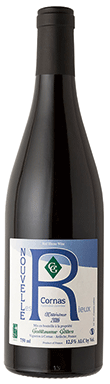

Exhilarating! A heady floral aroma leads to violets, cherries and minerals dancing around the palate, chased by a refreshing acidity. Like rhubarb, sweetness and acidity...
2016
Guillaume GillesCornas

Envínate, Benje, Tenerife, Spain, 2017
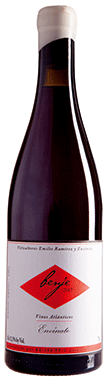
Organic Listán Prieto (95%) and Tintilla. Floral, red berry fruit aromas give way to deliciously sweet raspberry and cherry and a zip of energy. Mineral-backed...
2017
Envínate
2Naturkinder, Drei Freunde, Franken, Germany, 2017
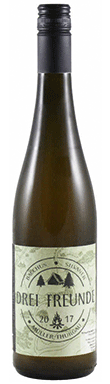
Organic Silvaner (61%), Bacchus and Müller-Thurgau left on their skins for a week. Lovely herbal, stone fruit nose leads to an energetic tannic bite with...
2017
2Naturkinder
Bodegas Bentomiz, Ariyanas Naturalmente Dulce, Spain, 2012
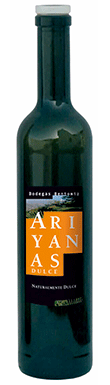
Organic Moscatel de Alejandria. Sweet apricots doused in honey. The palate is sweet but not cloying, thanks to a minerally streak of acidity. A deliciously...
2012
Bodegas Bentomiz
Anne et Jean-François Ganevat, Cuvée Madelon, France, 2016
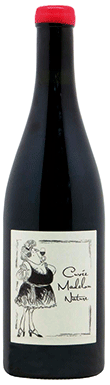
<p>Gamay from Morgon (80%) blended with Trousseau and Poulsard from the Jura. Organic. Reductive nose of burnt rubber, but what lies beneath is beautiful. Sweet...
2016
Anne et Jean-François Ganevat
Tillingham, Pinot Blanc, England, United Kingdom, 2018
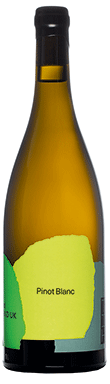
The delicious flavour of sweet apricots really hits you, along with a light, syrupy texture. A spray of pithy grapefruit balances things up, before a...
2018
Tillingham
