Vintage Armagnac: What difference does a year make?
Vintage Armagnac swims against the tide in a spirits world often dominated by ladders of age, price and prestige, writes expert Joel Harrison.


Unlike blended Cognac, vintage Armagnac can express the character of one particular year – making it a natural choice for wine lovers to explore.
Why vintage Armagnac goes its own way
Spirits like order. Scotch whisky has age statements neatly stacked into a ladder, reassuring the drinker that time equals value.
Cognac’s alphabet soup of VS, VSOP and XO provides a rough guide to age progression, even when the liquid itself is the product of extensive blending. In both cases, age provides a framework for expectation.
Armagnac sits adjacent to these systems. Officially, it has its own classifications: VS (one year), VSOP (four years), XO or Hors d’Age (10). They exist, and many producers use them.
Yet when Armagnac is discussed with any seriousness, the conversation almost inevitably turns to vintages.
The reason is partly structural. Unlike Cognac (built on a handful of large houses that age and blend, rather than cultivate and harvest), Armagnac is often made in smaller volumes by growers distilling once a year from their own wines. Blending across years is possible, but less central.
How vintage Armagnac expresses individual years
Where Cognac smooths variation, Armagnac allows the character of a single harvest to endure. Here, vintage is not decorative, but declarative: the growing season is captured and preserved in spirit.
This invites a question more familiar in wine: can one vintage be better than another?
In Armagnac’s case, the answer is yes; though ‘different’ is a more useful word. Each harvest shapes the style of the eaux-de-vie that emerge from the still.
A warm season may produce a rich, broad spirit; a cooler year, something firmer, more tensile.
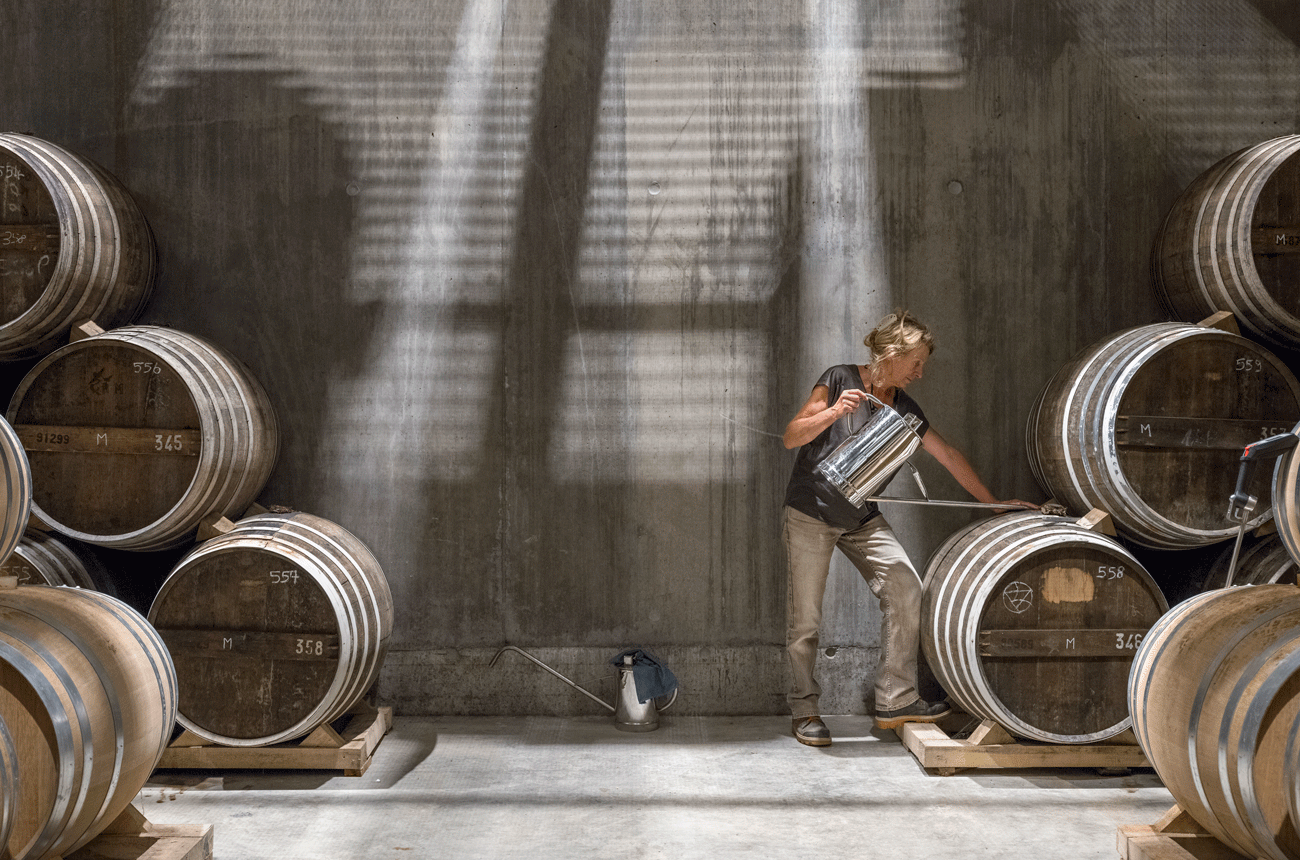
Maturation complicates matters further. A lighter vintage might be ready sooner and won’t need to be smothered with oak; more powerful years need time in barrel to be tamed.
What emerges isn’t a ranking, but a series of expressions, each year shaped by its own conditions and complete in itself.
In a spirits world obsessed with ladders of age, of price, of prestige, Armagnac’s attachment to vintage feels quietly resistant, showcasing postcards from the past where age isn’t a promise of quality or complexity, but a snapshot of a moment in time.
One to try
Château de Lacquy, Armagnac 2007, Bas-Armagnac, Southwest France

Where to buy it: £113/70cl, The Whisky Exchange
Château de Lacquy, Armagnac’s oldest family-owned estate (producing since at least the early 1700s), farms 22ha of vines for its Armagnac, all of which are harvested, vinified, distilled and aged by individual plot and variety.
Slow distillation in a 1939 wood-fired still has given this 2007 vintage a rich, full-bodied nose of strawberry jam and dark chocolate.
The palate has figs, poached pears and orange blossom, with a cinnamon powder finish. Alcohol 48%.
Related articles