
A taste of Clos des Lambrays from 1926-2022
Today a jewel in LVMH's wine crown, it took many centuries for Clos des Lambrays to gain the recognition it deserved among its Burgundian peers. Charles Curtis MW explores the wines and personalities that made that happen.

The launch of ‘Vins d’Exception’ in November by LVMH threw a spotlight on four of their illustrious properties: Château Cheval Blanc, Château d’Yquem, Colgin Estate, and Domaine des Lambrays. This election to an elite club by the world’s richest man would seem to confirm the status of the Clos des Lambrays at the pinnacle of the Burgundy pyramid, yet this was not always the case.
Numerous sources cite 1365 as the year the Clos des Lambrays was founded, yet the origins remain obscure. The eminent Burgundian historian Jean-François Bazin notes the name is that of the noble Lambrey family from the Haute-Saône, but explains that it was not known as a clos until the mid-19th century, calling it ‘in some ways the Mouton-Rothschild of Burgundy’. The comparison is apt: a superb terroir, yet one that was only recently recognised as great since Lambrays was only promoted to grand cru status in 1981.
Scroll down for 16 vintages of Clos de Lambrays dating back to 1926
The vineyard has seen the ebb and flow of fortune over time. Sold as the property of the state during the French Revolution, it was divided among no fewer than 75 owners. Bazin explains that the parcels were reunited in 1828 by local negociant Louis Joly, who repaired the 17th-century home on the property before selling it to another local negociant, Albert Rodier.
Rodier was the proprietor of the well-known negociant house Henry de Bahèzre, that his grandchildren Albert and Camille inherited on his passing. Camille created the Confrérie des Chevaliers du Tastevin with Georges Faiveley, while his brother Albert directed Henry de Bahèzre. When the Rodier family encountered difficulties during the Great Depression, Albert’s mistress Renée Cosson ‘saved’ Lambrays by purchasing it in 1938. Albert continued making the wines into the 1950s, assisted by his manager Etienne Amiot.
By all accounts, Renée Cosson was something of an eccentric character who felt that the nobility of her vineyard was so evident that she need not apply for grand cru status. She preserved the pre-phylloxera vines long after her neighbours, and when vines succumbed to the pest, she did not replant them.
After she died in 1977, the vineyard (what was left of it) was sold to a group of investors led by the Saier brothers from Alsace for a reported 10 million Francs (US$2.5 million or just over £1 million at the time). The Saier brothers hired oenologist Thierry Brouin to manage the estate and make the wines, a post he would retain until his retirement in 2018.
Brouin and his team were obliged to renovate and replant the vineyard extensively, and once the work was well underway, promotion to grand cru came quickly, in 1981. The group preserved as many old vines as possible and restored the home with its 17th-century cedar tree and beautiful garden. The vineyard has been farmed organically since this transition, although the estate only recently pursued certification.
The rows were tilled with a horse, herbicides avoided, and fungicides reduced to an absolute minimum. Brouhin kept yields low, made a severe selection, and fermented with all or mostly whole bunches before these were fashionable techniques. He would bleed the tanks to make a rosé and increase the ratio of skins to juice. The result was a magnificent, if slightly forbidding and somewhat rustic wine that nevertheless aged extremely well.
The Saier brothers sold in 1996 to Ruth and Günter Freund, who retained Brouin and continued to invest in the winery. After the death of Günter Freund in 2010, his widow sold the property to LVMH in 2014 for an estimated €100 million. Brouin stayed until his retirement in 2018 and was replaced briefly by Boris Champy, but LVMH quickly recruited rising star Jacques Devauges.
A new era

Devauges had been the winemaker at the neighbouring Clos de Tart; he took over next door in March 2019. He is a master of his craft, and he is set to do great things at Clos des Lambrays with its superb raw material and the investment of Bernard Arnault.
Devauges and his team have undertaken an ambitious programme at Lambrays. They have entirely rebuilt the winery from the foundations up. The cuverie now features custom wooden vats sized to receive the grapes from the 11 different parcels within the clos that Devauges farms separately – the ‘suivie parcellaire‘ that has been his approach since his days at Clos de l’Arlot.
The property is almost, but not entirely, a monopole – 8.66 hectares of the 8.84ha belong to Domaine des Lambrays, with a tiny parcel that belongs to Domaine Taupenet-Merme. The vineyard is all in one piece, but it is a fairly complex terroir with an undulating ‘wave’ that runs from north to south. The soil is an iron-rich clay over limestone that varies widely in depth. Brouin had farmed the clos sensitive to these variations, but the grapes were blended, and the wines were made in a few large vats. The new winery facilitates a precision that had not existed before.
Within the appellation of the Clos des Lambrays, there are three lieux-dits. The heart of the vineyards is the portion called ‘Les Larrets ou Clos des Lambrays’. Precision counts, since there is a portion called simply Les Larrets further up the slope that is not the same quality and is not part of the clos.
Devauges has divided the central portion of vines into two sections. One that runs along the southern edge of the vineyard next to Clos de Tart he calls ‘50 Ouvrées’. The other, in the centre, he refers to as ‘80 Ouvrées’. Both are further subdivided into upper, middle, and lower (dessus, milieu, and dessous).
80 Ouvrées contains some vines planted in the 1920s; these old vines give wines that are denser but somewhat closed initially. The underlying limestone here is calcaire rose de Prémeaux, a hard, often pink type of limestone also found in Ruchottes and Mazis-Chambertin. 50 Ouvrées includes the steepest part of the slope, 60 metres from the base to the top, and some of the oldest vines, planted in 1898.
The wine here has such concentration that they have done no punching down since 2018 for fear of extracting too much. The old vine parcels are fermented today (as under Brouhin) with 100% whole bunch fermentation, but this is reduced to 40% for younger vines. According to Devauges: ‘The common thread is the search for purity and precision. I am convinced that this is the best terroir of Morey’.
At the base of the slope is another lieu-dit called ‘Meix Rentier’, which Devauges calls ‘Cerisier’ after the cherry tree that grows there; this has thin, iron-rich red soil over Crinoidal limestone – a friable, fossil-filled rock type that is a common feature of some of Burgundy’s greatest sites. The vines here were planted between 1920–1935, and give a wine that is silky and fine.
Along the northern edge of the clos is the lieu-dit ‘Les Bouchots’, which Devauges calls ‘Les Plantes’ (also divided into upper, middle, and lower). Les Bouchots is cooled by the influence of the combe or valley that brings chilly air from higher elevations in the Hautes-Côtes. The wines produced here has a vibrant, fresh red berry fruit character. The lower portion of Les Plantes contains the youngest vines of the domaine, planted in the 1980s.
A new approach
Devauges obtained organic certification for the vineyard in 2022 and has implemented biodynamic practices in the vineyard. The winery he built is entirely gravity-fed, and the wine is not pumped at any stage of winemaking. The building and the rebuilt cellars are beautiful and give Devauges a high-performance tool to realise his ambitions for his dream terroir.
To showcase this work, he staged a magnificent dinner with the theme ‘A Century of Clos des Lambrays’ in November 2023, which featured an array of vintages from the spectacular 1923 to a sneak preview of the sleek, powerful 2023. The invaluable insight of being able to compare the wines made under Rodier, Cosson, and LVMH with my recollections of the wines of Thierry Brouin convinced me that this is an extraordinary site.
The style of the wines has changed over the years. Under Thierry Brouin, the wines were powerful, almost burly, while the recent vintages made by Devauges are polished and accomplished monuments to this great terroir in a modern style. The sublime 1923 is ample proof, however, that this vineyard has always had the potential to deliver wines that will last 100 years – a vin d’exception indeed.
Preview of the 2023 vintage
The preview of the 2023 vintage was an imperfect glimpse at a wine that still has most of its maturation yet to accomplish, but the indications are promising. The fruit is very forward and lush, with abundant red and black berry aromas still marked by the cask and a bit of reduction. The texture is approachable, and the structural elements appear to be in harmony. We tasted this at the end of dinner – it is not yet finished wine – but it prompted Jacques Devauges to proclaim: ‘For me, Lambrays is among the great grand crus of the Côte de Nuits.’ Due to its incomplete state the wine was not scored. Potential drinking window: 2035-2100.
A century of Clos des Lambrays
The wines are ranked youngest to oldest
Related articles
Domaine des Lambrays, Clos des Lambrays Grand Cru, Burgundy, France, 2022
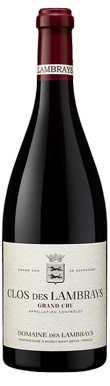

Although the colour is not as deep as the 2019, the mulberry and plum fruit aromas are every bit as intense, with hints of violets,...
2022
Domaine des LambraysClos des Lambrays Grand Cru

Domaine des Lambrays, Clos des Lambrays Grand Cru, Burgundy, France, 2021
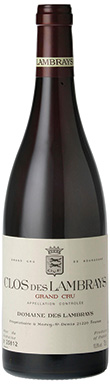
The product of a difficult vintage, the 2021 Clos des Lambrays is almost the antithesis of either the 2020 or the 2022, yet this wine...
2021
Domaine des LambraysClos des Lambrays Grand Cru
Domaine des Lambrays, Clos des Lambrays Grand Cru, Burgundy, France, 2020
After over a year in bottle, the 2020 Clos des Lambrays was still somewhat impenetrable, with an inky black colour and concentrated aromas of plum...
2020
Domaine des LambraysClos des Lambrays Grand Cru
Domaine des Lambrays, Clos des Lambrays Grand Cru, Burgundy, France, 2019
The deep purple/ruby colour of the 2019 and the intense blackberry and cassis fruit aromas speak to the youthful vibrancy of this impressive wine. The...
2019
Domaine des LambraysClos des Lambrays Grand Cru
Domaine des Lambrays, Clos des Lambrays Grand Cru, Burgundy, France, 2009
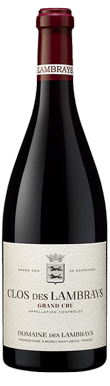
Tasted at the domaine several years after release, the 2009 Clos des Lambrays showed a deep and rich blackcurrant and plum fruit aroma with hints...
2009
Domaine des LambraysClos des Lambrays Grand Cru
Domaine des Lambrays, Clos des Lambrays Grand Cru, Burgundy, France, 2007
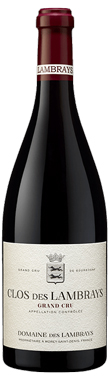
Drunk with friends over dinner in New York, the 2007 Clos des Lambrays was charming, with supple cherry fruit aromas, a bit of spice and...
2007
Domaine des LambraysClos des Lambrays Grand Cru
Domaine des Lambrays, Clos des Lambrays Grand Cru, Burgundy, France, 2006
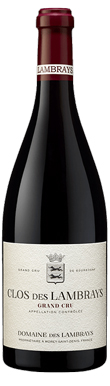
Tasted at the domaine with Thierry Brouin, the 2006 Lambrays boasted a lovely currant and pomegranate fruit aroma, but it was a bit earthier and...
2006
Domaine des LambraysClos des Lambrays Grand Cru
Domaine des Lambrays, Clos des Lambrays Grand Cru, Burgundy, France, 2005
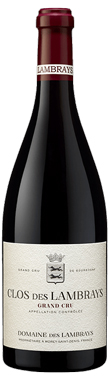
A bottle of the 2005 Clos des Lambrays from a private cellar demonstrated Thierry Brouin's success with the warm conditions. He delivered a wine that...
2005
Domaine des LambraysClos des Lambrays Grand Cru
Domaine des Lambrays, Clos des Lambrays, Burgundy, France, 1947
The 1947 Clos des Lambrays is still vibrantly alive, with an almost shockingly deep colour and a ripe, voluptuous bouquet that ranges from plum and...
1947
Domaine des LambraysClos des Lambrays
Domaine des Lambrays, Clos des Lambrays, Burgundy, France, 1946
The colour of the 1946 Lambrays is surprisingly deep, but this wine is in decline, if not without appeal. The bouquet has little fruit, but...
1946
Domaine des LambraysClos des Lambrays
Domaine des Lambrays, Clos des Lambrays, Burgundy, France, 1942
This intriguing wine was from the early years of the Cosson ownership is credited to Albert Rodier and Etienne Amiot, but according to Jacques Devauges:...
1942
Domaine des LambraysClos des Lambrays
Domaine des Lambrays, Clos des Lambrays, Burgundy, France, 1938
The first vintage under the Cosson ownership was considered poor; today, it appeals more to curiosity than for its quality. It is not unpleasant, but...
1938
Domaine des LambraysClos des Lambrays
Domaine des Lambrays, Clos des Lambrays, Burgundy, France, 1937
With the 1923 and 1934, this is a testament to the potential longevity of the Clos des Lambrays. Two bottles were tasted, with consistent results....
1937
Domaine des LambraysClos des Lambrays
Domaine des Lambrays, Clos des Lambrays, Burgundy, France, 1934
This extraordinary wine boasts a still powerful and complex bouquet, with notes of plum and prune, smoke, cedar, and game. The texture is creamy and...
1934
Domaine des LambraysClos des Lambrays
Domaine des Lambrays, Clos des Lambrays, Burgundy, France, 1926
Impressively fresh and lively, the medium-deep tawny colour of the 1926 Clos des Lambrays hinted at age, but the bouquet hangs together well, with notes...
1926
Domaine des LambraysClos des Lambrays