
California’s under the radar wines
The high-profile big names of Californian wine dominate media coverage, but if your interest is piqued by the fascinating and the smaller-scale, where best to look? Julie Albin points to the producers and regions quietly making waves, and recommends 10 great wines to try.

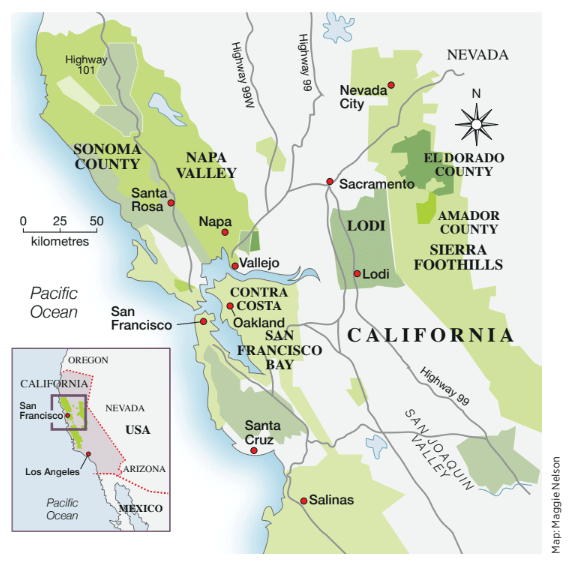
California has no shortage of sun- kissed vineyards and praiseworthy wine. Images of Napa and Sonoma instinctively come to mind, yet the Golden State is actually a treasure chest of esteemed vineyards rooted in less obvious areas. Among these underdog regions are the Sierra Foothills, Lodi and Contra Costa.
Unique in their own right, what they share is a repertoire of old-vine, own-rooted vineyards that unveil a movement towards wine that’s picked at lower Brix (sugar levels/potential alcohol) with gentler handling to achieve supple texture, fruit purity and crunchier acidity. With the appealing price- quality ratio of these regions, both new and veteran winemakers have access to some of the state’s most distinguished sites.
Sierra Foothills
After James W Marshall struck gold in 1848, it was the arrival of European immigrants that brought viticulture to what later became the expansive Sierra Foothills AVA (American Viticultural Area). One of five sub-AVAs, El Dorado represents high-elevation plantings up to 975m with more than 70 varieties sprawled across a multitude of microclimates. James Skinner was among the first to acknowledge El Dorado’s potential in 1861 and his vineyard remains a staple for Rhône varieties.
Farming its land since 1972, the Boeger family also helped boost the area’s reputation with Barbera as its flagship variety. And Barsotti Vineyard’s Beaujolais-esque pink granite has made it a mainstay for Gamay and other varieties in labels such as Donkey & Goat, Arnot-Roberts and Jolie-Laide. The rugged landscape exposes a diversity of volcanic rock, granite and alluvial deposits.
The wines typically display a rustic finesse and ageworthy structure that entice producers from elsewhere. ‘El Dorado’s future is wide open,’ Skinner Vineyards winemaker Adam Smith says. ‘As most wine regions find a solid identity in one thing, our strength is in variety.’
But there is one predator here that’s larger than life: at Lava Cap Winery, bears neatly pick off the thick-skinned Mourvedre berries with their giant claws. In certain years it has caused the Jones family to release its Mourvedre as a non-vintage. Californians certainly love bears Sierra Foothills and even sport one on the state flag, but these furry pests aren’t so good for business. Directly south in Amador County is The Original Grandpère Vineyard, home to the state’s oldest living Zinfandel vines dating back to 1869. Home to two AVAs, Shenandoah Valley glistens with granite while the mountainous Fiddletown is iron-hued with volcanic soil at higher elevation.
For the last two decades the region has witnessed an expansion of varieties such as Barbera, Sangiovese, Teroldego and Petite Sirah. According to growers, some have also replaced portions of their Zinfandel with Primitivo for its looser bunches and fresher fruit. In Amador’s modera era, Bill Easton of Easton Wines and Terre Rouge has been an industry leader here since 1986. Terra d’Oro, formerly Montevina Winery, was the region’s first post-Prohibition winery and is now owned by Trinchero Family Estates. The Turley family also landed here in 2012, advocating for the region’s authenticity with graceful renditions of Zinfandel. Another well- known resident is Rombauer, owning vast vineyard acreage here and recently purchasing the historic Renwood Winery.
In the mountainous outskirts is the coveted Shake Ridge Vineyards with plantings of Syrah, Grenache, Zinfandel and more. Proprietor Ann Kraemer treats her 19ha like a jigsaw puzzle, planting each variety in a methodical combination of slope, aspect and soil. Attracting customers such as A Tribute to Grace Wine Co and Edmunds St John, Kraemer also finds it gratifying to work with different winemakers who put their individual spin on a wine, such as the quirky styles Chris Walsh produces for his label, The End of Nowhere.
Then again, in many ways it comes back to tradition. Paul Bush’s family planted Madroña Vineyards in the 1970s and he’s observed the ebb and flow of trends over the years. While there’s always been pressure to follow fashions, Bush believes these local growers have always remained true to the region.
Lodi
Just 90 minutes east of San Francisco is the self-proclaimed Zinfandel Capital of the World. Before there was Zin, the land was laden with Flame Tokay and Mission vines that were planted shortly after German and Italian settlers arrived in the mid-1800s, but Lodi now offers more than 75 commercially grown varieties. Stretching from the Sacramento River delta to the Sierra Nevada, Lodi’s seven AVAs display a wide spectrum of topography bestowed by their two rivers, Mokelumne and Cosumnes, bringing granitic minerals down from the mountains. Even more notable to the area is Tokay sandy loam that was named in homage to its original plantings.
Mokelumne River AVA best exemplifies this soil and is considered the heart of old-vine Zinfandel. Experimentation plays a key role here, exemplified by Mokelumne Glen Vineyards’ German-Austrian plantings of Kerner, Grüner Veltliner, Dornfelder, and Blaufränkisch; next door at Bokisch Vineyards are plantings of Albariño, Graciano and Tempranillo. In 2012, Turley winemaker Tegan Passalacqua also purchased the celebrated Kirschenmann Vineyard, with own-rooted Zinfandel plantings from 1915. Prestigious vineyards like these continue to charm forward-looking brands such as Ramey Wine Cellars, Markus Wine Co and The Scholium Project. Whether it’s obscure varieties, whole-cluster fermentations or unfiltered wines, the aim is to reverse Lodi’s stigma of ripe, high-alcohol wine.
While the region is assumed to be monotonously hot, its Mediterranean conditions are cooled by delta breezes that create diurnal swings from day to night. Sue Tipton founded Acquiesce Winery in 2012 to prove the climatic potential for white wines with retained acidity. Focusing on southern French varieties such as Picpoul, Grenache Blanc, Clairette Blanche and Bourboulenc, she points out that Lodi’s climate is similar to the southern Rhône and, therefore, the region should not be restricted to red wines. ‘A few were sceptical, believing that we’d nevermake it without a red wine,’ Tipton admits. ‘We have sold out every year.’
From artisan winemakers to high-volume producers, Lodi’s future depends on collaboration within the winemaking community. ‘Lodi has grown tremendously in quality, image, style and who we are as a region,’ says Joan Kautz of Bear Creek Winery and Ironstone Vineyards.
Contra Costa
In Contra Costa, or ‘CoCo’ for short, viticulture thrived throughout the early 20th century until becoming debilitated by Prohibition and urban expansion. But here are some of California’s most exciting vineyards, influencing a new era of winemakers to venture to this corner of the San Francisco Bay AVA. Set along the Sacramento River delta, CoCo’s landmark plantings include Zinfandel, Mourvedre (known as Mataró here), Carignan, Malvasia Bianca, Muscat Blanc and more. Found with more austerity in other areas of California, here they exhibit aromatic restraint and elegant depth like their Old World counterparts.
Vines bask in the beach-like terrain until breezy afternoons usher in the brisk evenings. Because the soil here is actually sand, Tom Del Barba’s family vineyard self-regulates moisture and minimises the need for cover crops, weed management and virtually any fear of phylloxera. With roots down to 12m, his vines produce smaller berries, making his Mataró among the most highly sought-after in the region. Nearby is the fabled Cecchini Family Vineyard, revived in the early 2000s and now organically farmed and managed by German-born Julian Erggelet. Sites like Del Barba and Cecchini are now a mecca for indie labels such as Martha Stoumen Wines, Deux Punx, Hatton Daniels and Stagiaire, who share a natural approach to winemaking.
Bedrock Wine Co’s Morgan Twain-Peterson MW took over the beloved Evangelho Vineyard in recent years and reflects on how CoCo transitioned from a lull into a cutting-edge region. Frank Evangelho’s legacy is recognised for transforming the region’s ‘prune and pick’ mentality to an all-embracing vineyard approach that captivated household names like Ridge and Bonny Doon. With 130-year-old plantings, Evangelho Vineyard’s thumbprint I now found in top labels such as Dirty & Rowdy, Frog’s Leap and Calder Wine Company.
For Twain-Peterson, the region’s evolution relies on a flow of knowledge, from both long-time residents and newcomers. Erggelet shares that sentiment: ‘We try to invigorate the local scene by sharing ideas on holistic farming to make wine that tells a story of sand, glazing sun and howling winds off the delta.’
The journey for these regions will be me with growing pains, but the conjoined efforts will further strengthen their presence in the global wine market. ‘We sought out Shake Ridge Ranch, Skinner Vineyards and Evangelho because they have soil-driven voices that stand alone,’ Hardy Wallace of Dirty & Rowdy explains. ‘Together we can create something joyful, affectionate – and distinctly Californian.’
Julie Albin is a US-based wine and spirits journalist, educator and consultant, and former editor-in-chief of Drink Me magazine.
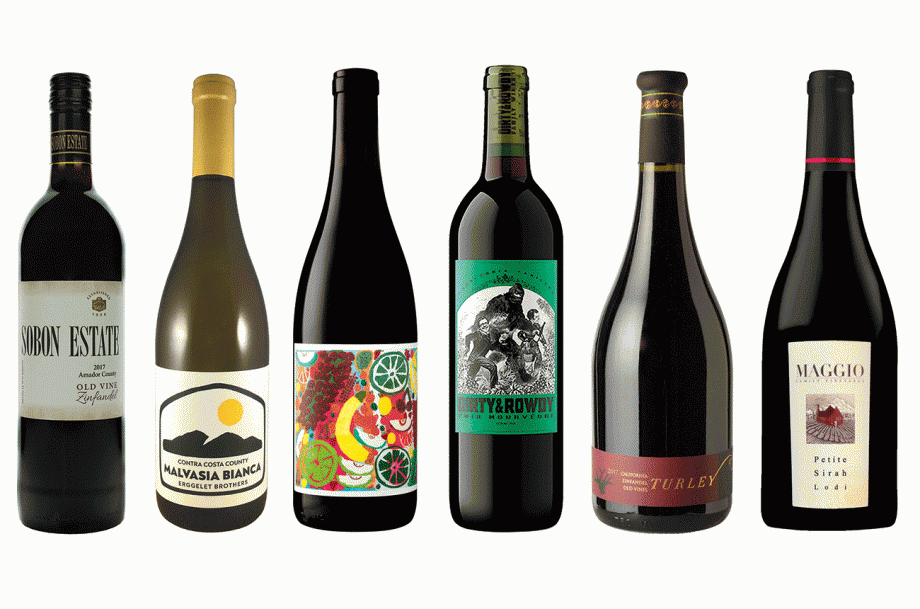
Discover California: Albin’s top 10
Terre Rouge, Viognier, Amador County, California, USA, 2016
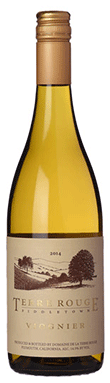

<p>Organically grown in Fiddletown, this whole-cluster-pressed Viognier with lees stirring in French oak offers density and a refreshing palate. Notes of guava and honeysuckle allude...
2016
Terre RougeAmador County

Erggelet Brothers, Malvasia Blanca, San Francisco Bay, Contra Costa County, California, USA, 2018
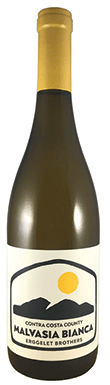
Having undergone malolactic fermentation in barrel, this unfiltered Malvasia from the Cecchini Vineyard entices with notes of rose, pineapple, lemon curd and creamy hints of...
2018
Erggelet BrothersSan Francisco Bay
Peeps, Chardonnay, Lodi, California, USA, 2018
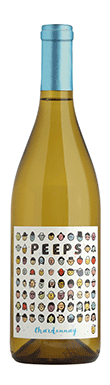
Picked at around 14.5% potential alcohol and spending a short time in French oak without malolactic fermentation, this straightforward Chardonnay displays its round body with...
2018
PeepsLodi
Calder Wine Company, Evangelho Carignane, San Francisco Bay, Contra Costa County, California, USA, 2017
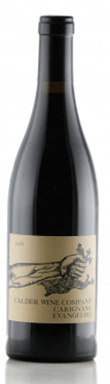
If there’s a case to be made for Contra Costa Carignan, this is one of the wines to support it. Dry-farmed fruit spends 18 months...
2017
Calder Wine CompanySan Francisco Bay
Jolie-Laide, Shake Ridge Vineyard Grenache-Syrah-Mourvedre-Viognier, Amador County, California, USA, 2017
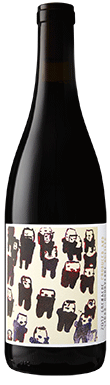
Shows Old World qualities of dark plum, red rose and summer herbs with brambly undertones. The floral essences within this high-toned blend create a lovely...
2017
Jolie-LaideAmador County
Turley Wine Cellars, Old Vines Zinfandel, California, USA, 2017
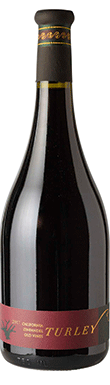
From 18 different old-vine vineyards, including sites in Amador County, Lodi and Contra Costa, this wine’s depth and purity are mesmerising. Hints of plum, black...
2017
Turley Wine Cellars
Jolie-Laide, Barsotti Vineyard Gamay, Sierra Foothills, El Dorado County, California, USA, 2018
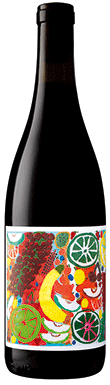
With whole-cluster fermentation and six months in neutral barrel, this youthful wine radiates with brambly fruit and violet. The acidic tension and hint of spice...
2018
Jolie-LaideSierra Foothills
Dirty and Rowdy, Familiar Mourvedre, California, USA, 2018
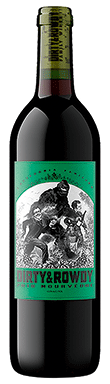
Sourced from sites throughout California, including fruit from Amador County, Contra Costa and El Dorado. 100% whole-cluster fruit is fermented with ambient yeasts, displaying a...
2018
Dirty and Rowdy
Sobon Estate, Old Vine Zinfandel, Amador County, California, USA, 2017
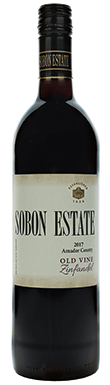
Broad structure is illuminated by notes of redcurrant, tarragon and black tea. Deeply concentrated and full of oak character, it will need pairing with a...
2017
Sobon EstateAmador County
Maggio, Petite Sirah, Lodi, California, USA, 2016
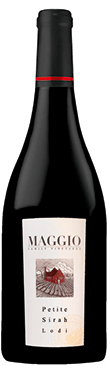
Picked on the early side, this unveils herbaceous notes, sage and blackcurrant leaf alongside its grapey qualities and almond finish. With rich fruit and robust...
2016
MaggioLodi
