
Château Lafite and Long Dai masterclass: DFWE Singapore 2024
Although both are creations of the same family, Château Lafite Rothschild and Domaine de Long Dai are rarely tasted side by side – especially with the chairwoman of DBR Lafite herself presenting them. Read our report from the sold-out Lafite masterclass at Decanter’s inaugural Singapore Fine Wine Encounter.


The legacy and the road ahead
Saskia de Rothschild began the masterclass by taking the audience back over 150 years, to when the Rothschild family first started making wine at Château Lafite, the Pauillac first growth, in 1868.
‘These are vineyards nurtured by a family that has been living there forever. It’s a home for me and my father (Baron Eric de Rothschild). And wine is all about family, sharing and transcending generations’, said the sixth generation of the Rothschild family to lead Domaines Barons de Rothschild Lafite (DBR Lafite).

In addition to Lafite, the group has expanded over time to add more jewels to its crown – in 1962, Baron Philippe de Rothschild acquired Château Duhart-Milon, a fourth growth in Pauillac. Baron Eric de Rothschild, in turn, acquired Château Rieussec in Sauternes in 1984 and Château L’Évangile in Pomerol in 1990.
‘My father always said that two of the greatest things he’s done in his life are marrying my mum and buying L’Évangile,’ said Saskia.
Notes and scores for the masterclass wines below
Inspired by the ever-growing interest in fine wine in China, DBR Lafite was an early operator in the country. They decided to build a winery – later named Domaine de Long Dai – there in 2008 as part of its global presence, which also includes operations in Chile and Argentina.
The most recent Lafite outpost, acquired under Saskia’s watch, was Domaine William Fèvre in Chablis, in a move to balance the group’s presence in northern France, she said.
The Lafite philosophy

Château Lafite, as one of the five 1855 1er Grand Cru Classés, is known to have the ‘most delicate’ identity, and can be difficult to taste at a young age.
On this point, Saskia explained the winemaking philosophy of the Rothschild family; ‘We don’t follow the trends to make very opulent wines. We always try to make wines for the long run.’
‘We are very slow. Every decision we make, we need 10 years to realise (whether) this is the right decision or the wrong one.’
A strong R&D team provides crucial support in making those decisions while the group seeks to operate ‘in the interest of the planet and the community’.
All the DBR Lafite estates, domestic and overseas, obtained the B Corp label (awarded to companies verified by B Lab to meet high standards of social and environmental performance, transparency, and accountability). Domaine William Fèvre is set to be included as the label renews, a testament to the company’s overall commitment.
While her team works on science and data, ‘human observation is still the most important,’ Saskia said, pointing at an ancient map of the Lafite terroir, which demonstrates local growers’ accurate understanding of the Pauillac soils through observation more than a century ago.
Even if, one day, AI plays a part in the production process, ‘every decision is still made by our hearts and our minds’, she stressed.
Blending, the crucial process of forging Lafite’s widely respected identity, is done in a collective manner. ‘It’s never one person or one ego who decides what makes the wine. The ego of Lafite is bigger than all of our egos.’
In the face of climate change, Saskia regarded Cabernet Sauvignon, among the four classic Bordeaux varieties (the other three varieties are Merlot, Cabernet Franc, and Petit Verdot) planted in the 112 hectares of organically-farmed Lafite terroir in Pauillac, as the best bet against a warming globe due to its ability to retain balance and resist disease.
As part of this battle, Lafite is also experimenting with restoring its historical landscape, uprooting vines in areas that were once orchards and ponds decades ago to plant trees and hedges instead.
Domaine de Long Dai — the status quo

Lafite’s signature circular cellar, built in 1987 by Baron Eric de Rothschild, was ‘one of the first cellars to use architecture to create a scenic view’ while improving efficiency in managing barrels, explained Saskia.
The circular cellar, symbolising harmony and stability, was also introduced by Maria-Beatrice Caracciolo di Forino, Saskia’s artist mother when designing the interiors of Lafite’s China estate. At Domaine de Long Dai, however, the columns are painted red, a colour associated with prosperity and good fortune in Chinese culture.
‘My father always says it’s the first 100 years (of a wine estate) that’s difficult,’ said Saskia, adding that the family is at the first page of another long story – one set in the Shandong Peninsula on the eastern coast of China.
Drawing its name from an ancient, engraved jade artefact used in agricultural rituals (‘Long 瓏’) and Mount Tai (‘Dai 岱’), Domaine de Long Dai was launched in 2008, with the first vines planted in 2011. The first commercial vintage – the 2017, a blend of Cabernet Sauvignon, Cabernet Franc and Marselan – was released in 2019.
‘The idea of Long Dai is never to make a Bordeaux in China. It was to find a land where we believe we could make a great Chinese wine,’ explained Saskia.
Read the Decanter coverage in 2019 at the launch of Domaine Long Dai’s first release
Finding the right spot
And the decision to settle in Shandong was derived from DBR Lafite’s commitment to the long-term.
To endure the harsh winter, growers in most wine regions of north China such as Ningxia and Xinjiang have to bury their vines in autumn and dig them out in spring. Repeated vine burying is likely to shorten the life span of grape vines, explained co-host CH’NG Poh Tiong, also long-standing Regional Chair for Asia at the Decanter World Wine Awards.
Therefore, to find a location in China where vineyards can last decades and beyond, the Lafite team researched the whole country and chose the Shandong peninsula, where vine burying isn’t necessary thanks to its proximity (20km) to the moderating Yellow Sea, explained Saskia.
The Qiu Shan Valley, to be specific, is where Lafite planted its 38ha vineyards across 62 plots.
The appellation, now home to nine villages and seven wineries, features cold but not overly harsh winters, short, hot summers, and favourable weather during the critical ripening season.
Its granitic bedrock soils are combined with terraced vineyards carefully carved out by Lafite-trained local growers based on nuanced terroir. These precisely defined terraces – now an astonishing 547 of them — enable the estate to make wines of elegance and complexity.
The precise viticulture carried out at Long Dai by a long-standing team, mostly former orchard farmers from the Mu Lan Gou village, was ‘very impressive,’ recalled Saskia when speaking about her first visit to the estate.
Vineyards before prestige

‘Obviously, they like hard work,’ commented CH’NG Poh Tiong, who visited the estate in 2019. ‘An average vineyard owner would say, can we flatten the terraces so it’s easy to work. But you (the Rothschild family) decided not to disturb the terrain, keep them as they are, and work around it. What’s always impressed me about the family and its mantra (philosophy) is that Lafite is always about vineyards, not brand prestige.’
The initial results from the Chinese estate are ‘spicier and more opulent’ wines than Lafite, said Saskia, adding that the sometimes racy vein combined with an austere finish is already interesting for food pairing – especially Shandong seafood.
Now the estate’s key plantings include Cabernet Sauvignon, Cabernet Franc and Marselan – the French cross of Cabernet Sauvignon and Grenache which is hailed as China’s potential poster grape, added CH’NG Poh Tiong. Recently the estate is experimenting with white grapes such as Chardonnay, Chenin Blanc and Petit Menseng.
There are also plots of Merlot and Syrah – currently mainly used for Hu Yue, the second wine.
Saskia introduced the technical team on-site, led by Charles Treutenaere (who speaks fluent Mandarin and has lived in China for many years) as general manager, France-trained Peng Zhang as technical director, and Chen Liang as cellar master. Olivier Trégoat, also technical director of the group’s Château L’Évangile, Château Paradis-Casseuil, Rieussec and Domaine d’Aussières, provides technical supervision for the project.
Though now focusing on the Chinese market, Long Dai is set to become more accessible internationally as production increases, she noted.
The tasting
The eight wines tasted at the Singapore masterclass include four from Domaine de Long Dai and four from Château Lafite Rothschild.
Domaine de Long Dai – wines tasted
Domaine de Long Dai, Long Dai, Qiu Shan Valley, Shandong, China 2020
Domaine de Long Dai, Long Dai, Qiu Shan Valley, Shandong, China 2021
Domaine de Long Dai, Hu Yue, Qiu Shan Valley, Shandong, China 2021
Domaine de Long Dai, Long Dai, Qiu Shan Valley, Shandong, China 2018 (Magnum)

‘Like in Pauillac and the other regions (where we work), we’d like our wines to be different every vintage,’ said Saskia.
And the maritime Shandong doesn’t disappoint when it comes to freshness and vintage variations, which is also reflected in the blend.
In the 2021, which was deemed an ideal vintage for Marselan, the grape makes up 31% of the blend, significantly higher than the usual 20% mark.
‘Marselan always has a floral, violet aspect to it,’ said CH’NG Poh Tiong, adding that the character of each parent (Cabernet Sauvignon and Grenache) shows differently depending on the winemaker.
Marselan brings spice and some roundness, but if added in excess, ‘it can overpower the Cabernet Sauvignon, which provides the direction of the wine,’ explained Saskia.
While ‘freshness and structure’ are the defining characteristics of the cooler 2020 vintage, according to CH’NG Poh Tiong, the drier 2021 has spiciness and pleasing peppery notes coming through from Cabernet Franc, said Saskia.
Domaine de Long Dai sources its oak barrels from Lafite’s own cooper, with a similar toasting level to Château Rieussec in Sauternes, making sure that it ‘never overpowers the wines’ she added.
2018 was a ‘benchmark’, warm vintage for Shandong. The six-year-old Long Dai 2018, served in magnum, offered a glimpse of how the wines may evolve with time: spiced and complex, with a velvety texture; great balance, and a gentle power driving through. Saskia expects the 2021 vintage to follow a similar ageing trajectory to that of the 2018.
Hu Yue, the estate’s second wine, uses fruit from younger vines to achieve a fresher, more approachable style with less oak expression. The 2021 vintage includes 15% Syrah, featuring a hint of savoury ‘tapenade’ (olive paste) to this juicy and plush wine, perfect for food pairing.
Château Lafite Rothschild – wines tasted
Château Lafite Rothschild, Carruades de Lafite, Pauillac, Bordeaux, France 2018 (Magnum)
Château Lafite Rothschild, Pauillac, 1er Cru Classé, Bordeaux, France 2018 (Magnum)
Château Lafite Rothschild, Pauillac, 1er Cru Classé, Bordeaux France 2008 (Magnum)
Château Lafite Rothschild, Pauillac, 1er Cru Classé, Bordeaux, France 1988 (Magnum)

At the 150th anniversary of the Rothschild family’s arrival at Lafite, the 2018 vintage began with a rainy spring, but from June 13, the weather turned very warm and dry. Saskia recalled it as ‘a spectacular vintage that started as a terrible child.’
The grand vin, with just 8.5% Merlot in the blend, has a modern style that ‘tells the story of a warmer vintage,’ reaching 13.5% alcohol – one of Lafite’s highest ever – while maintaining youthful freshness, thanks to a terroir capable of ‘tempering the extremes’.
The Carruades de Lafite 2018, on the other hand, includes Merlot coming from the estate’s premium sites deemed too ripe and ‘seductive’ for the grand vin. Saskia and CH’NG Poh Tiong both praised the ‘definition of the tannins’, as well as the roundness, juiciness and elegance in the 2018.
To commemorate the beginning of its China project, the 2008 vintage of Lafite’s grand vin features a small Chinese character ‘八’ (eight) – a number symbolising fortune and wealth in China.
Saskia described the vintage as a ‘late bloomer,’ with cedar and a charming hint of ‘greenness,’ including aromas of ivy. CH’NG Poh Tiong also noted the ‘hints of mint’ as well as its lively freshness.
The masterclass also presented wine lovers a rare opportunity to taste the magnum edition of Château Lafite Rothschild 1988.
‘1988, 1989 and 1990 are three great vintages at the end of the 1980s,’ which Saskia described as an ‘era of classic Lafite’.
The 1988 saw one of the highest percentages of Merlot (28%) ever blended in the grand vin.
As she put it; ‘We always say that at a party, Lafite may not be the first person you notice, but it will likely be the one you remember at the end of the night.’
And does it last? With 36 years under its belt, the 1988 is in ‘superb’ condition, said CH’NG Poh Tiong, highlighting the ‘persistent mint, sandalwood and leather’ notes.
‘Lafite is not defined by chunky concentration. The power of Lafite is persistence and intensity – just like Mozart’s music. Melodious, almost feminine – and always with charm and power. The soft power is not measured by muscles but by persistence.’
Now, the final question from the audience: Will Long Dai ever become like Lafite?
Probably not – and it doesn’t have to.
‘Will it grow and get better? I’m sure of it,’ said Saskia. ‘We believe in vines getting old – that’s the reason we went there (Shandong). For now, the vines are young, 10 to 15 years old, at best. But the wine will only get better.’
Lafite and Long Dai masterclass – eight wines tasted
Related content:
Bordeaux vintages: The best of the 1960s & 1970s
Left and Right Bank Bordeaux: What is the difference?
Bordeaux 2014 revisited 10 years on
Domaine de Long Dai, Qiu Shan Valley, Shandong, China, 2018
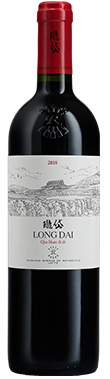

The magnum edition of the 2018 vintage presents a perfumed nose of blueberry, dates, and clove, with hints of creamy cedar and black tea. Chocolatey...
2018
Domaine de Long DaiQiu Shan Valley

Domaine de Long Dai, Qiu Shan Valley, Shandong, China, 2021
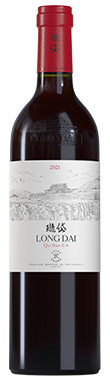
Hailed by the producer as the 'Marselan vintage,' the 2021 vintage has 'more shoulder' than the 2020, according to Saskia de Rothschild. The floral perfume,...
2021
Domaine de Long DaiQiu Shan Valley
Domaine de Long Dai, Qiu Shan Valley, Shandong, China, 2020
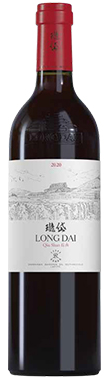
A cool vintage that began with sufficient rain in spring, the 2020 saw one of the lowest yields at Domaine de Long Dai. Minty freshness...
2020
Domaine de Long DaiQiu Shan Valley
Domaine de Long Dai, Hu Yue, Qiu Shan Valley, Shandong, China, 2021
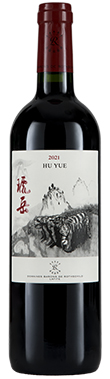
Hu Yue is the second wine of Domaine de Long Dai, with the 2021 vintage featuring a higher percentage of Merlot (24%) and no Marselan...
2021
Domaine de Long DaiQiu Shan Valley
Château Lafite Rothschild, Pauillac, 1er Cru Classé, Bordeaux, France, 2018
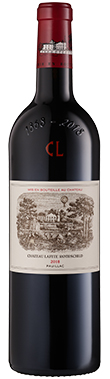
<p>Perfumed on the nose with menthol, blackcurrant, liquorice, and creamy prunes, it is juicy and mellow on the palate, with chocolatey tannins. The relatively high...
2018
Château Lafite RothschildPauillac
Château Lafite Rothschild, Pauillac, 1er Cru Classé, Bordeaux, France, 1988
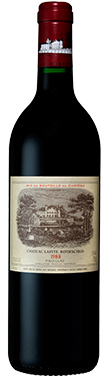
<p>Born in an era of 'classic Lafite,' as described by Saskia de Rothschild, the 1988 vintage – now with more than three decades under its...
1988
Château Lafite RothschildPauillac
Château Lafite Rothschild, Pauillac, 1er Cru Classé, Bordeaux, France, 2008
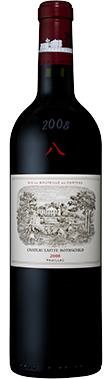
<p>Commemorating the advent of Lafite's Shandong project, the 2008 vintage carries the symbolic Chinese character ‘八’ (eight) on the bottle. A pronounced nose of menthol...
2008
Château Lafite RothschildPauillac
Château Lafite Rothschild, Carruades de Lafite, Pauillac, Bordeaux, France, 2018
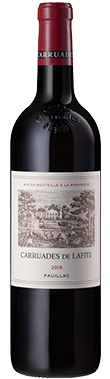
The 2018 Carruades, stored in magnum, is immediately appealing, with dark fruits on the nose infused with coconut and milk chocolate. Richly hedonistic on the...
2018
Château Lafite RothschildPauillac
