The Decanter interview: Chris Howell
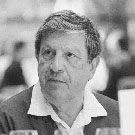

The man behind the iconic Cain Five, Chris Howell of Cain Vineyard & Winery in Napa Valley talks terroir and natural winemaking with Stephen Brook, explaining why he thinks wine is ‘intrinsically human’
Standing on a hillock overlooking the Cain vineyards on Spring Mountain, Chris Howell, slight and trim in build, is lord of all he surveys. Vines are planted in blocks among mountain meadows and rocky outcrops, and in the distance lie the Newton vineyards and the outline of Howell Mountain (no relation) on the skyline.
For Howell the journey to Cain was more circuitous. He was born in Washington state, and although his father’s work took him to Europe frequently, Howell was slow to follow. After studying philosophy and cultural criticism in Chicago, he began to visit France, as his first wife’s parents lived in Geneva and encouraged their wine travels. At the same time Howell was studying biochemistry, immunology, and other subjects in Seattle and working as an environmental chemist.
‘Someone in my lab suggested I try making my own wine. Some old-time home winemakers gave me a few tips. I made a Muscat – my first orange wine!’ Then in 1982 he went to Montpellier University in France, with Miguel Torres as one of his classmates, and also took courses at Bordeaux University. ‘But the courses were on winemaking, and it was terroir that intrigued me, and no one was teaching that.’On he went: some classes at UC Davis, a few months at Château Mouton Rothschild, a harvest in Stags Leap District. Then spells at Clos Pegase in Calistoga, where André Tchelistcheff was his mentor, and consulting with Marimar Torres (sister of his old classmate) and with Helen Turley at the Peter Michael winery. In 1990, Cain offered him a job, and he has been there ever since.
Howell at a glance
- Born 1952
- Education University of Chicago 1972-1975
- Wine studies Montpellier University 1982- 1984; Bordeaux University; UC Davis
- Hobbies Reading and music
Napa character
Cain had been founded in 1980, and its flagship wine Cain Five, a blend of the five principal Bordeaux varieties, already existed by 1990. Howell’s first project was to replant most of the vineyards, which had been planted on AXR1 rootstocks. in the meantime he created another blend: Cain Cuvée. ‘I didn’t want a wine that would essentially be a collection of leftovers. I wanted a style that was more immediate and approachable than Cain Five, with less extraction, more Merlot, less new oak.’ The portfolio of red wines was completed in 1997 with Cain Concept.
‘As our estate vineyards were still very young, Jim Meadlock wanted to know where the best vineyards were in Napa. I said around Rutherford, so we started buying grapes from the valley floor 700m below. We used much of it for Cain Five, but once the replanting was finished, it seemed a shame to give up those fruit sources, so we used them for the new wine, Cain Concept.’ In recent years Cain Concept differs significantly from Cain Five in that its fruit sources are completely different, from the Napa Valley floor and benchlands rather than the Spring Mountain estate. Cain Cuvée remains unchanged as a lighter, more accessible style, as described above.
All the Cain wines are Bordeaux-style blends, but Howell has always disliked the term. ‘I’d sooner wine was defined by vineyards than by variety. “Bordeaux blend” refers to a place that we’re not. Blends in Bordeaux have an economic element. They plant many varieties because they flower and ripen at different times. That’s not the case in Napa. Take Merlot: it is often thought of as a softening variety, but the best Napa Merlots aren’t at all soft. As for Petit Verdot, in Bordeaux it can fill out the structure, but Napa wines don’t lack structure. So here at Cain it seemed superfluous until I moderated the extraction, and found that the variety could instead contribute spicy, herbal aromas and add complexity.
‘What’s more, the term Bordeaux blend means little to many Americans who probably haven’t tasted much Bordeaux. It’ll be a sign that Napa has come of age when it no longer needs to refer to Bordeaux.’

Balanced philosophy
Howell is one of the most thoughtful of winemakers, and our stroll through the vines would prompt various ruminations. ‘When I came here in 1990, I was more influenced by a scientific approach than I am now. Today I feel more open and I’m conscious that we’re still learning. I’m a believer in less intervention, but not in no intervention.
‘Anyway, intervention applied to wine is a continuum; without some human intervention wine could not exist. I believe in terroir too, but it’s not straightforward. We recognise a certain site gives great wine, so we analyse the site and the soil and then assume that data is what explains its greatness. But that’s not necessarily the case. It’s not causal.’
Given the essential mysteriousness of terroir, and the ability of skilled winemakers to intervene to varying degrees in fashioning the expression of that terroir, where did the balance lie? ‘Winemaking can so easily obscure terroir,’ he says. ‘Here in Napa it’s unfortunate but true that winemakers have to make certain styles to get high scores. They’re under intense pressure from their owners.
‘Often it’s based on phenolic ripeness, as though the sole criterion in a wine’s balance is tannin. The problem with ripening is that you can’t go backwards. If you wait for phenolic ripeness, you may gain something but you may lose other things. Fruit doesn’t have to be fully expressive when you pick it. What matters is sensing how it will turn into wine. Defining levels of ripeness is cultural and personal too, so it’s blurred. Unfortunately blind tastings often favour sweet and loud.’
Yet, I tried to point out, US consumers have come to accept that Pinot Noir can be made in different styles: the burly, high-alcohol, Syrah-like wines in fashion a dozen years ago, and, in complete contrast, the slimmer, more fragrant and ethereal Pinots made today in coastal sites. Why doesn’t this apply to Cabernet? ‘To some extent it does,’ he explains. ‘Cathy Corison and Randy Dunn choose to harvest at lower ripeness. But Cabernet, unlike Pinot, is a status wine with consumer expectations. They’re very expensive and need to conform to a certain model. With Burgundian varieties, consumers are more open-minded. Of course Bordeaux is picking riper too – it’s a choice.
‘But you could also argue that even in Burgundy, the heartland of terroir, winemaking can impose itself on terroir. Echézeaux wines from Jayer or Dujac are poles apart in terms of their winemaking. So there too you could say that winemaking rules.’
Deep engagement
Despite his scientific background, Howell takes a more relaxed approach to wine faults than most winemakers. ‘Wine is a fermented product, not fruit. You can’t completely preserve the integrity of that fruit as you’re transforming it into wine. Today natural wine and low-intervention wines expose faults anew! I find fault-free wines lack sensuality. Wine is about more than winemaking.
‘In the mid-19th century, Pasteur worked on identifying and curing maladies du vin. Today’s renaissance of minimal-intervention or “natural” wine allows us to experience the kinds of wines that Pasteur would have known. Now we can taste the relatively unaffected, uninflected wines of pre-technology. Here we can find the undeniable beauty of some of them, and also rediscover all the “wine diseases” that would have been familiar to that generation.
‘Perhaps unintentionally, the natural movement gives us a window into the pre-oenology wines of the past. There is something intrinsically human about wine – that’s what pulls us towards “real” or “natural” wines.’
It’s become an alternative for those who have come to distrust the AP or DOC or a fancy château label. Indeed, Howell is not unsympathetic towards the natural wine movement, and dislikes the false antithesis of ‘natural’ and ‘technological’.
‘Natural wine is by far the most interesting part of the world of wine today,’ he continues. ‘Here is the quest for honesty, and the pursuit of a deep engagement with nature. Why would you have 100,000 wines, or even 100 wines – if they don’t easily give us some unique expression and reflection of the place and time where they grew, and the hands that grew and made them? Wine is a conversation!’
Sometimes he may express himself cryptically, but Chris Howell sees himself less as a technician than, perhaps, an overseer, seeking to transform place into a living product: the wine in your glass. For him the mysteries resonate – whether of soil or terroir, or the imperfect control a winemaker has of the process he must undertake. Everything, one senses, is up for question, and there are no easy answers.
After a series of encounters with Howell in London and at his Spring Mountain stronghold, there are few more stimulating people with whom to share a finely crafted Napa blend.
Brook’s pick: five to try from Cain
Cain Vineyard & Winery, Five, Napa Valley, Spring Mountain, California, USA, 2013
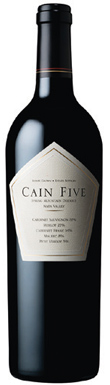

A fragrant but savoury bouquet of perfumed blackberry, rich earth, fennel seed and cigar tobacco leads to a wine with lovely cut, vibrancy and concentration,...
2013
Cain Vineyard & WineryNapa Valley

Cain Vineyard & Winery, Concept, Napa Valley, Spring Mountain, California, USA, 2012
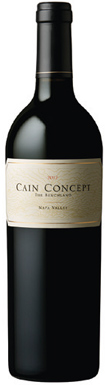
Cabernet Sauvignon dominates at 80%, with lesser roles taken by 10% Merlot, 9% Cabernet Franc and 1% Petit Verdot. Less opulent than the 2013, this...
2012
Cain Vineyard & WineryNapa Valley
Cain Vineyard & Winery, Concept, Napa Valley, Spring Mountain, California, USA, 2013
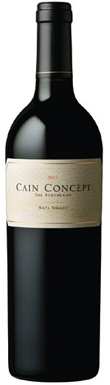
No Malbec in this blend, but 31% Cabernet Sauvignon, 27% Cabernet Franc, 23% Merlot and 19% Petit Verdot. Quite different aromas from Cain Five, with...
2013
Cain Vineyard & WineryNapa Valley
Cain Vineyard & Winery, Five, Napa Valley, Spring Mountain, California, USA, 2012
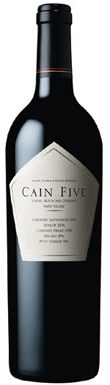
Cabernet Sauvignon accounts for half the blend, the supporting characters being 29% Merlot, 8% each Petit Verdot and Cabernet Franc, and 5% Malbec. In striking...
2012
Cain Vineyard & WineryNapa Valley
