
Domaine Jean Grivot: Profile and wine ratings


Burgundy master Clive Coates MW tells you everything that you need to know about Domaine Jean Grivot, along with historical tasting notes on wines from top vintages - as part of a series that looks back at domaine profiles from Clive's most recent books.
I don’t like half bottles: stupid size. Not nearly enough for one – let alone two. But for some reason, lurking about in the Château Coates cellar, I owned a half of the Domaine Grivot’s Clos de Vougeot 1964. Eventually I opened it at the end of a boozy dinner. My friend said she’d take half a glass up to bed with her. I finished the washing up and relaxed with the rest. It was delicious.
Why? Because they were over-fertilising the vineyards, and as a teacher demonstrated to Etienne when he was doing his studies in the late 1970s (first a B.T. (Brevet Technique) in general agriculture, and then a B.T.S. (superior) in viticulture and oenology), the soil in Burgundy was becoming increasingly incapable of producing vins de terroir, wines which had the magic character and flavour concentration of where they come from.
Find all Clive Coates MW’s Domaine Jean Grivot tasting notes here
The origins of the Grivot family lie in the upper reaches of the river Doubs, a hundred kilometres to the east in the Jura, but Grivots have been established in Burgundy since the French Revolution.
At first they lived in Nuits-Saint-Georges, farming vines at Arcenats in the Hautes-Côtes and at Corgoloin, but raising other crops as well. A branch then moved to Vosne-Romanée, and slowly but surely the activities of this side of the family concentrated on wine production.
Gaston Grivot, son of Joseph and father of Jean, sold his vines in these lesser areas in 1919 in order to buy an important piece of Clos Vougeot from a M. Polack. He was one of the first to pursue a proper oenological degree at Dijon university in the 1920s.
And he had the foresight to marry Madelaine, daughter of Émile Grivot of Nuits-Saint-Georges in 1927 – no close relation, but surely a distant cousin – who brought vines in Pruliers and Roncières with her as a dowry.
Jean Grivot, the present head of the family, was born in 1928. He too studied at Dijon, married a Jayer, Yvonne, inheriting vines in Chambolle, Vosne-Romanée, Les Rouges and Échézeaux from her and her sister Jacqueline, and, in 1984, acquired a parcel of land in Richebourg, formerly owned by the Vienot estate, dividing it with Jean Mongeard.
The vines here were not in the most perfect of conditions. And it takes time to get them in order. But the majority of the vines date from the late 1930s. Since 2006 the vineyard, like other Grivot land in Vosne-Romanée has been ploughed by a horse, Pirate. See the tasting notes below.
Little by little, therefore, a sizeable (by Burgundian standards) domaine has been created. There are currently 40 parcels of vines spread over 14.8 hectares. And 22 different wines. From 1959 all has been sold in bottle.As early as 1978 Etienne persuaded his father to abandon chemical fertilisation.
He didn’t join the domaine until after he’d finished his military service in 1981. But right from the beginning he persuaded Jean Grivot to let him take charge of at least one wine. Gradually over the decade he took over.
“I see the evolution of Domaine Grivot in four phases,” he says. “Between 1982 and 1986 I forged my opinions. I talked and tasted with my friends and contemporaries, among them Dominique Lafon and Christophe Roumier. We were all in the process of taking over well-reputed estates, but we all felt we could and should improve things.”
It was at this period that he met Marielle Bize, the tall, elegant, slender, younger sister of Patrick, of Domaine Simon Bize in Savigny-Lès-Beaune. “Patrick,” says Etienne, “asked if he could come to taste with a client. Later, I went back to sample his wines. I saw Marielle. This is the woman I want to marry, I said to myself.” They were married in 1987, and have two children. Mathilde, born 1989, and an international eventer, and Hubert, born in 1991, destined to take over, eventually, from his father.
Phase two begins with his introduction to Guy Accad. “Accad was incompetent as a communicator, rude and ungainly as an individual, but a genius when it came to soil analysis and what was vital to do to regenerate the life therein: how to persuade the vines to get the maximum out of their environment. He also had very definite views over vinification. And it is here that the controversy lies.”
It is difficult to appreciate today how original Guy Accad was at the time. Alongside Claude Bourguignon and his ground-breaking book: Le Sol, La Terre et Les Champs, Accad was the first to demonstrate the importance of the vines’ environment and the role it had to play.
But Accad was also a strong advocate of long, indeed prolonged, cold-soaking before vinification. This occurred naturally in the old days, when harvests took place in October, for the grapes were gathered at 10°C and it took a week for the fermentations to get underway.
But it did not produce the succulent, juicy, easy to appreciate wines [that] critics and buyers liked to find when they sampled them in cask, especially if you followed the Accad edict to block the onset of the fermentation for a week or more.
“My father was all in favour,” says Etienne. “The wines I began to produce reminded him of those of his youth. I too was utterly convinced that my 1987s, not an easy vintage, were distinctly superior to most of my friends. But they tasted odd, different, and almost everyone found them un-Burgundian.”
He still rankles at what he sees as the unjust desertion he experienced following his first few Accad vintages, and the fact that he was left, as the most prominent Accadian, to justify all the Accad wines, good or bad.
“In fact I began to feel I was the only one making bad wine in the 1987-1992 period. We also lost three-quarters of our clients.
“Gradually I began to modify, to take the best of Accad (we are still friends, and I would trust no one else to do my soil analysis) and jettison the rest. I wanted the liberty to make Grivot wines, not Accad wines. This began in 1993.”
The fourth phase followed on logically. In 1998 Etienne began to make somewhat more generous wines. “It was I who had changed. I was approaching 40; more mature; more relaxed. The wines became more serene and supple, without compromising their freshness and potential to age, because I was more at ease.”
He began vinifying at a slightly higher temperature, 31° rather than 28°. The wines became less monolithic.
”Let the wine make itself, particularly in the better years”. And, (which we didn’t touch on) because of a decade of Accad techniques in the vineyard was now resulting in better fruit from more “grown up” vines. Gradually he ceased the use of insecticides and herbicides. Gradually the domaine became totally biological. Since then the Grivot wines have been truly excellent.
It was with the 1998 vintage, co-incidentally, that the Institute of Masters of Wine in London commenced an annual Burgundy tasting sponsored by the Domaines Familiaux et Tradition, a group of top estates. Grivot sends along his Vosne-Romanée, Les Beaumonts and sometimes something else. It is consistently among the top three wines on the table.
What of the future? “One is never satisfied. This is an obsession: to improve. And I don’t think I will ever give up. I certainly don’t have to for many, many years. I’m hardly 50. And Hubert is still a young man. Like me, he is assuming that one day he will take over. But nobody’s is forcing anything on him.
“But we all need changes. Changes of scene and occupation. I need freshness. I’m a very curious person. I don’t understand those of my colleagues who never take a holiday. That’s absurd. We go to Canada (the Grivots have a house on Lake Masson, about an hour away from Montreal) every summer for three or four weeks. One gets back regenerated.” He also flies helicopters.
“Do I have a philosophy of wine? Let’s make a parallel. Terroir is like what a composer of music has created. The winemaker is like the conductor. You have fine terroirs, like great pieces of music. But you need a fine interpreter. In fact being a winemaker has a lot in common with being a conductor. Though I wouldn’t describe myself as especially passionate about music, I would like to have been a conductor. The power of being in charge intrigues me.
“As far as winemaking is concerned I’m looking for harmony and balance: freshness is primordial. I don’t want wines which are too spontaneous. I like a wine which is slow to develop. What I have learnt over the years is that some vintages need fermenting at a different temperature to others.
“At Domaine Grivot we de-stem 100 percent; we’ve had a sorting table since 2000; there is cold-soaking, but not in such an exaggerated way as before; we use anything from 20 to 80 percent new oak; in our cold cellars the malos are often late to complete; and we bottle after 18 months without fining – except on the rare occasions when it is necessary – and, since 1988, without filtration. Are we late or early pickers? Neither. I pick when I think it is the right time. But I hate sur-maturité. What my neighbours do doesn’t concern me. My 1997s are very fine because I picked very early, to preserve the freshness.”
Etienne Grivot is tall and fit, an attractive looking man, gently greying, intelligent and thoughtful. (In the 1980s I wrote a piece on Vosne-Romanée growers for an American wine magazine, Wine News. Etienne was featured on the cover. He received several proposals of marriage!)
This Grivot is not, you would think, easily aroused (which is not for a minute to suggest he lacks passion. He’s just got it under control). He only once got really belligerent during our conversation. Back in the early 1990s, as I knew, the INAO had asked him to experiment with a concentrating machine. What did he think of them. He is fundamentally against. “They destroy the harmony of the wines: all the wines taste the same; they are banal!”
I think there is now a fifth phase apparent at the Grivot domaine. The wines since 2005 or so are even more relaxed – less introverted, as Etienne would put it. And even more distinctive and profound.
The Grivot domaine currently includes:
Grands Crus: Richebourg (32 a); Clos de Vougeot (1.86 ha); Echézeaux (85 a).
Vosne-Romanée Premier Cru in Les Beaumonts, Les Brulées, Les Chaumes, Les Reignots, Les Rouges and Les Suchots.
Nuits-Saint-Georges Premier Cru in Les Boudots, Les Pruliers and Les Roncières.
Village Vosne-Romanée including Les Bossières.
Village Nuits-Saint-Georges including Les Charmots and Les Lavières.
Village Chambolle-Musigny La Combe d’Orveaux.
As I begin to take my leave I ask him one more question. Do you have a frustrated ambition, Etienne? He thinks for a minute. “I would have liked to have been someone really famous.”
But in the wine world you are, Etienne. You really are.
See Clive’s wine ratings for top vintages
Where to buy Clive Coates MW’s ‘My Favorite Burgundies’ book:
My Favorite Burgundies, Clive Coates – Available at Amazon UK
My Favorite Burgundies, Clive Coates – Available at Amazon USA
Domaine Jean Grivot, Richebourg Grand Cru, Burgundy, France, 1990
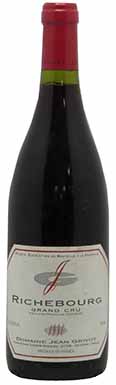

Fullish colour. Still quite closed in on the nose. Marvelous concentration on the palate. Full body, creamy and rich. Great class and marvelous fruit. Very,...
1990
Domaine Jean GrivotRichebourg Grand Cru

Domaine Jean Grivot, Richebourg Grand Cru, Burgundy, France, 2006
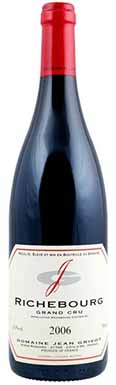
Fullish colour. This was very closed-in at first, but opened up to show something of real beauty. Fullish. Tannic. Ripe, rich and concentrated. Splendidly profound...
2006
Domaine Jean GrivotRichebourg Grand Cru
Domaine Jean Grivot, Richebourg Grand Cru, Burgundy, France, 2005
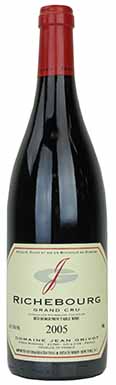
Full colour. Splendidly concentrated and complex on the nose, but still very closed in. Full body, finely tuned, fragrant, understated and very harmonious. Vigorous, intense...
2005
Domaine Jean GrivotRichebourg Grand Cru
Domaine Jean Grivot, Vosne-Romanée, 1er Cru Beaux Monts, Burgundy, France, 1999
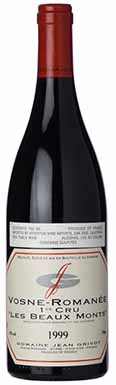
Fullish colour. Vigorous, intense nose Very profound and high class. Very fresh. Still youthful. Fullish body. Some tannin. Lots of lovely fruit underneath. But still...
1999
Domaine Jean GrivotVosne-Romanée
Domaine Jean Grivot, Vosne-Romanée, 1er Cru Aux Brûlées, Burgundy, France, 1998
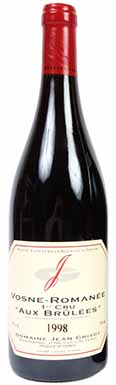
Full, vigorous colour. On the nose still quite firm, with some oak. Fullish body. Very good grip. Round, ripe tannins, but still immature. Lots of...
1998
Domaine Jean GrivotVosne-Romanée
