
Perrier-Jouët Belle Epoque: brut vintage and blanc de blancs vertical tasting
Having long earned a place among Champagne's most iconic names, Perrier-Jouët is preparing the re-release of rare back vintages of its Belle Epoque. Giles Fallowfield tasted these 10 very special wines and discovered what lies ahead for the maison's flagship cuvée.


Since she joined Perrier-Jouët back in October 2018, Séverine Frerson, now head winemaker in her own right, has been studying the DNA of the house. Particularly the style as represented by the wine – Perrier-Jouët Belle Epoque – that graces the Emile Gallé, white anemone-clad bottle, surely Champagne’s most elegant looking prestige cuvée.
The wine that for her: ‘represents the purest expression of Perrier-Jouët style, built around three pillars: florality, Chardonnay and nature’.
Scroll down to see scores and tasting notes for 10 vintages of Perrier-Jouët Belle Epoque
Having discovered for herself Belle Epoque’s ability to age attractively, sometimes magnificently – thanks in no small part to the portion of top-quality Cramant Chardonnay that sits at the heart of all the Belle Epoque Cuvées – Frerson has picked out a number of rare back vintages to re-release.
In all these, ‘Chardonnay plays a central role, and even though Pinot Noir is sometimes almost as important, the blends are all constructed to showcase the Chardonnay style. We choose Pinot Noir that will help reveal the Chardonnay signature.’
‘I have selected vintages, first to pay tribute to the wine heritage of the house, but also wines that represent the purest expression of the Perrier-Jouët style,’ she says. In this tranche of releases, one in jeroboam, four in magnum and the rest in 0.75cl bottle, the wines are all made by her two immediate predecessors, Hervé Deschamps and, before him, André Baveret, who created Belle Epoque back in 1964.
Baveret made the inaugural 1964 vintage of Belle Epoque as a blanc de blancs style, 99% sourced in Cramant and 1% in Avize.
Two years later the style changed when Montagne de Reims Pinot Noir was added to the blend. Cramant and Avize Chardonnay set against Verzy, Verzenay and Mailly Pinot Noir has gradually become the norm, plus the addition of around 5% Pinot Meunier from Dizy. But Frerson says, ‘we can also use Le Mesnil sur Oger to bring a bit more amplitude, or richer Chardonnay, or Chouilly, to enhance the finesse of the blend. For Pinot Noir, we sometimes use Aÿ when we need structure, or more rarely Ambonnay.’
‘My ambition is to stay true to the singular style of Perrier-Jouët Belle Epoque, but also to introduce a personal touch, just like my predecessors did. To do this, I can use other crus, adapt the liqueur, or even use barrels from Burgundy’s Chardonnay, for a small part of the wines, to enhance the Chardonnay and floral signature.’
Frerson is looking forward to the challenge of matching the elegance of the Emile Gallé bottle with her own twist on the Belle Epoque style, when her first such wine is released towards the end of this decade.
10 vintages of Perrier-Jouët Belle Epoque tasted:
Wines are shown by vintage, in ascending order
Related content
First taste: Louis Roederer Collection 242
Champagne Philipponnat vertical: rare and recently-disgorged Clos des Goisses
Perrier-Jouët, Belle Epoque Brut Vintage, Champagne, France, 1988
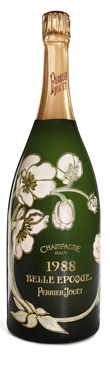

Quite a contrast to the 1989 and 1990, this was a cooler, less ripe vintage. When the 1988s were first released they were dominated by...
1988
Perrier-Jouët

Perrier-Jouët, Belle Epoque Brut Vintage, Champagne, France, 1989
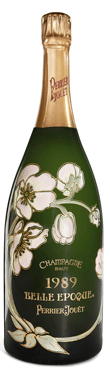
Another warm and sunny vintage, with lower average acidity than the 1990, and not quite the same high level of potential alcohol, this wine, a...
1989
Perrier-Jouët
Perrier-Jouët, Belle Epoque Brut Vintage, Champagne, France, 1990
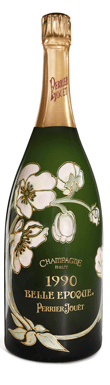
The trio of vintages 1988 to 1990 have been rightly hailed as one of Champagne’s greatest. But not that many producers declared them all, so...
1990
Perrier-Jouët
Perrier-Jouët, Belle Epoque Brut Vintage, Champagne, France, 1999
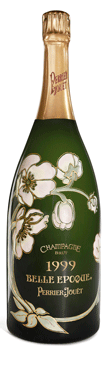
A lovely golden yellow, this shows both good concentration of fruit and an elegant, honeyed intensity on the palate, leading to a long complex finish...
1999
Perrier-Jouët
Perrier-Jouët, Belle Epoque Brut Vintage, Champagne, France, 2000
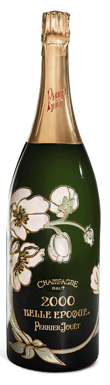
<p>While 2000 was a warm, ripe harvest, declared more widely than perhaps the vintage deserves because of the millennium factor, in this jeroboam format it’s...
2000
Perrier-Jouët
Perrier-Jouët, Belle Epoque Blanc de Blancs, Champagne, France, 2002
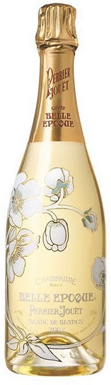
The nose is poised between freshness and maturity, and seems to be fresher and younger than the 2004, we seem to be reversing time, but...
2002
Perrier-Jouët
Perrier-Jouët, Belle Epoque Brut Vintage, Champagne, France, 2004
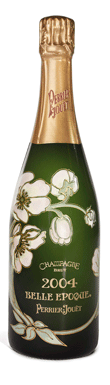
<p>Partly because of the large volume of grapes produced – it followed the drought year and subsequent tiny 2003 harvest – 2004 has long been...
2004
Perrier-Jouët
Perrier-Jouët, Belle Epoque Blanc de Blancs, Champagne, France, 2006
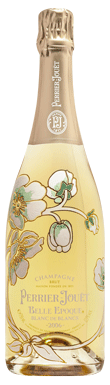
A mature nose with tertiary notes beyond toast and brioche, the most powerful nose of the vertical tasting. The same sense of austerity as on...
2006
Perrier-Jouët
Perrier-Jouët, Belle Epoque Brut Vintage, Champagne, France, 2012
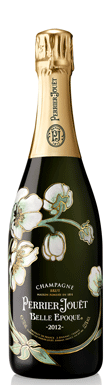
<p>This is one of those magical harvests in Champagne, a truly outstanding year,' says head winemaker, Séverine Frerson. Notes of acacia flower mingle with ripe...
2012
Perrier-Jouët
Perrier-Jouët, Belle Epoque Brut Vintage, Champagne, France, 2013
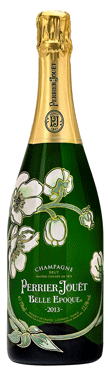
<p>The 2013 harvest didn’t start until early October and the cooler temperatures in the last weeks of ripening allowed for a long and steady aromatic...
2013
Perrier-Jouët
