
The Meunier Makeover
A grape with a long and sometimes troubled history, Pinot Meunier is enjoying popularity once again – not just in its traditional homeland of Champagne, but in the vineyards of England and America’s west coast, as well. Alice Lascelles finds out more.

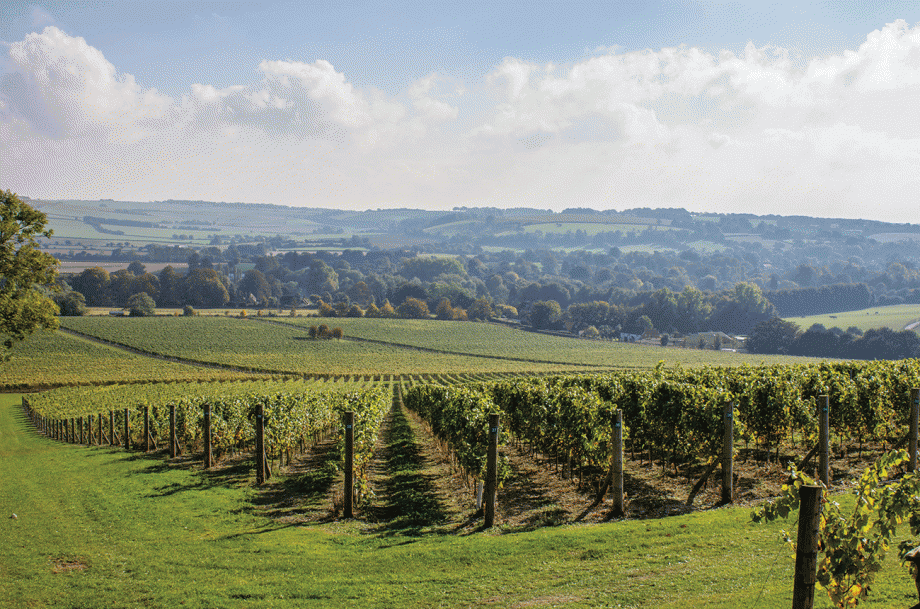
Stripped of their grapes, vines can be hard to tell apart. But there is one variety whose silvery-grey leaves are instantly recognisable, and that is Pinot Meunier.
Named after the French word for ‘miller’, on account of the floury-looking down that adorns each leaf, this distinctive vine was once the most widely planted in the Champagne appellation. Later budding (and therefore more frost resistant) than Pinot Noir, and also higher yielding, it was prized for being a dependable workhorse, well suited to the cooler climes of northern France, and particularly the frost-prone vineyards of Champagne’s Marne Valley.
But as competition between Champagne and Burgundy grew, Pinot Meunier started to lose ground to Pinot Noir and Chardonnay. Plantings declined and so did its reputation – a demotion from which the black grape has seemingly never fully recovered.Today, according to the CIVC (Comité Interprofessionnel du Vin de Champagne), Pinot Meunier accounts for 31% of all plantings in the AP, putting it neck-and-neck with Chardonnay and just a few per cent behind Pinot Noir. It remains a key component in many blends, adding a touch of floral, slightly spicy fruitiness that can often be exactly what’s needed to reconcile the nerviness of Chardonnay and the weight of Pinot Noir.
Yet the stigma persists. Critics accuse Meunier of being flabby, overly fruity and a poor performer in the cellar. It’s also often claimed that a village planted with Meunier can’t be classified as grand cru – a story that the CIVC assures me is a complete myth. With a few distinguished exceptions such as Krug – which has always proudly highlighted the role of Pinot Meunier in its Grand Cuvée – most luxury cuvées don’t use the grape at all.
Pinot Meunier has had a rough time of it. But lately it has started to look like the grape might once more be in the ascendant – not just in Champagne, but in other countries, too. Last autumn, the region’s oldest wine house, Champagne Gosset, gave the grape a major fillip when it launched Gosset, Grand Blanc de Meunier Extra Brut, a 100% Pinot Meunier, limited-edition cuvée with a price tag of £85-£90.
Made from fruit sourced principally from the ‘circus’ of premier cru villages around Epernay (Cumières, Dizy, Pierry, Moussy, Chavot and Vinay), and aged for 10 years in bottle, this non-vintage cuvée was a riposte to those who claim that Pinot Meunier can’t age. ‘I didn’t know we could do this with Pinot Meunier,’ admits Gosset export director Bertrand Verduzier at the launch in London. ‘It gives a different and new view of what the grape can do in Champagne.’
When selecting the plots, he explains, Gosset prioritised vines on south-facing mid-slopes, rather than the low-lying, north-facing slopes where Meunier is normally planted, resulting in fruit with greater ripeness and complexity. In keeping with the Gosset style, malolactic fermentation was also blocked, helping to preserve the wine’s bright acidity and increase its ageing potential.
‘It is a delicious, racy, elegant wine with the inimitable fruitiness of Pinot Meunier, both tropical and spicy,’ he says. ‘It already has 10 years of ageing in the bottle, but it has still plenty of life ahead of it.’
Growers’ favourite
The Gosset Pinot Meunier may have grabbed the headlines, but it’s the grower houses that have really been behind Pinot Meunier’s renaissance in the past generation or so.
One of grape’s great champions has been Laherte Frères, a biodynamic domaine in the village of Chavot, just south of Epernay. Using fruit from different plots around the Marne Valley and the Côteaux Sud d’Epernay, this family-owned winery produces three exceptional, and very contrasting, 100% Pinot Meunier Champagnes (two rosés, one white), and also a still red.
‘We love the wines from Meunier, as the Meunier takes a lot of the characteristics of the terroir – in both a good and a bad way – and I feel that the aromatic variation could be really large,’ says winemaker Aurélien Laherte. ‘We have Meunier planted on clay, some on chalky subsoil, and some on a mix of sand, clay and marl.’
It’s the fruit from the richer, clay-based plots that goes to make Laherte Frères’ Rosé de Meunier, an exuberant, saignée blend the colour of crushed strawberries. ‘This is more the profile of the charming Pinot Meunier,’ as Laherte puts it.
For the more ‘intellectual’ blanc de noirs Les Vignes d’Autrefois, Laherte takes fruit from 60-year-old Meunier vines (some without rootstock) rooted in deep chalk. ‘It has the same minerality as a Chardonnay from Côte des Blancs, because of the chalky terroir,’ he says. ‘But of course, it also has more fruitness and aromatics than a Chardonnay!’
This wine has none of the ponderousness that Meunier is notorious for – its focus is laser-sharp. The fruit is firm: dried apricot, pale stone fruit. And the finish has an appetising touch of saltiness.
‘The quality of the grape comes from the soil where it’s grown – if you plant Meunier in the best soils, there is no reason why it should not give you top wines,’ insists Laherte. ‘Also, we have to say that global warming is helpful for getting better and better Meunier.’
Other grower houses that have long championed Pinot Meunier include Georges Laval (Cumières), Chartogne-Taillet (Merfy), Collard-Picard (Epernay) and the Moussé family, which has been cultivating vines in the Marne Valley since 1750. In 2015, eight houses joined forces to form Meunier Institut, which now runs a showcase at the Printemps des Champagnes tasting each spring.
Arguably the most famous, and sought- after, Pinot Meunier Champagnes of all, however, are those made by Jérôme Prévost at La Closerie, a tiny 2.2ha domaine in Gueux. Here, in this out-of-the-way village just west of Reims, the soil is a mix of fossil-rich sand and limestone. From this terroir, Prévost produces just two single-vineyard cuvées: Les Béguines – a non-vintage blend that’s more than 90% Pinot Meunier – and Fac-Simile, an ultra-scarce rosé made from a blend of Les Béguines and a richly concentrated red wine made from the same grape.
Fermented on the skins for up to eight hours, and bottled with little or no dosage, Prévost’s Champagnes have a reputation for being challenging when young. But with time they develop an intensity and texture that’s incredibly compelling.
‘Pinot Meunier is very timid – if you push it and add lots of fertiliser it doesn’t work. You must have low yields,’ says Prévost. ‘But for me wine is not a question of cépage. I don’t want to know about the Pinot Meunier. It’s a question of terroir. With every fermentation you increase the presence of the terroir. You reveal things about the place you can’t see.’
‘Pinot Meunier loves deep, sandy soil, but phylloxera hates it,’ says Raphaël Rodriguez of Vine Trail, Prévost’s importer. ‘So you get these pockets of really old, ungrafted Meunier vines on sand, especially in the Marne Valley, that make really amazing Champagnes.’
Les Barres Extra Brut 2013 by rising star Chartogne-Taillet is one of those – made from a tiny parcel of ungrafted Meunier planted in 1952, it has an uplifting bouquet of apples and flowers, and fine, racy acidity.
Home and away
France remains the Pinot Meunier heartland – about 80% of all the Meunier in the world grows in Champagne. But increasingly, the grape is finding a home in England, too. One of the best English sparkling wines I tasted this year was a limited-edition 100% Meunier rosé from Hampshire’s Exton Park. Harvested in 2014 from the estate’s oldest vines (planted in 2003), this copper-pink rosé has crisp, sherbetty red berry fruit, aromatic rose notes and a succulent, slightly creamy finish. It was released in 2016, but has yet to reach its peak.
Pinot Meunier is also a major component of Exton Park’s non-vintage rosé blend, so it comes as no surprise to learn that winemaker Corinne Seely is a fan. ‘I adore Pinot Meunier,’ she says, with a grin. ‘I always thought it is the grape that expresses the terroir best. And it has this wonderful floral character that I associate with an English garden in early summer – fresh, delicate and slightly spicy, slightly green, but pink too, with this deep, deep bouquet of rose.’
The 100% Pinot Meunier was officially a one-off, but Exton Park recently planted a further 2ha of the variety – which suggests that more single-varietal and Meunier-led cuvées might be on the way. ‘I am also trying to get together a little club of fellow winemakers who love Pinot Meunier,’ says Seely conspiratorially. ‘I can’t say who just yet, but so far we have members in England, Germany, Italy and Champagne.’
Earlier this year the Kentish winery Simpsons released its Derringstone Pinot, Meunier 2018, a still white with ultra-creamy, quite viscous orchard fruit. In October, Hambledon Vineyards in Hampshire also unveiled its first 100% Meunier sparkling rosé, a rather meaty saignée that tastes more like an homage to the still wines of Burgundy than the pink wines of Champagne. Zero dosage, non-vintage and constructed from a blend of 2015 wines bolstered by some barrel-aged reserve wines it is, in their words, ‘a gastronomic wine, free from categorisation’.
Another English winery that’s made a big play of the grape is Black Chalk in Hampshire – both its white and rosé cuvées are about one-third Pinot Meunier. ‘It’s always struck me what incredible weight and texture Pinot Meunier can achieve at quite an early stage,’ says Black Chalk’s winemaker Jacob Leadley.
‘Pinot Noir may be slightly more elegant in the long run, but the vines need to be more mature to achieve that elegance.’ Leadley favours harvesting Meunier on the early side, ‘while the fruit is still bright. And rather than using oak to soften the acidity, I like to use a touch of lees ageing, then you get that texture and weight, and even some autolytic character, without losing the very expressive, bright red fruit.’
Over on the US west coast, rising prices for Pinot Noir have also prompted some of California’s more maverick winemakers to explore the potential of Pinot Meunier. Keep Wines, a low-intervention winery in Oakville, California, makes a delightful still red using Meunier from Yount Mill, a renowned organic Sierra Foothills vineyard.
‘It’s rustic Pinot meets a fruit-forward Gamay, which is exactly the style we were going for,’ says winemaker Johanna Jensen, who cut her teeth at the fashionable Broc Cellars and the Scholium Project before founding Keep Wines with husband Jack Roberts (who is also assistant winemaker at Matthiasson Wines).
And it looks like Pinot Meunier may have more surprises in store. The received wisdom has always been that Pinot Meunier is a clonal variation of Pinot Noir. But, according to Tim Hall of Champagne specialist Scala Wine, new insight suggests that might not actually be true. ‘Research is now casting doubt on the link of Meunier with the Pinot family,’ he says. ‘Hence most people are now dropping the “Pinot” from the name of the grape.’
Misunderstood, maligned and possibly even misnomered – high time, it seems, that Meunier got a second hearing.
Lascelles’ pick: 10 top Pinot Meunier wines
Laherte Frères, Les Vignes d’Autrefois Extra Brut, Champagne, France, 2013

Very appetising nose: fresh, slightly yeasty. Excellent focus and definition on the palate, zippy Bramley apple, dried apricots and a fine, creamy texture, followed by...
2013
Laherte Frères

Chartogne-Taillet, Les Barres Extra Brut, Champagne, France, 2013
Distinctly ‘Meunier’, with a big bouquet of apples and flowers and complex layers of flavour. Full-flavoured yet still lean: bright, racy acidity keeps it moving...
2013
Chartogne-Taillet
Gosset, Grand Blanc de Meunier, Champagne, France
Rather understated at first, but flowers into very refined Meunier characters: succulent stone fruit and delicate, yet penetrating floral notes. Harmonious, elegant and fresh –...
Gosset
Collard Picard, Cuvée Selection Brut, Champagne, France
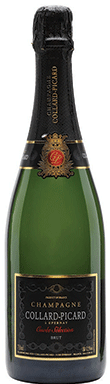
A proportion of oaked reserve wines in the mix gives this organic Meunier blend (with 50% Pinot Noir) unusual richness – buttery apple tatin, cut...
Collard Picard
Thomas-Hatté, Tradition Brut, Champagne, France
A golden Brut in the traditional style. Honeyed baked apples dusted with cinnamon and a whiff of smoke on the nose. Ripe orchard fruit and...
Thomas-Hatté
Jérôme Prévost, La Closerie Fac-Simile Extra Brut Rosé, Champagne, France
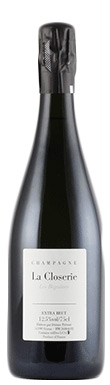
<p>A pale rosé that combines intensity with gracefulness. The sandy terroir imparts delicate textures and subtle, slightly spicy red fruit characters. Elegant but uncontrived, and...
Jérôme Prévost
Exton Park, Pinot Meunier Brut Rosé, Hampshire, England, United Kingdom
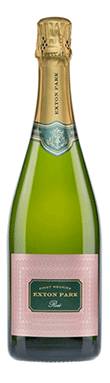
Has an attractive coppery pink colour and fruity, slightly spicy aromatics. Raspberry sorbet freshness mellows into nutmeg and dusky rose. The finish is elegant and...
Exton ParkHampshire
Moussé Fils, Les Vignes de Mon Village Brut Nature, Champagne, France
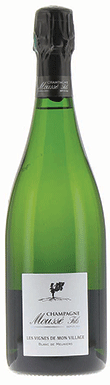
Mouth-watering aromas of crushed apple on the nose, that turn more golden on the palate – buttery apple strudel dusted with cinnamon. The blend of...
Moussé Fils
Black Chalk, Wild Rose Brut, Hampshire, England, United Kingdom, 2016
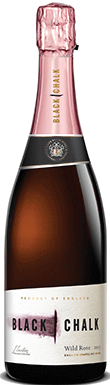
Meunier blended with 41% Pinot Noir and 21% Chardonnay. Very crisp and bright: crunchy red apple and red berry aromas, and taut, sherbetty acidity on...
2016
Black ChalkHampshire
Keep Wines, Pinot Meunier, Napa Valley, Oakville, California, USA, 2017
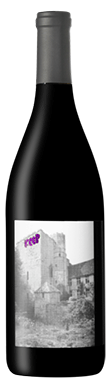
Deep damson, with aromas of cherry bakewell, violet and a little natural funk. Some whole-bunch fermentation gives lovely lifted red fruit: raspberry, mulberry. Chalky tannins....
2017
Keep WinesNapa Valley
