
Producer profile: Thymiopoulos
Committed to organic and biodynamic farming, and working with indigenous grapes, Apostolos Thymiopoulous is one of the winemakers steering Greek wines towards an innovative future and global recognition. Sarah Jane Evans MW meets the charismatic master of Xinomavro at his home in northern Greece


The car screeches to a halt by an isolated, dusty roundabout to pick us up and we race off to the vineyards. But what vineyards! A hillside in the shadow of snowcapped Mount Olympus, in full sun, with a fresh breeze and a breathtaking view of the Aegean sea sparkling in the distance. There’s a glorious sensation of good health, appropriate for a producer who follows organic and biodynamic practices, and whose main problems in the vineyard are wild boars, greedy birds and, very occasionally, locusts. Our host is vivid in a pink polo shirt, blue shorts and shades. He definitely doesn’t look like the typical winemaker. I definitely have the sensation of being in a film.
We are in the tiny PDO of Rapsani, about a 90-minute drive south of Thessaloniki, towards Athens. I am visiting Apostolos Thymiopoulos. He’s one of a new generation of wine people in Greece who are driving a step change in the country’s wines – and in their international reputation. He’s a native of Naoussa, located about half an hour away (hence the hectic driving to and fro). His family home in Trilofos is close to Aristotle’s school in Mieza, where the philosopher is said to have taught Alexander the Great.
Thymiopoulos at a glance
Production 460,000 bottles
Vineyards 38ha owned, certified organic
Other vineyards Works 60ha in collaboration, all farmed organically, with 80% certified
High praise
His rise to international recognition has been as fast as his driving, yet it may have felt as if he were pushing water uphill. He was the first in the family to bottle wine. He was using the local variety Xinomavro, hardly known outside Greece, and from a region few could (and many still can’t) place on the map. Furthermore, quality Greek wine had a low profile in export markets, the main exceptions being prestige red wines made from international varieties.
His progress has been impressive. ‘He’s one of the great winemakers of the world,’ says Freddy Bulmer, buyer at The Wine Society. ‘One of the stars of his generation,’ adds Mark Andrew MW, co-owner of the London wine bar Noble Rot and its accompanying magazine. ‘A mature Harry Potter, as he brings “magic” to every region he sets eyes on,’ states Yiannis Karakasis MW, stretching the point a little…
Thymiopoulos’ father was already farming organically, and his son has continued these practices. ‘It’s important to mention his commitment to organic and biodynamic farming, especially in a region that doesn’t have the best record when it comes to sustainability in the vineyard,’ says Andrew. ‘There are now a number of others who share his commitment to the environment, but a winemaker of his scale insisting on such high- quality viticulture is incredibly important to the future of the region.’
Andrew cites winemakers such as Yiannis Economou [in Crete], Evriviadis Sclavos [Cephalonia], Kostis Dalamaras [Naoussa] and Panagiotis Papagiannopoulos [Patras] who are also driving the international perception of Greece in a positive direction. This generation is ‘rediscover[ing] the potential of indigenous Greek varieties and the country’s incredible terroir, while combining traditional, sensitive winemaking practices with an understanding of modern science’. He points out, however, that ‘the quality of [Thymiopoulos’] wines and his ability to engage drinkers in international markets have understandably given [him] a higher profile than many of his colleagues’.

Heart of the matter
It’s a result of the return to making wines from indigenous varieties, with names such as Agiorgitko, Assyrtiko, Kotsifali, Malagousia, Mavrotragano and Roditis, which are working their way onto international wine lists and into independent wine merchants’ stores. As Konstantinos Lazarakis MW notes in The Wines of Greece, Thymiopoulos is one of those who ‘helped local growers understand that viticulture could be a meaningful choice’. He continues: ‘Thymiopoulos showed them that growing grapes could be something to make them proud… He also devised a style of Xinomavro that was more modern but not international – amazing purity and intensity of fruit, pale colours, light-handed but structured tannins, almost invisible oak, extremely round mouthfeel.’
That comment about tannins is crucial. He’s a tannin-tamer; an important insight with Xinomavro. He uses very good quality French oak, and mainly large wooden tanks. ‘We did some experiments with concrete and the result was really very interesting. But the most important thing is the “winemaker feeling”. I don’t follow protocols. Each year is different and needs different practices. The best answer is experience and this is the reason I focus on this one variety,’ he says.
Looking over the way his winemaking has changed, he notes: ‘I’ve used indigenous yeasts since 2009, and more big barrels and wooden tanks from 2015. I’m looking to try Slovenian wooden tanks. And when I have more space in the new cellar, I want to offer more mature wines to the markets.’
Thymiopoulos’ first wine was Earth and Sky (known in Greece as Ghi kai Uranos). It remains a benchmark. Karakasis remembers: ‘It changed the idea of a stereotypical Naoussa, by filling the mid-palate with juicy fruit. In this way he is an innovator for Xinomavro.’ The Jeunes Vignes (‘Young Vines’) followed to fulfil demand, and between those wines and the ones that came next – the more popular Atma range, the Nature (unsulphured), the Rosé and the glorious single-vineyard, old-vine Aftorizo – it’s been possible to understand the real character of Xinomavro.
At Rapsani, the PDO wines include two additional varieties. It’s fascinating to see the stylistic change in Xinomavro. Karakasis comments: ‘His Rapsani wines follow the same path as Naoussa, combining terroir expression with fruit purity and juiciness. I’m curious to see his next moves.’
One person who has watched him grow is his UK importer and friend Mary Pateras of Eclectic Wines. ‘We imported the wines of Haridimos Hatzidakis, and he suggested we go and see Apostolos in 2008 as he was making a stonking Xinomavro,’ Pateras recalls. ‘We met, shook hands and our first order was for 25 dozen Earth and Sky, the only wine he was making at the time – we now sell pallets and pallets. His father and brother were looking after the viticulture of the family’s old bush vines on the farm. Sadly by 2010 he had lost both [family members].’ She points out that, at the time, he was also running a wine shop in Thessaloniki. The advantage was that it gave him the opportunity to understand consumer preferences and also to taste a great many wines from outside Greece. He sold the shop and returned to focus on the farm, planting more vines.
Creative ambassador
Today, Thymiopoulos’ home life includes his wife, young daughter, mother and grandmother. It’s also busy with the animals, including various goats, chickens, domestic cats and his Japanese Akita dog, Hachi. Says Pateras: ‘He has an affinity with Japan, as his inspiration for non-interventionist viticulture is [the late microbiologist and natural farming pioneer] Masanobu Fukuoka. Like Haridimos Hatzidakis, Apostolos is the product of a childhood on the farm and knows that the vineyards hold all the secrets.’
Hatzidakis was an outstanding winemaker, based in Santorini, who died aged 50 in 2017. I ask Mark Andrew about the friendship between Thymiopoulous and Hatzidakis. ‘It was incredibly important to both of them,’ he says. ‘To many of us, Haridimos was the most important winemaker in Greece, and his death was a tragic loss. Haridimos opened the door for an entire generation of terroir-focused artisanal Greek winemakers.’ Pateras continues: ‘Apostolos and Haridimos were great friends and bounced ideas off one another, and of course argued – all Greeks love a good argument of animated debate. They holidayed together in France and Italy, visiting biodynamic winemakers and assessing new ideas that could work in Greece. In Haridimos’ last few, challenging years, Apostolos helped and supported him both emotionally and in practical ways.’
Wine merchant Daniel Illsley at Theatre of Wine sums Thymiopoulous up. ‘He is a creative man, restless and hungry for innovation. We are never 100% sure what he is going to make each year.’ He now has 29 parcels in Trilofos, as well as the high-altitude site of Fytia in Naoussa, so there is plenty to look forward to,’ he says.
‘He is a savvy operator, producing enough wine to build up the winery and give him the capital to invest and produce more,’ Illsley adds. ‘He is becoming like Dirk Niepoort [in the Douro and Portugal] – an ambassador for the region and for Greece generally.’
Thymiopoulos: go-to grapes
Xinomavro
The name Xinomavro means ‘sour/acid black’. It’s a late-ripening variety, widely planted across northern Greece, and centred especially on Naoussa, where it is the only permitted grape variety, as it is in Amynteo. In Rapsani, it is combined equally with a blend of Stavroto and Krassato. Xinomavro needs careful management. Thymiopoulous says: ‘It’s a very productive variety, so we have to control the yields. Organic viticulture is a good answer, so lower yield means better ripeness.’ The wines are typically pale in colour with marked tannins, which can be exaggerated if there is heavy oak handling. The acidity gives the wines good cellaring potential.
Xinomavro can also make good rosés. Theatre of Wine’s Daniel Illsley says: ‘The Thymiopoulous Rosé has been a huge draw and matches my interest in serious rosés that have the potential to age.’ Some call Xinomavro ‘the Greek Pinot’, but Illsley prefers ‘cru Beaujolais’ or ‘Nebbiolo’. Wine Grapes, the tome by Jancis Robinson MW, Julia Harding MW and Dr José Vouillamoz, sums up Xinomavro succinctly: ‘Top quality, widely planted but pernickety, high-acid Greek variety.’
Stavroto & Krassato
Stavroto is local to Rapsani, a vigorous variety with compact bunches of small berries. ‘It’s more like Grenache or Poulsard,’ says Thymiopoulous. Krassato, the other element of Rapsani, delivers alcohol, a darker colour and aromatics, but is lower in tannins and acidity, hence making a good complement to Xinomavro.
A taste of Thymiopoulos: Evans’ picks
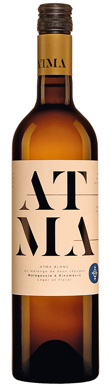
Thymiopoulos, Atma White, Naoussa, Macedonia, Greece, 2019
90
Original, summery blend of a direct press of Xinomavro (that’s to say, a blanc de noir) with about one-third of the white Malagousia. The wines are made separately and blended later. Xinomavro gives the aromatic, exotic Malagousia the crunchiness it lacks. Altogether very appealing. There’s a mouthwatering acidity, with a savoury, mineral texture to add interest.
2019
ThymiopoulosNaoussa
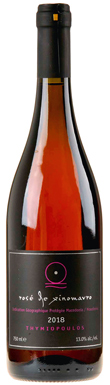
Thymiopoulos, Rosé de Xinomavro, Naoussa, Macedonia, Greece, 2018
92
Spends one night on skins before ferment, plus a few months in 500-litre barrels. The effect is texture and complexity, with no overt oak character. A salmon-copper coloured rosé: one of the rare ones that tastes like real wine. An exciting blend of bright acidity and wild strawberries builds on a flavoursome palate. Keep some for the cellar: tasting back through the vintages shows it develops with a savoury character that makes it a great match for charcuterie.
2018
ThymiopoulosNaoussa
Thymiopoulos, Alta, Naoussa, Macedonia, Greece, 2016
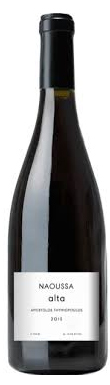

From Naoussa’s highest vineyards at 500m-600m, on rocky granite and schist soils. The vines are an average 25 years old – the fruit from the...
2016
ThymiopoulosNaoussa

Thymiopoulos, Terra Petra, Rapsani, Thessaly, Greece, 2017
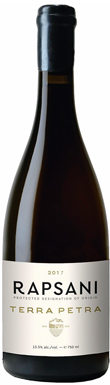
Windswept vineyards between the Mediterranean and Mount Olympus, growing on schist. A different feel to the Naoussa wines and a different style, as the Xinomavro...
2017
ThymiopoulosRapsani
Thymiopoulos, Earth and Sky Xinomavro, Naoussa, Macedonia, Greece, 2017
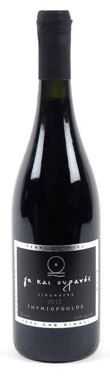
The flagship red from Thymiopoulos, this is a blend of fruit from the best vineyards, from vines around 40 years old. Fermentation with indigenous yeasts...
2017
ThymiopoulosNaoussa
Thymiopoulos, Jeunes Vignes Xinomavro, Naoussa, Macedonia, Greece, 2018
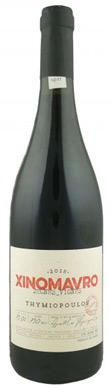
Earth and Sky’s little brother, this is the young-vine approach to the Naoussa vineyards. Zippy, zesty and pure, with notes of local herbs and wild...
2018
ThymiopoulosNaoussa
