
Regional profile: Vinsobres
Producing wines with a level of natural freshness few other regions can match, Vinsobres is as yet overshadowed by its better-known southern Rhône neighbours, discovers Matt Walls.

There are some descriptors in wine that are always considered complimentary. ‘Fresh’ is one of them. Even in mature wines it’s always considered a virtue. So it’s not surprising that claiming freshness as a characteristic of their wines is something many appellations do, including Vinsobres.
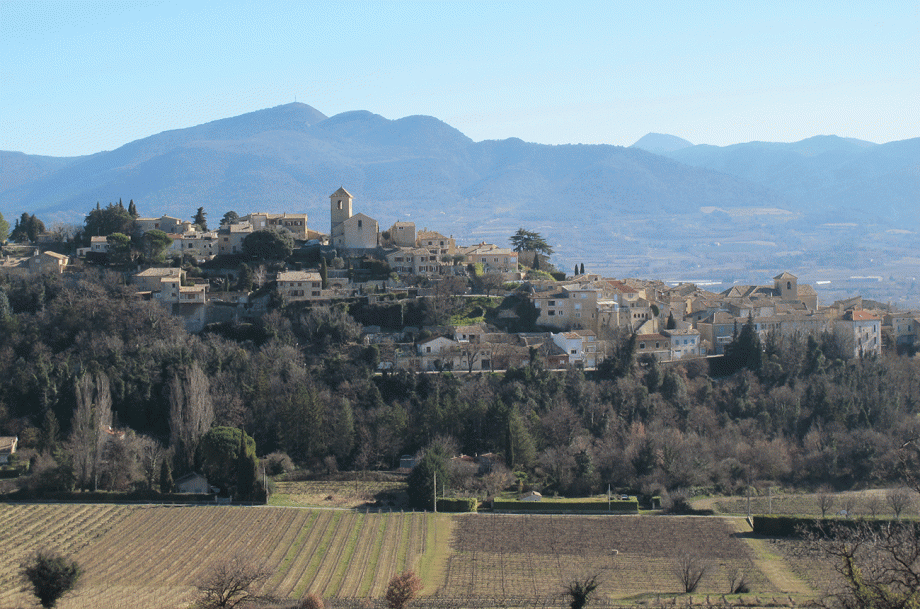
But thanks to its unique natural setting – a northerly location, high altitude and, crucially, wind – its wines genuinely do have an aerial quality rarely found in the southern Rhône. No wonder the canny Louis Barruol of Château de St-Cosme has just bought the 62ha Château de Rouanne there. ‘I’ve always loved the terroir; I’ve always adored Vinsobres,’ he says. ‘It was an opportunity I couldn’t miss.’
What exactly is freshness? Some use the word interchangeably with ‘acidity’, but it’s more complex than that. For a wine to be fresh it does require adequate acidity. But it also needs brightness and definition to its aromatics – add as much tartaric acid as you like to a vat of overripe, jammy wine but it will never be fresh. After these two principal traits, there are other contributing factors: salinity, inner tension and a crisp tannic structure. The best Vinsobres have all of these.
Vinsobres might not be a household name, but it’s counted among the nine cru-level wines of the southern Rhône. At 35km northeast of Châteauneuf-du-Pape, it’s also the most northerly. It traces production back to Roman times, but it was the winter of 1956 that proved a turning point. In the south of France, temperatures dropped below -20°C, the cold accentuated by a fierce northerly Mistral wind that resulted in conditions so severe that many olive trees perished. Vineyards are quicker to establish than olive groves, so local farmers replaced the petrified trees with vines. And its renown began to grow.
‘We are neither north nor south, not totally mountain, not totally plain’ – Cédric Guillaume-Corbin, Domaine La Péquélette
Today the appellation consists of a large, south-facing slope, the quiet village of Vinsobres sitting towards the bottom, near the River Aygues. The terroir is commonly divided into four parts. Les Collines is the hilly, high-altitude land (300m-450m; clay and sand) to the northeast of the village. Le Plateau is a flatter high-altitude section (350m-450m; large pebbles, silt, red clay) to its northwest. The warmer Coteau (250m-350m; clay, sand, pebbles, limestone) is a band that extends east and west from the village. Beneath that is the thin Première Terrasse (200m-250m) that follows the river. Though some of the best wines are grown on the Coteau, most of the local vignerons covet the higher vineyards, where grapes can ripen up to 10 days later than the lowest sites.
Breath of fresh air
Vinsobres’ windy, northerly location and its high-altitude vineyards are the source of its freshness. These factors contribute to a longer, slower growing season that helps conserve acidity and fragrance in the grapes.
Though the Mistral can be destructive, local air currents are generally a force for good. The Pontias is another that’s peculiar to Vinsobres, flowing in from the Prealps to the east. It’s chilly and it visits at night, dropping temperatures and helping to preserve freshness and vibrancy. Syrah grown at the highest altitudes has a florality and brightness that places it somewhere between northern and southern Rhône in style.
These winds help keep vineyard diseases at bay: 30% of the planted area is now organic. Biodynamic viticulture is also growing in popularity. Philippe Chaume of Domaine Chaume-Arnaud converted his estate to biodynamics in 2003, ‘to keep freshness in the wines’, and confirms they now have a higher natural acidity as a result.
Others, such as Cédric Guillaume-Corbin at Domaine La Péquélette have followed his lead. What he likes about this terroir is that ‘we are neither north nor south; not totally mountain and not totally plain’, and he suggests the extensive woodlands interspersed among the vineyards also help. ‘They bring freshness, they transpire. They’re important.’ Instead of planting more vines, he’s planting more trees.
Assertive grip
The freshness of Vinsobres should be considered within the context of the southern Rhône: this is a hot, sunny corner of France growing plentiful Grenache. It has to make up at least half of the blend, whereas Syrah and/or Mourvèdre must equate to at least a quarter – though in practice Syrah is more popular, often between 30%-50% of the blend. There’s not much Cinsault grown here, but it plays a beneficial role, bringing lightness and perfume.
The wines of Gigondas or Châteauneuf are generous and flowing; by contrast the wines of Vinsobres are steely and tensile with a straighter profile. Along with a tremulous acid line they can have an assertive, crisp tannic grip and salinity that deliver quite a physical impact. On higher sites, the fruit flavours push towards red berries, violets and spice and generate a refreshing upward lift. But this being the southern Rhône, some wines can tip into overripeness and unbalanced alcohol levels, particularly in hot vintages.
Pascal Jaume of Domaine Jaume explains that when he worked on promoting the appellation to cru there were four or five producers who made white wines here. Since they lacked a unified style, it was easier to seek the appellation for reds only. But more and more producers are now making whites on Vinsobres terroir, bottled under AOP Côtes-du-Rhône. Some are excellent, particularly those from Chaume-Arnaud and Domaine Vallot, and they represent great value. Jaume hopes that the authorities will give the nod to Vinsobres Blanc within the next decade.
Though the terroir and style of Vinsobres is tight and defined, it takes more than this for an appellation to thrive: it needs a dynamic, collegiate network of winemakers. With new quality-minded estates such as Château MontPlaisir and Domaine Serre Besson joining established names such as Domaine Vallot and Domaine Jaume, there is a growing sense of purpose and energy.
Nonetheless, it takes time to gain visibility and establish a fairly new appellation in the minds of wine-lovers outside the region. ‘It reminds me of Gigondas in the 1990s,’ says Barruol. ‘It doesn’t have a bad image, it’s just unknown outside France – but I believe in it strongly.’ As it attracts more powerhouses such as Château de St-Cosme and the Perrin family, it won’t be long before more wine-lovers get to inhale the particular freshness of this northern eyrie.
Vinsobres at a glance
Southern Rhône cru, 35km northeast of Châteauneuf-du-Pape
AP created 2006
Main grapes (100% still, dry reds): Grenache, Syrah, Mourvèdre, Cinsault, Carignan
Climate: Mediterranean – very sunny, northerly and easterly winds
Surface area: 1,376ha
Annual production: (2018) 16,361hl
Maximum yield: 38hl/ha
Top recent vintages: 2016, 2012, 2010, 2007
Independent wineries (2016): 23
Cooperatives (2016): 3
Exports (2016): 42%
Vinsobres: 10 estates to know
Domaine Vallot-Le Coriançon
After a stage at Château d’Yquem, the energetic Anaïs Vallot has returned to the family domaine to make wine with her father François. The four Vinsobres in their range are all worth trying. Les Hauts des Côtes is about as classic a Vinsobres as you’ll find; L’Exception is made in a richer, more ageworthy style.
Domaine Chaume-Arnaud
Domaine Serre Besson and Domaine La Péquélette both told me how helpful the jovial Philippe Chaume was in establishing their domaines. You couldn’t hope for a better mentor – his vibrant biodynamic Vinsobres cuvées (don’t miss La Cadène) and his white Côtes-du-Rhône all come highly recommended.
Domaine Jaume
Pascal Jaume’s family has been growing vines in Vinsobres since 1905, and he claims it was his grandfather who first planed Syrah here in 1955. Pascal joined the family business in 1981, his brother Richard in 1987; their children represent the fifth generation. They find that managing the 92ha estate without herbicides and pesticides isn’t workable, but they keep them to a minimum. The Altitude 420 represents incredible value for money.
Domaine La Pequelette
It’s impossible to be glum in the company of the beret-sporting Cédric Guillaume-Corbin. He pulled out of the co-op in 2004 to make the most of his biodynamic grapes. His vineyard isn’t big (péquélette means ‘smallest’ in Provençale) but all his wines are full of joy – and so is he.
Domaine Gramenon
Established in 1978, Domaine Gramenon was one of France’s first natural wine estates. Its red wines are mostly produced from parcels of old-vine Grenache around the most northerly reaches of the southern Rhône, and they combine concentration, energy and purity to thrilling effect.
Domaine Constant-Duquesnoy
In 2004, Domaine Les Aussellons sold its 12ha of Vinsobres to Gérard Constant and Denise Duquesnoy; thus, a new domaine was born. Its terraced vineyards are mostly on the plateau, and vines average 30 years old. Fermentation is in stainless steel, maturation in one- or two-year-old barriques, resulting in a taut, highly spiced style of Vinsobres.
Domaine Serre Besson
Californian ex-sommelier Victor Taylor’s ‘active retirement project’ is more challenging than most – it’s creating a new domaine. He bought an existing vineyard in Vinsobres in 2011, converted it to organics and built a gravity-fed winery. His first vintage, the 2016, won Silver in this year’s Decanter World Wine Awards, and his 2017 is even better.
Domaine L’ancienne Ecole
Its cuvée La Dame Anglaise is a clue: Anna Thorburn is English and, together with her Scottish husband, bought the estate in 2006. They admit it has been a steep learning curve, but after constructing a winery, holiday gîtes and restructuring the vineyards, they now do everything themselves. They might be relatively new to the region, but the style is classic Vinsobres.
Chateau Montplaisir
Benoît Chaignon worked in construction but long dreamt of making wine. Eventually, in 2013, he retrained in winemaking and bought some land. He chose Vinsobres, and was lucky enough to purchase some very old vineyards at the top of the plateau. His first two vintages, 2015 and 2016, are both impressive – an estate to follow.
Famille Perrin
The Perrins of Château de Beaucastel in Châteauneuf-du-Pape need little introduction. They’ve long believed in Vinsobres and now own 50ha in the area, 40ha of which sits within the Vinsobres appellation. Their two cuvées are drawn from old vines and farmed according to biodynamic principles. Les Hauts de Julien is a particularly age-worthy parcel selection of 90-year-old vines.
A taste of Vinsobres: Matt Walls’ top 12 wines
Domaine Gramenon, Contre Couleur, Côtes du Rhône, Rhône, France, 2017
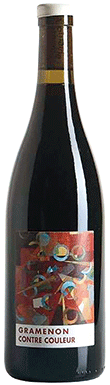

An amazingly forthcoming and vibrant nose that speaks of lilies, blood and iron. Beautiful freshness, minerality and vibrancy on the palate, which is cooling despite...
2017
Domaine GramenonCôtes du Rhône

Famille Perrin, Les Hauts de Julien, Vinsobres, Rhône, France, 2016
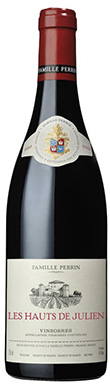
<p>Biodynamic methods, from a parcel of 90-year-old Grenache and Syrah. A whiff of oak spice over the fruit for now. Full, generous, intense, with driving...
2016
Famille PerrinVinsobres
Domaine Gramenon, La Papesse, Vinsobres, Rhône, France, 2016
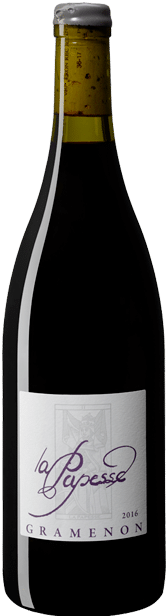
Hand-picked parcel of 60-year-old Grenache. Reductive still – decant six hours before serving. Raw steak and liquorice flavours: full-bodied, dense and tannic but fresh. Very...
2016
Domaine GramenonVinsobres
Domaine La Péquélette, Emile, Vinsobres, Rhône, France, 2017
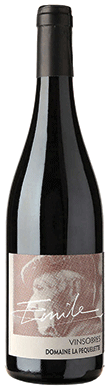
<p>Sumptuous juicy red fruits with enticing hints of peppery spice. Vital, pure and delicious, evolved by a firm sophisticated structure.</p>
2017
Domaine La PéquéletteVinsobres
Domaine Vallot, L’Exception, Vinsobres, Rhône, France, 2015
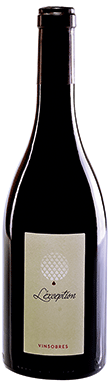
Rich, rounded, generous style of Vinsobres. Intense fruit – plum, black cherry, liquorice – and slightly raised alcohol on the lifted finish. Has great finesse...
2015
Domaine VallotVinsobres
Famille Perrin, Les Hauts de Julien, Vinsobres, Rhône, France, 2004
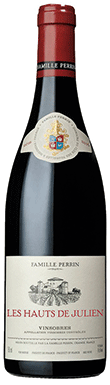
Remarkably fresh still for a 15-year-old Vinsobres, starting to lose fruit a little, but still has lovely tannic grip and a saline edge. Shows how...
2004
Famille PerrinVinsobres
Domaine Chaume-Arnaud, Vinsobres, Rhône, France, 2016
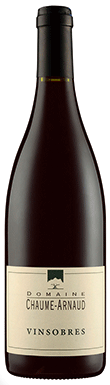
10% Cinsault adds sprightliness and perfume to the red berry Grenache and Syrah aromas. Medium-bodied, fresh and lively, not overly fat or full, with a...
2016
Domaine Chaume-ArnaudVinsobres
Château MontPlaisir, Hauts Galets, Vinsobres, Rhône, France, 2015
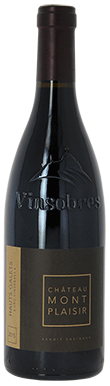
15 months in new demi-muids. Fresh, dense nose, slightly meaty. Very rounded tannins and expressive fruit: vibrant black cherry and blackberry. Pinging acidity and a...
2015
Château MontPlaisirVinsobres
Domaine Serre Besson, Vinsobres, Rhône, France, 2017
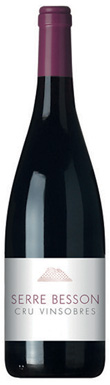
Oak surrounds but doesn’t occlude the berry fruits, fennel and rosemary. Upright and medium-bodied. The acidity is piercing, the freshness palpable. Elegant and so drinkable,...
2017
Domaine Serre BessonVinsobres
Domaine Constant Duquesnoy, Confidence, Vinsobres, Rhône, France, 2016
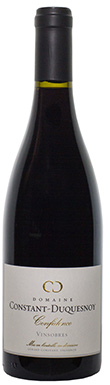
From vines at 350m; matured 12 months in year-old barrels. Vibrant, spicy and fresh. Tight, fine tannins, precise acid line. Rises upwards, an aerial, bright...
2016
Domaine Constant DuquesnoyVinsobres
Domaine l'Ancienne École, L’Essentiel, Vinsobres, Rhône, France, 2015
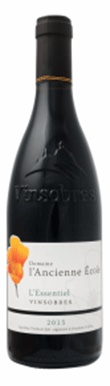
Has a wildness about the aromas, and a lifted palate. Real density and tightness of tannins, coupled with concentrated black fruits and electric inner tension....
2015
Domaine l'Ancienne ÉcoleVinsobres
Domaine Jaume, Altitude 42, Vinsobres, Rhône, France, 2016
Fruit grown up to 420m altitude. Light, aerial, fresh, red-fruited aromas. It’s medium-bodied, with acidity and tight tannins providing drive. A lifted style of southern...
2016
Domaine JaumeVinsobres
