
Rethinking ripeness in Napa Valley: A fresh perspective on the region’s evolution
Ripeness in Napa Cabernet Sauvignon is frequently misunderstood, too often reduced to a question of power or excess. Jonathan Cristaldi spoke with a select group of leading Napa winemakers whose wines challenge that stereotype – and reveal far more nuanced approaches to achieving balance today.
Having tasted extensively across the contrasting 2022 and forthcoming 2023 vintages of Napa Cabernet – the former early-drinking, riper with softer tannins, and the latter a cellarworthy year marked by vivid, fresh fruit and structured tannins – it made me consider the concept of ‘ripeness’
I asked a handful of Napa’s top winemakers to reflect on their approach and perspectives on ripeness in any growing season.
I wanted to know what it means to achieve ripeness today. How do farming choices shape ripening, whether ripeness is measured beyond numbers, and what does it mean in the context of balance?
What emerged was a familiar wine-world paradox: everyone agrees that achieving ideal ripeness – and ultimately a balanced wine – is paramount. Yet no one agrees on any fixed definition of that ideal.
‘The American palate has evolved towards less sweetness and more appreciation for acidity, bitterness, and a diversity of flavours,’ says Julien Fayard, of Fayard Wines, Covert, and Gemstone.
‘Culturally, as the food in our country changes, so do the wines. Napa is following a slower path, but reinventing and re-adjusting itself to better align its wines with what we’re eating today.’
For Aron Weinkauf of Spottswoode, it’s more personal and subjective. ‘I appreciate more subtlety, beauty, and freshness than I did 25 years ago,’ he says, echoing many others interviewed for this article.
Get our daily fine wine reviews, latest wine ratings, news and travel guides delivered straight to your inbox.
Across conversations, the notion of achieving an ideal ripeness reveals no straight line to a target number. Instead, it follows a curving path, with overlaps between freshness and richness, hedonism and restraint, lab numbers and intuition – shaped by farming decisions, soil, vine material, climate, and stylistic preferences.
Evolution of the Napa style
From the higher-acid, tannic, long-lived wines of the 1970s, to the full-bodied, lush, sweet-fruited, richly oaked wines of the early aughts, and back toward a more nuanced middle ground today, the winemakers I spoke with consistently traced Napa’s ripeness conversation to historical planting decisions in the vineyard.
Rebekah Wineburg of Quintessa points to the 1990s as a defining moment: ‘The phylloxera crisis forced wide-scale renewal of vineyards,’ she says, explaining how it brought new clones and rootstocks selected to enhance physiological ripeness and bold flavour development.
At the same time, she continues, winemakers were ‘rejecting the vegetal flavours’ of earlier wines and seeking a style aimed at pleasure and immediate appeal.
By the 2000s, vineyard design and winery tools reinforced that shift. ‘Winemakers were chasing concentration, and the path to it seemed clear: lower yields, later picks, and absolute selectivity,’ Wineburg says. Advances in cellar technology made later harvesting feel safer – and, for a time, stylistically rewarding.
The alcohol fallacy
Rarely was ripeness framed in terms of potential alcohol levels.
Matthew Crafton, President and Winemaker of Chateau Montelena, explains: ‘I’ll see a picking window where the potential alcohol is in a good place, and the flavours are really nice’, explains , ‘but wait a day or two, and those numbers shift, and so do the flavours. You’re not measuring alcohol for balance—you can’t use alcohol as a proxy for ripeness.’
Meanwhile, Jean Hoefliger, of JH Consulting and AXR asserts: ‘You can’t be fooled into thinking a wine should always sit at a specific alcohol level.’
‘One of the greatest wines ever made – the 1947 Cheval Blanc, which came in at 14.4% ABV. Which was over two points higher than was typical for that wine. As for Napa Cab, in the late 1990s and early 2000s, consumer desire for more immediately approachable, pleasurable wine led to picking late, no acid or tannin additions, and ultimately to higher-alcohol, flabbier wines. That trend is now in reverse.’
Weinkauf emphasises how changes in vine material alone have altered ripening dynamics. ‘Today’s vine structure and vine vigour are very different. Trellis and vineyard infrastructures have changed.’
He notes that vertical shoot positioning differs radically from California sprawl or head-trained vineyards, with implications for yield, flavour concentration, and tannin development.
Climate change has added further complexity. Since 2015, Napa has experienced three of its warmest vintages on record. Nile Zacherle of David Arthur Wines argues that growers must adapt structurally, ‘rethinking row orientation and canopy architecture so wines are not shocked by climatic swings’.
Tasting ripeness
Despite access to unprecedented amounts of data, none of the winemakers describe ripeness as something determined solely in the laboratory, either. ‘Ultimately, it still comes down to taste,’ says Celia Welch of Scarecrow fame, and Celia Welch Consulting, with winemakers leveraging data as ‘checkpoints,’ above all else – as Rebekah Wineburg put it.
‘I literally ask myself: Do I want to eat this grape? Is it delicious?’ says grower, winemaker, and winery owner Steve Matthiasson.
As Aron Weinkauf explains, ‘we do measure sugar per berry,’ but he stresses that those numbers are weighed alongside ‘evaluating vine health, watching the weather, and tasting.’
Grapes growing on the vine give tangible cues such as ‘firm clusters versus limp, flaccid ones’, says Zacherle, ‘and a healthy canopy is one that provides dappled sunlight,’ for even-keeled ripening, ‘as harvest approaches.’
Wineburg describes ‘brown flavours’, bruised fruit, and a loss of freshness in grapes that are overripe.
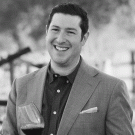
By contrast, Jonah Beer of Pilcrow Wines (pictured above) frames under-ripeness biologically, suggesting that until the vine believes the seed can survive, ‘the vine keeps the acid high and sour’ in grapes.
Farming towards balance
‘Vines are pretty great at adapting to and reading their environment,’ says Weinkauf, ‘but our actions as the farmers can confuse them.’ He avoids early watering and excessive intervention, preferring to ‘guide rather than control’.
Matthiasson describes a season-long approach – cover crops, compost, pruning, shoot thinning, leaf thinning, irrigation – designed to deliver fruit that ‘makes the winemaking job easy’ and improve wine quality ‘without having to harvest later at higher potential alcohol’ (his Cabernet-based wines usually come in around or under 13% alcohol).
Chelsea Barrett talks of site-specific decisions. ‘In high-vigour blocks, we may plant permanent cover crops and [grow] larger canopies’, to control ripening, while ‘in lower-vigour sites, we might drop down to one cluster per shoot’, aiming at finding balance.
Fayard, by contrast, notes that, ‘we have been steadily lowering our alcohol by picking slightly earlier’. He adds that increasing yields at certain sites has improved hang time, slowed sugar loading, and led to ‘lower alcohols and better refined tannins’.
As an example, Fayard cited his Les Vins Julien line of wines, which are made with deliberately lower alcohol levels (as low as 11%).
Pendulums, preferences, and diversity
At a broader level, Napa’s ripeness story follows more of a pendulum swing. From pre-Parker elegance to power-packed Cabernets, now veering back toward a newer version of balance, based on how the growing season shapes a vintage. ‘There is no wrong or right, just diversity of style and taste,’ says Beer.
‘Remember those crazy-ripe Cabernets that had alcohols in the high 16% range?’ asks Welch, echoing Hoefliger that: ‘In recent years, the trend seems to be in the opposite direction.’
Continuum’s Tim Mondavi describes how smarter farming has changed the equation. He says: ‘In the past, we harvested late, in order to ameliorate the harshness of the wines.’
But better farming has allowed him to achieve ideal ripeness earlier in the season, thereby mitigating pressure from potential late-season extreme heat or fire.
‘Harvest is unpredictable,’ says Chelsea Barrett, ‘you make the best decisions you can with imperfect information,’ which is why better farming often comes with some capital-intensive technological improvements.
During the major heat event of 2022, wineries that had spent money to install vineyard misters kept canopy temperatures 15-20 degrees cooler on extremely hot days, thereby limiting sugar spikes and staving off higher potential alcohol levels.
‘We observe various movements – organic, biodynamic, regenerative farming, natural winemaking, on and on – but we do not commit to any single philosophy,’ concludes Fayard. ‘Instead, we prioritise transparency and customising our farming approach to each site.’
Wineburg summarises the collective mood best: ‘Ripeness is important, of course,’ she says, ‘but the intent has shifted.’
And that recalibration – toward balanced wines, expressive of site – suggests Napa Valley will never abandon its signature ripeness so much as refine it, just as regions such as Bordeaux and Burgundy did over generations.

Related articlesHeitz Cellar: Six decades of a Napa Valley icon
Meet the next generation at four legacy Napa Valley wineries
Mining for value in the Napa Valley: Over 20 of the best wines for under $75
Jonathan Cristaldi is a wine writer and critic based in the San Francisco Bay Area. For more than a decade, his articles on wine, spirits and beer have appeared in a host of print and digital platforms, including Decanter, Food & Wine, Departures, The SOMM Journal, Tasting Panel Magazine, Liquor.com, Seven Fifty Daily, Los Angeles Magazine, Thrillist, Tasting Table and Time Out LA among others. When not writing about wine, Cristaldi works as a scriptwriter on film and documentary projects with award-winning commercial photographer and director Rachid Dahnoun.