
Savennières masterclass with Domaine FL
With 30 hectares across the famous Loire appellation, including 5ha in its jewel, Roche aux Moines, Domaine FL is perfectly positioned to talk about what makes Savennières so special.

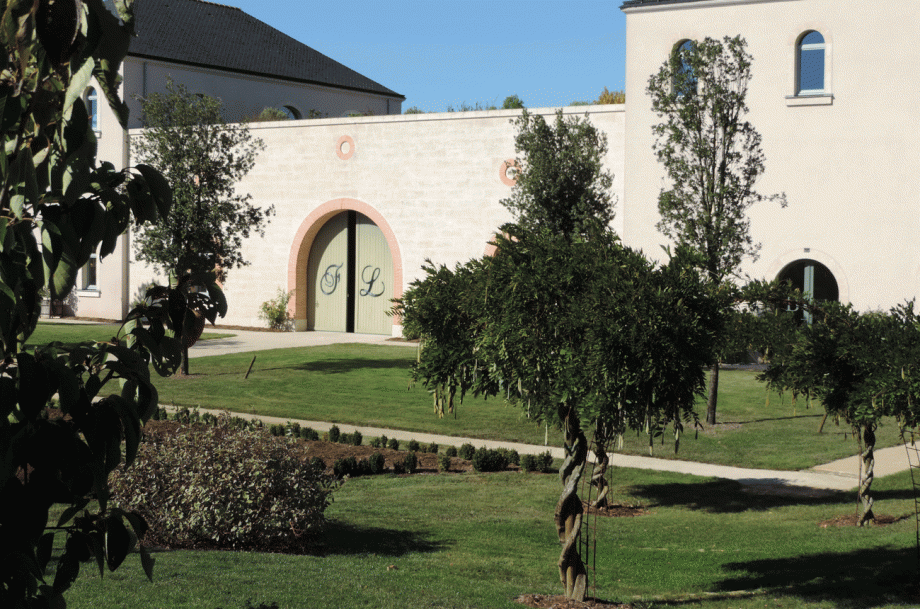
When Philip Fournier Longchamps established Domaine FL by buying two estates in 2006 and 2007, he had a clear vision. Born and raised in Anjou, he and his son Julien resolved to make Savennières that could age for decades, inspired by old vintages in Philip’s father cellar.
Scroll down for tasting notes and scores of six Savennières from Domaine FL
Birth of an estate
Philip, CEO of a telecoms company, acquired and merged two estates, one on each side of the river Loire – Domaine Jo Pithion and Château de Chamboureau – building a winery in 2011 to process the fruit from the 45ha of vineyards, including 30ha in Savennières. (The other holdings are in Anjou, Coteaux-du-Layon and the grand cru Quart de Chaumes.)
The pair work organically in the vineyards, with some plots farmed biodynamically, including the parcel in Roche aux Moines. The aim is to express the terroir to its fullest potential, and consultants in the vineyard (Ludovic Pierrot from Burgundy) and winery (Kyriakos Kynigopoulos, who took over from Stéphane Derenoncourt) focus on plot-by-plot winemaking.
Against malolactic
Vinification is the same across the range of Savennières wines, and so any differences are down to the soils. Everything is done to avoid oxidation and to preserve expression of terroir. The wines are aged in barrel for 12 months, and a further six months in large wooden vats.
The estate chose to eschew malolactic fermentation, in order to preserve acidity and achieve maximum ageing potential. ‘We were wine lovers before becoming winemakers,’ said Julien. ‘Before 1980, almost no one in Savennières used malolactic. We’d tasted and loved older wines that hadn’t undergone malolactic fermentation, and could also see how some newer wines that had were evolving. We wanted wines that would age for a long time – malolactic is usually used to make a wine more accessible at a younger age.’
How it evolves
The pair recommend that you keep their wines for at least three years after the vintage before opening, and five for Roche aux Moines. ‘Savennières is one of the great ageable white styles of France, a conjunction of energy and minerality’ says Julien.
So how do the wines evolve? ‘Like Alsace, our wines become less acidic and more mineral with time. You won’t find oxidation, you won’t find buttery notes, and you won’t usually find petrol notes. It’s more a candied citrus fruit character, perhaps a hint of white truffle.’
Schist is everything
The more schist there is in the soil, the higher the level of acidity and complexity, and the greater the ageing potential, explains Julien. Domaine FL owns 4.8ha of the 22ha total vineyard in Roche aux Moines, and considers it the greatest ‘Savennières terroir. ‘It’s down to the metamorphic rock, which gives massive ageing potential. You can happily keep those wines for 30 years.’
The shallower the soils, the more mineral the wines. The typical characteristic of Savennières is flintiness. But you’ll also find vintage character coming through. ‘Riper vintages such as 2009 might display botrytic aromas, while 2011 would be more about white flowers, and 2012 more aromatic,’ says Julien. ‘In general, you’ll find bright fruit and lemon citrus in riper years, with a confit character in warm vintages and a more electric aspect in fresher years. Acidity and minerality will always dominate, but the exposure of the vineyards also gives the wines a body that balances this.’
Ripe 2018 vintage
Why do the alcohol levels go so high on some of the ‘Savennières? ‘We have to get the right balance between acidity and alcohol,’ replies Julien. ‘It’s never less than 13.5%. Also, 2018 is riper than some other Loire vintages. We have seen some signs of climate change, and that could be a factor, but the alcohols are due more to our winemaking choices.’
The milder conditions in 2018 were welcome after the severe frosts and tiny yields of 2017 (repeated this year when the estate lost around 80% of production). ‘2018 was a vintner’s vintage,’ says Julien. ‘We had a cold winter followed by a damp spring, then a nice summer; so as long as you avoided problems in the spring, then you could enjoy the long ripening period. It ended up being a good balance between quality and yields.’
Savennières at a glance:
- Appellation created: 1952
- Right bank of the Loire river, southeast exposure
- 168ha in production; 38 growers
- Named by the Romans after Vicus Saponaria, meaning ‘place of soap’ after the soapwort, a perennial pink flower which once bloomed along the banks of this part of the Loire
- The appellation sits at the easternmost edge of the Massif Armoricain where it meets the Paris Basin, in short the place where white Anjou (67 million years old formation: marls chalk, limestone and shell beds) meets black Anjou (500 million years: granite, slate and schist). Sandstone was converted to quartzites, compacted limestone.
- Dry Savennières represents 90% of production, with an average yield of 34hl/ha
- Suggested food matches: asparagus; white meat or poultry with cream and lemon; Asian dishes; grilled fish with butter. In general, open the day before drinking.
Savennières to seek out:
Related content
Best new release Loire whites: 2019 and 2020
Best new release Loire reds: 2019 and 2020
Regional profile: Savennières
Domaine FL, Le Parc, Savennières, Loire, France, 2018
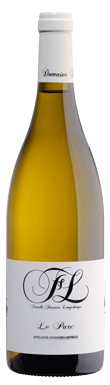

<p>Formerly the ornamental gardens of the Château de Chamboureau, this 2ha walled plot has the same geological formation as the top part of the Coulée...
2018
Domaine FLSavennières

Domaine FL, Chamboureau, Savennières, Loire, France, 2018
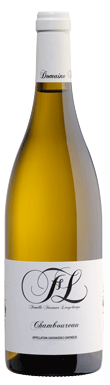
<p>This 1ha plot surrounds the château of the same name, planted on sandy loam soils covering a bedrock of rhyolite and micro-granites. Compared to the...
2018
Domaine FLSavennières
Domaine FL, La Croix Picot, Savennières, Loire, France, 2018
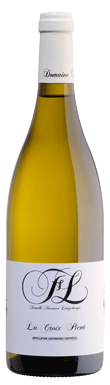
<p>The soils in this 2.4ha plot are sandy clay loam with sandstone and schist; the vines are 15 years old. Slightly less oak ageing than...
2018
Domaine FLSavennières
Domaine FL, La Frémine, Savennières, Loire, France, 2018
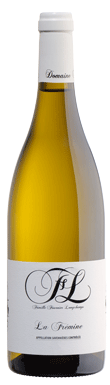
<p>La Frémine is at the bottom of the appellation, where the soils contain more loam, along with sandstone and metamorphic schist. The vines on this...
2018
Domaine FLSavennières
Domaine FL, La Roche aux Moines, Savennières, Loire, France, 2018
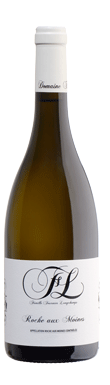
<p>Wow, this is a beast of a wine! The rich style, high alcohol and warmth reflect the character of the vintage and the south-facing exposure...
2018
Domaine FLSavennières
Domaine FL, La Roche aux Moines, Savennières, Loire, France, 2016
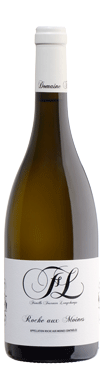
<p>A beautifully balanced vintage, which saw no hydric stress and a long Indian summer, which lends a soft maturity to the wine. Mouthwatering acidity, and...
2016
Domaine FLSavennières
