
Stars of Southern Italy – and the wines to try
With its plethora of native and local grape varieties and an increasing number of skilled and dedicated winemakers, southern Italy’s wine future is looking bright. Michaela Morris showcases some of its leading lights.

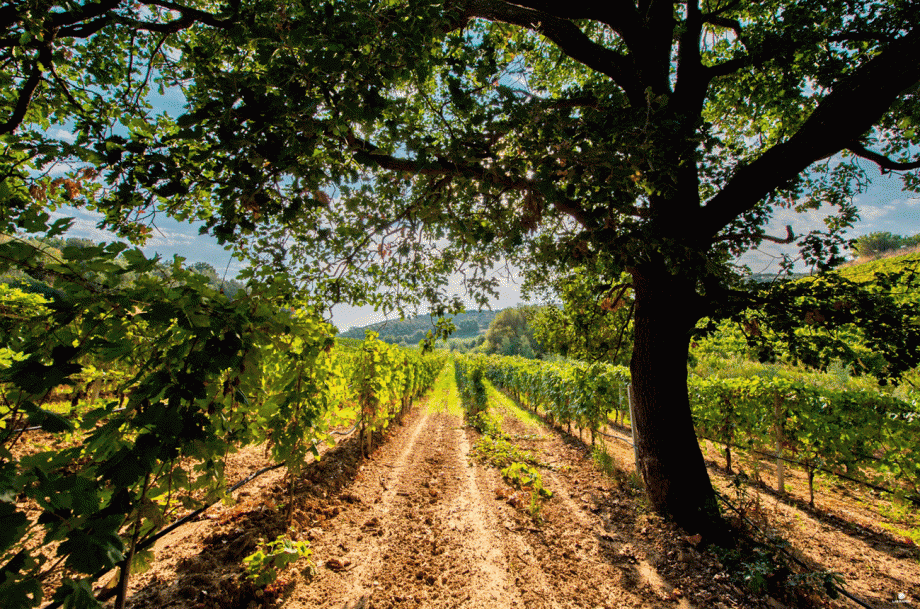
Italy’s deep south has long been smouldering in the shadows of the country’s celebrated wines from further north. After flashes of greatness over the years the area has now reached a critical mass of top-quality wines. Sure, certain pockets still lag behind, but a revolution has been set in motion. Greater care in the vineyard and skilled winemaking are showing southern Italy’s grapes in their finest light.
The south is undoubtedly most associated with reds. Nerello Mascalese in Etna is synonymous with terroir-driven wines, and Aglianico provides some of Italy’s most age-worthy offerings. The latter continues to dazzle in Campania, while in neighbouring Basilicata, cleaner winemaking and more discriminating oak use is proving to be Aglianico’s merit. Lesser-known Uva di Troia in Puglia and Carignano in Sardinia are equally exciting, and long-forgotten varieties such as Magliocco in Calabria and Tintilia in Molise are waiting in the wings.Somewhat surprisingly for these southerly latitudes, the area also offers a hit list of fresh, flavourful whites. In Sicily, Grillo is on the rise, showing its crisp, dry, herbal side, and Etna’s racy, minerally Carricante continues to soar. Over in Abruzzo, Pecorino is making a rich and textural name for itself while Bellone could be Lazio’s future champion.Finally, the south provides ample hunting ground for some of Italy’s best rosatos. Unlike Provence’s pale rosés, they are often darker and packed with unique character. Look for Abruzzo’s Cerasuolo made from Montepulciano, Bombino Nero and Negro Amaro-based pinks of Puglia, and Gaglioppo in Calabria. If south Italy’s wines are riding high today it is thanks to the efforts of its top producers.Many are pioneers who saw potential before actual proof. Their research and endeavours have benefited the region – not just their own wineries. Others are leaders in sustainable, environmentally responsible practices.
Beyond the trustworthy veterans, a growing number of more recently established producers are vying for superstar status. These up-and-comers have impressed with early efforts and are harbingers of Italy’s bright wine future.
What unites them all is their immense pride for their respective regions. They give value to native and local grapes and are guardians of Italy’s rich vinous treasures. And they are making delicious wines of course.
Sicily: Planeta
Diego Planeta comes from a long line of farmers. His father was one of the founding members of the respected Settesoli cooperative in 1958. Diego acted as president for four decades and under his leadership Settesoli was one of the first Sicilian wineries to start bottling and exporting wines rather than selling in bulk.
In 1985, he planted vineyards for his own private estate. The first wines were released a decade later with the help of his daughter Francesca and nephews Alessio and Santi.
Planeta initially made its name crafting premium examples of Chardonnay and Syrah. ‘International varieties helped get our foot in the door,’ Francesca explains. At the same time, they were experimenting with native grapes such as Nero d’Avola, Frappato and Nerello Mascalese. Today, Planeta is restoring forgotten cultivars such as Vitraruolo, Lucignola and Catanese Nera in Mamertino.
Planeta’s 395ha are spread across five zones in Sicily. ‘Our energies are concentrated in a development that goes deeper and deeper in the study and interpretation of the different terroirs,’ says Alessio. A pilot winery for Italian programmes SOStain and VIVA Sustainability and Culture, Planeta has also completely eliminated chemical fertilisers, herbicides and insecticides, lowered emissions, reduced water use and introduced recycled packaging.
Lazio: Marco Carpineti
I first tried Marco Carpineti’s Moro Bianco at Rome’s popular Enoteca Cavour 313. Based on the obscure Greco Moro grape (of which very little is known), it was a dense, flavourful and nuanced white – the antithesis of the Frascati-esque wines I’d been quaffing by the carafe.
I’ve been stalking Carpineti’s wines ever since. The property is located in the Cori area south of Rome, in the foothills of the Lepini Mountains. Vineyards sit on volcanic soil at 200m-400m. Carpineti took the reins of his family’s estate in 1986. He converted the now 41ha to organic viticulture in 1994 and more recently adopted biodynamic practices.
Carpineti’s respect for the environment is matched by his dedication to the area’s local grapes. He is leading Lazio’s quiet revolution in that regard. Besides Greco Moro, he has contributed to the recovery of Bellone, as well as the red grape Nero Buono. Convinced of the potential of these latter two, he also uses both to produce traditional method sparkling wine under his Kius label. And in 2015, he introduced Nzù, an amphora-aged Bellone. Its red counterpart crafted with Nero Buono will be released early next year.
Abruzzo: Valentini
Of Spanish descent, the Valentini family has been growing grapes in Abruzzo since the 17th century. Edoardo Valentini started bottling in 1956 and developed a cult following for his anomalous wines. Since his death in 2006, Edoardo’s son Francesco has followed closely in his footsteps.
Francesco describes himself as an artisan, rather than a natural winemaker. ‘The more you try to correct things in the winery, the more you lose the true character of the land,’ he declares. The wines ferment spontaneously with indigenous yeast and age in large Slavonian oak casks dating back to the late 1700s. He lets his wines decide when they should be released. ‘Like people, some mature later, others earlier,’ he says.
Valentini only makes three wines, and not every vintage. The Trebbiano d’Abruzzo is one of very few in the region featuring the tragically scarce Trebbiano Abruzzese grape (most are made with Trebbiano Toscano). Remarkably ageworthy, it should be in every serious white wine collector’s cellar. The Cerasuolo and Montepulciano are first rate too.
Sitting in Valentini’s Victorian-era salon with liveried house help, one is transported to a bygone age. The wines are equally old-fashioned, yet not dated. Instead, in a world of immediate gratification and generic look-alikes, they are as refreshing as they are fascinating.
Campania: Mastroberardino
Without a doubt the iconic Mastroberardino winery is responsible for putting Campania on the wine map, particularly the area of Irpinia, which encompasses the revered DOCGs of Taurasi, Fiano di Avellino and Greco di Tufo.
While the winery wasn’t legally registered until 1878, the Mastroberardino family has been making wine since the mid-1700s. After returning from World War II, Antonio Mastroberardino found the property in shambles. He set about restoring it, as well as native grapes Aglianico, Greco and Fiano – essentially saving them from extinction. Following a devasting earthquake in 1980, he took the opportunity to update the winery, introducing modern technology that was (and still is) used judiciously to bring out the best of the region’s grapes.
For many years, Mastroberardino was the only quality name in Campania. Today, there are many top producers. But Mastroberardino continues to make excellent wines under the direction of Antonio’s son Piero. His newest wine, Stilèma Fiano di Avellino, epitomises the potential and ageworthiness of Fiano.
Nevertheless, Mastroberardino’s Taurasi Radici remains the winery’s flagship and has established Aglianico in the trifecta of Italy’s noble reds alongside Nebbiolo and Sangiovese.
Basilicata: Cantina di Venosa
Cantina di Venosa has long played a crucial social role. While the hillsides planted to Aglianico del Vulture were substantially abandoned, this cooperative provided an income for growers who remained; essentially keeping the area alive. Established in 1957 with just 27 members, it now boasts around 350 members farming 800ha and makes 1.5 million bottles per year.
Like many wineries in Campania and Basilicata, Cantina di Venosa had to rebuild after the massive earthquake of 1980. It continued to produce bulk wine and didn’t start bottling until 1990. Today, reds account for 98% of its output and it is responsible for 70% of all Aglianico del Vulture.
Luigi Cantatore has been winemaker here since 2003. Despite the focus on reds, he is an advocate for Basilicata’s whites. Under his guidance and encouraged by Ian D’Agata, Italy’s foremost expert on native Italian grape varieties, Cantina di Venosa has revived Malvasia Bianca di Basilicata. ‘Now there are at least six producers vinifying a monovarietal Malvasia Bianco di Basilicata,’ estimates Cantatore. Aromatic, with great potential for complexity, it offers an indigenous white counterpart to Aglianico.
Puglia: Rivera
The de Corato family is deeply rooted in the high plain of the Murgia hills just inland from the charming fishing town of Trani. For three generations they have owned and run the Rivera property. ‘Carlo joined his father in 1970,’ says Sebastiano de Corato, speaking of his father. Carlo turned his attention to the Rosso Stravecchio, an aged red that eventually became Il Falcone, the winery’s flagship. ‘It was probably southern Italy’s first branded wine,’ Sebastiano speculates. Dominated by the local Uva di Troia (also known as Nero di Troia), Il Falcone is an important wine not just for Rivera but for the denomination of Castel del Monte. Its success contributed to the upgrade to DOCG for the Riserva in 2011.
Rivera also crafts two distinct rosés from Bombino Nero. Equally delicious is its Marese Bombino Bianco, which belies its warm southern home with lightness, zip and modest alcohol. Despite the connection with Castel del Monte, Rivera also works with Primitivo and Negro Amaro from the southern reaches of the Salento peninsula.
Beyond the quality of Rivera’s wines, it is de Sebastiano’s knowledge and enthusiasm for Puglia that makes this property such a great ambassador for the region.
Calabria: Librandi
Calabria’s largest winery, the family-owned Librandi makes 200,000 cases a year. On a global scale this isn’t enormous and hints at how limited wine production in Calabria is.
Librandi’s efforts, however, are far from insignificant. The winery traces its history back to 1953 when Raffaele Librandi planted 6ha at the Ponta Duca Sanfelice estate in the hills between the Sila mountains and the Ionian coast. Now in the hands of Raffaele’s grandchildren and great-grandchildren, Librandi counts 232ha across six properties.
While international varieties such as Cabernet Sauvignon helped introduce the wines to export markets in the late 1980s, the estate focuses on native varieties. Being centred in the Cirò DOC, Librandi has conducted extensive research on Gaglioppo and worked with Piedmont consultant Donato Lanati to bring some refinement to this oft-rustic grape. Lanati has also assisted Librandi with the revival of white Mantonico and red Magliocco.
Librandi’s path has paved the way for other producers. Nevertheless, according to third-generation Paolo Librandi: ‘The market still does not have a clear idea of what Calabrian wine is.’ For him, the next frontier is marketing the region’s great diversity of varieties and terroirs. ‘This goal can only be reached if we all work together,’ he declares.
Etna: Girolamo Russo
When Girolamo Russo died in 2004, his son Giuseppe returned to his home in Passopisciaro. On the northern slopes of Mount Etna, the property included 15ha of vines. While his father had sold the grapes to the local cooperative, Giuseppe decided to make wine.
A classically trained pianist and professor of Italian literature and Latin, Russo had no formal wine background. He sought advice from neighbours including Andrea Franchetti of Passopisciaro and Frank Cornelissen, and hired consulting oenologist Emiliano Falsini, with whom he still works today.
Despite the radical career change, Russo is clearly at home in the vineyards – the same ones he accompanied his father in as a young boy. Gnarly old bush vines of Nerello Mascalese with the occasional Nerello Cappuccio emerge out of the black volcanic soil, sometimes lost in the tangle of wild flowers amid the hypnotic buzz of honey bees.
Russo has farmed organically since taking over the vineyards. He vinifies each plot separately to capture Etna’s diverse terroir, releasing small quantities of three crus: Feudo, San Lorenzo and Feudo di Mezzo. His ’a Rina label is a blend from younger vines of the three, as well as the first-picked grapes of the older vines. Russo’s wines are as expressive as he is soft spoken, demonstrating their intricacies with precision.
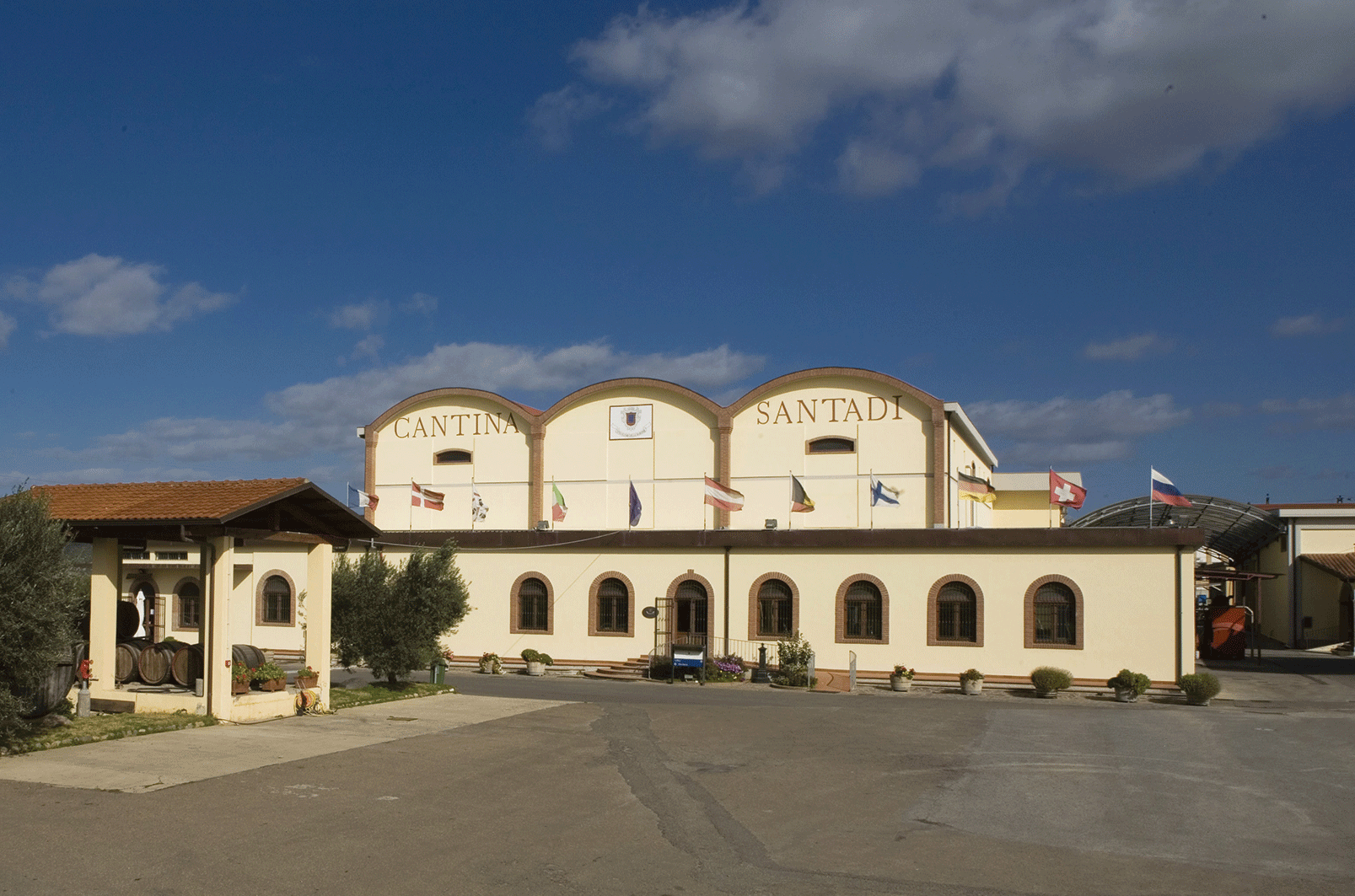
Sardinia: Santadi
When I visited, the cooperative’s president, Antonello Pilloni, was eager to show me the barrel room. Understandable as Santadi’s – and Pilloni’s – pride is producing Sardinia’s first barrique-aged wine. The 1984 Terre Brune was released in 1988. I, however, wanted to visit the vineyards, and Pilloni graciously acquiesced. In the southwestern corner of Sardinia, the region of Sulcis is something to behold. This is Carignano country and the area’s old vines grow on sandy soil a stone’s throw from the intense blue sea.
Pilloni has been president of the co-op (which now counts 200 members cultivating 600ha) since 1976. ‘It’s like a marriage – you have to love what you do. Without this, there is no longevity,’ says the octogenarian.
Until the 1980s, Cantina Santadi was producing primarily bulk wine. But Pilloni had greater aspirations. He sought out oenologist Giacomo Tachis, who was employed by Antinori. Tachis helped Santadi’s growers modify viticulture to favour quality rather than quantity. He worked with the co-op until 2011. Though Tachis died in 2016, his soul and influence are still palpable at Santadi.
Besides flagship wine Terre Brune, the co-op offers a range of excellent value bottlings. The philosophy here is that everyone has the right to drink well, even those who can’t spend a lot.
Sardinia: Argiolas
Probably Sardinia’s best-known winery, Argiolas has been instrumental in raising quality on this underrated island. Early credit goes to Antonio Argiolas, who took over his father’s property in 1938. While he gave value to Sardinia’s traditional grapes, he also sought out the latest technology to improve winemaking. ‘Even when he was 100, he was still thinking about what to do next,’ says his granddaughter Valentina Argiolas, who now runs the property with her sister Francesca and cousin Antonio Jr.
The new generation continues to champion Sardinia’s library of grapes. Experimental vineyards study various biotypes of Cannonau, Vermentino, Bovale Sardo, Monica and more. Argiolas is also responsible for reviving the white grape Nasco, and partial sales of its Iselis label help fund a school in Africa. Ongoing research and development includes methods to reduce water usage, lower sulphur dioxide additions and implement chemical-free solutions to control pests and weeds.
Like Santadi, Argiolas benefited immensely from working with consultant Giacomo Tachis. He helped create Turriga in 1988 and brought talented oenologist Mariano Murru on board in 1992. Over a vertical of Turriga going back to the inaugural vintage, Murru explains: ‘It was born from a dream to make a wine that could stand the test of time.’ A rarity in Sardinia at the time, it remains one of the island’s top wines.
Ones to watch: Southern Italian wineries to seek out
Lazio: Casale Del Giglio
Casale del Giglio was fashioned as an experimental vineyard with 57 different grapes. ‘I’ve learned more from the varieties that haven’t worked than from the ones that have,’ asserts winemaker Paolo Tiefenthaler. Rather than making a distinction between international and indigenous varieties, he simply focuses on those that have an affinity with the Agro Pontino area. Petit Manseng and Syrah co-exist happily with Lazio’s native Bellone and Cesanese.
Abruzzo: Tiberio
Siblings Cristiana and Antonio Tiberio work solely with a massal selection of Abruzzo’s native grapes. ‘They represent the original genetic patrimony with distinct flavours of the region,’ says Cristiana. Her meticulous yet hands-off winemaking translates into impeccable wines, from the Cerasuolo (a dark and serious yet charming rosato) to the single-vineyard bottling Fonte Canale, crafted from 60-year-old Trebbiano Abruzzese vines.
Campania: San Salvatore 1988
Harbouring fond memories of his childhood spent among the vines, successful hotelier Giuseppe Pagano decided to create his own winery. He chose the Cilento National Park in the southern stretches of Campania, where water buffalos roam and ancient Greeks first cultivated vines. After planting Fiano, Greco and Aglianico on virgin land and hiring consulting winemaker Riccardo Cotarella, Pagano released his first wines from the 2009 vintage.
Basilicata: Elena Fucci
On completing oenology studies in 2000, Elena Fucci started making wine from her family’s 6ha. It was either that or sell the vineyard that her grandfather planted in the 1960s. She couldn’t bear to do the latter. It was a brave decision, as much of her generation (including her two sisters) were seeking opportunities elsewhere. Her commitment to Vulture has paid off for the denomination as a whole.
Puglia: Morella
Roseworthy graduate Lisa Gilbee left Australia to explore the wines of Italy. After falling for Pugliese Gaetano Morella, the couple launched the Morella label in 2001. Set on salvaging Puglia’s precious old bush vines, they have amassed 17ha, nurtured with organic and biodynamic practices. Their top bottling is a toss-up between the astonishingly elegant La Signora Primitivo and the fantastically unabashed Old Vines.
Calabria: ‘A Vita
While Francesco de Franco’s quick smile recalls the laid-back sunny south, his wines are anything but easy going. He captures the true essence of the idiosyncratic Gaglioppo grape in both his Cirò rosso and rosato without making any apologies for it. His first vintage was 2008 and he produces a mere 20,000 bottles from his family’s 8ha, which have always been farmed organically.
Sicily: Le Casematte
Faro is an up-and-coming region in the far northeast of Sicily. Steep, terraced vineyards look out over the Strait of Messina towards Calabria, reaching altitudes of 500m. One of only a handful of wineries here, Le Casematte was founded in 2008 through the unlikely union of accountant Gianfranco Sabbatino and ex-footballer Andrea Barzagli. With help from consulting winemaker Carlo Ferrini, early results are promising.
Sardinia: Antonella Corda
When wine is in your blood it’s difficult to ignore its pulse – at least for Antonella Corda, granddaughter of Antonio Argiolas (late patriarch of Argiolas). After studying agronomy and winemaking management, Corda took over her mother’s 40ha property and established her own label. Working with renowned consultant Luca d’Attoma she crafts two Vermentinos (one aged in amphora), a mouth-cleansing Nuragus and a juicy Cannonau.
Southern Italian Wines: Michaela Morris’ top picks
Girolamo Russo, San Lorenzo, Etna, Sicily, Italy, 2016

<p>The highest of Russo’s crus at almost 800m, this is the most muscular and ageworthy wine, from 100% Nerello Mascalese. Smoky tobacco leads to stony...
2016
Girolamo RussoEtna

Morella, Old Vines Primitivo, Salento, Puglia, Italy, 2015
From vines pushing a century old, 14 months’ ageing in new French barriques lends integrated sweet baking spice to black cherry, prune and red liquorice....
2015
MorellaSalento
Elena Fucci, Titolo, Aglianico del Vulture, Basilicata, Italy, 2015
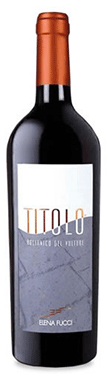
Elena Fucci crafts one single wine. The piercing and focused Titolo exudes incense, violet, dark earth and black cherry. Volcanic soil translates with vibrant energy....
2015
Elena FucciAglianico del Vulture
Mastroberardino, Radici Riserva, Taurasi, Campania, Italy, 2012
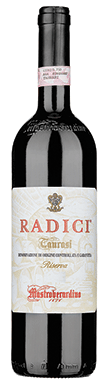
Produced since 1986, Radici hails from the highest part of Mastroberardino’s Montemarano vineyard at 550m. A savoury rather than fruity Aglianico with plenty of substance...
2012
MastroberardinoTaurasi
Rivera, Puer Apuliae, Castel del Monte, Puglia, Italy, 2014
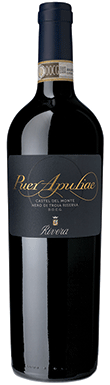
This single-varietal Uva di Troia was launched in 2000 after extensive clonal research. Gorgeously expressive juniper, heather, black olive and lavender on a sinewy frame....
2014
RiveraCastel del Monte
Cantina di Venosa, Carato Venusio, Aglianico del Vulture, Basilicata, Italy, 2012
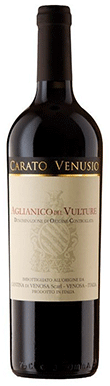
Made from low-yielding vines aged 50 years or more. Gorgeously expressive nose of rose and fennel with toasted oak (18 months’ ageing) in the background....
2012
Cantina di VenosaAglianico del Vulture
Cantina Santadi, Terre Brune, Carignano del Sulcis, Sardinia, Italy, 2015
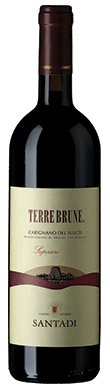
An ode to Sulcis’ ungrafted old Carignano vines. Scents of anis, bay leaf and dried broom reveal slowly, then crushed stone and concentrated black plum...
2015
Cantina SantadiCarignano del Sulcis
Marco Carpineti, Kius Nero Buono Extra Brut, Lazio, Italy, 2015
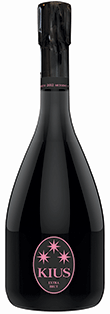
A distinctive, organic traditional-method sparkler from the Nero Buono grape, aged three years on lees. Saline and tangy with dried herbs and smoky flintiness. Sumptuous...
2015
Marco Carpineti
Casale del Giglio, Faro della Guardia Biancolella, Ischia, Lazio, Italy, 2018
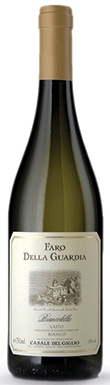
Long cultivated on Campania’s island of Ischia, Biancolella is a recent import to Lazio. Here flavours of pink grapefruit, passion fruit, apricot and honey are...
2018
Casale del GiglioIschia
Tiberio, Pecorino, Abruzzo, Italy, 2018
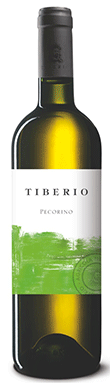
Cristiana Tiberio planted out Pecorino from just five old vines discovered in her vineyard. Sage and lemongrass aromas meet custard apple, winter melon and green...
2018
Tiberio
San Salvatore 1988, Pian di Stio Fiano, Paestum, Campania, Italy, 2017
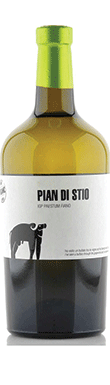
Besides following organic and biodynamic practices, San Salvatore encourages biodiversity and has installed photovoltaic panels to generate electricity. This beautifully focused and limpid Fiano sports...
2017
San Salvatore 1988Paestum
Argiolas, Turriga, Isola dei Nuraghi, Sardinia, Italy, 2014
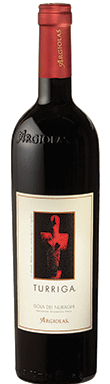
Bovale Sardo, Malvasia Nera and Carignano give an extra boost of fruit and structure to Sardinia’s flagship Cannonau. Opens exuberantly with cola and sassafras. Richly...
2014
ArgiolasIsola dei Nuraghi
Planeta, Cerasuolo di Vittoria, Sicily, Italy, 2017
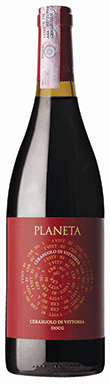
No oak to compete with the Nero d’Avola and Frappato fruit: raspberry, strawberry and red plum notes burst forth, rosehip and fennel add nuance....
2017
Planeta
Librandi, Efeso, Val di Neto, Calabria, Italy, 2016
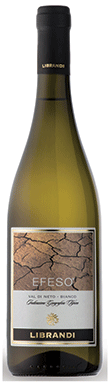
100% Mantonico Bianco. Discreet pineapple, melon and rosewater aromas. Fermentation and ageing in barriques on the lees adds hints of raw cashew, vanilla and a...
2016
LibrandiVal di Neto
’A Vita, Rosato, Cirò, Calabria, Italy, 2018
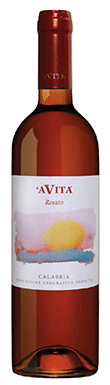
After a 12-hour skin maceration, free-run Gaglioppo juice is fermented spontaneously then aged on the lees for nine months. Orange-hued and slightly hazy, with quince...
2018
’A VitaCirò
La Casematte, Faro, Sicily, Italy, 2015
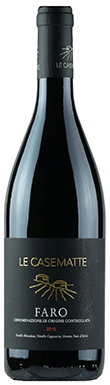
Nerello Cappuccio, Nocera and Nero d’Avola are blended seamlessly with Nerello Mascalese. Notes of orange peel and pomegranate lift blueberry and leather while powdery tannins...
2015
La CasematteFaro
Antonella Corda, Cannonau di Sardegna, Sardinia, Italy, 2017
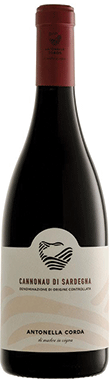
Cannonau’s pomegranate and blood orange mingle with red berries, while the small dose of Syrah imparts a peppery, floral character. Crunchy, bright and elegant. Chill...
2017
Antonella CordaCannonau di Sardegna
