
The thrilling diversity of Alto Adige including eight spectacular wines to seek out
At the Decanter Italy Experience in London, Michael Garner introduced eight excellent wines from Alto Adige to showcase the viticultural diversity of the area, including some of Italy's most highly regarded wines.


Alto Adige is a tiny region in north Italy, with fewer than 6,000 hectares under vine accounting for less than 1% of Italy’s total wine production. Yet at least 20 different grape varieties grow in these spectacular Alpine vineyards, ranging from 200 to over 1,000 metres above sea level.
Scroll down to see tasting notes and scores for the eight Alto Adige masterclass wines
The near-perfect climate for viticulture enjoys nearly 2,000 hours of sunshine, with adequate rainfall (approximately 800mm per annum). Cold down-slope winds from the high Alps to the north are mitigated by warm, early evening breezes blowing up from the south across Lake Garda, ensuring excellent ventilation for the bunches. Crucially, extreme temperature fluctuations between warm days and cool nights prolong the ripening process as harvest approaches, allowing the fruit’s aromatic precursors to develop to their full potential.
A change of focus
Today, almost two-thirds of the wine produced in Alto Adige is white, whereas 40 years ago, reds made up almost 80%. In the 1970s and ‘80s, the native red variety, Schiava (aka Vernatsch; Trollinger) dominated, covering nearly 70% of the land under vine and producing light, often innocuous bulk reds from over-cropped fruit for the traditional markets of Austria and southern Germany over the Brenner Pass.
That figure has now dropped to just 9% – unable to compete in terms of quantity with other Italian regions, the Alto Adige’s quality revolution over the last few decades has seen Schiava widely uprooted in favour of premium white varieties. The region’s wineries, prompted by the local agricultural institute at Laimburg, decided there was simply no room any longer for anything less than excellence given such rarified growing conditions.
Matching the right varieties to the right sites in terms of altitude, exposure and soil composition became the guiding light, with the aim of making limited quantities of the premium wines that the vineyards are clearly best suited to.
Average holdings of less than one hectare are distributed amongst some 5,000 growers, many of whom choose to supply the region’s cooperatives, who lead the way in terms not only of quantity but, perhaps surprisingly, quality too. Meanwhile, smaller cellars are beginning to flex their muscles and grower/negociant wineries like Haas, Lageder and Tiefenbrunner are more than holding their own. Competition is for once a sign of good health; the rivalries stimulating and largely friendly thanks to a common goal.

The Decanter masterclass
This masterclass was designed to illustrate the extraordinary variety and the consistently high standards the wines of Alto Adige achieve. The first wine, Pinot Grigio from the Klausner vineyard located in the Punggl area of Magre, showed the value of adopting an uncomplicated approach to winemaking: inert containers only (stainless steel and glass) for fermentation and storage showcased the grape’s pristine fruit aromas and flavours; a marriage of freshness and opulence balanced by the stony, mineral notes that are the true hallmarks of the region’s wines.
The next three wines, made following more ambitious cellar methodology including wood fermentation and ageing, showed the extraordinary ageing potential that is common to many of the region’s whites. The iconic white variety is Pinot Bianco, and Limes – from a vineyard lying at around 600m above the village of Appiano – showed the structure and intensity that promise greatness to come over the next 10 years.
Müller Thürgau, frequently dismissed as a minor variety, from the Feldmarschall vineyard at 1,000m above sea level shattered that misconception with its staggering breadth of spicy and herbal-toned aromas and exquisite balance.

The final dry white was another trailblazer. Most of the region’s wines are produced as single varietals but Terlano, from vineyards surrounding the volcanic crater where the village lies, is a blend of Pinot Bianco, Chardonnay and Sauvignon Blanc; the three grapes most commonly planted locally. This wine is the prototype for the increasingly popular trend of using blends to interpret the individual terrains of the various subzones, rather than focusing on the characteristics of single varieties.
Wines five and six showed what the Adige does best with red grapes: G’Schleier, from old Schiava vines (including some majestic centenarians), and a Pinot Nero from the reputed, west-facing Mazzon area on the river’s left bank, were lighter-bodied wines of real style and balance.
The final red was from the native Lagrein variety, and a very different proposition: a deeply coloured, ripe full-bodied wine from the Taber vineyard that is the ideal match for hearty mountain dishes.
To complete the tasting, Epokale, a late-harvested Gewürztraminer, has undergone a truly inimitable ageing process, spending a period of no less than six years four kilometres inside the mountain in a disused silver mine. It proved to be well worth the wait, and for anyone with enough patience, it will continue getting better and better.
Alto Adige’s diversity in eight wines:
Related articles
- Cantina Tramin’s Epokale: No imitators
- Expert’s choice: Premium Pinot Grigio
- Alto Adige for winelovers
Cantina Tramin, Epokale, Alto Adige/Südtirol, Trentino-Alto Adige, Italy, 2016
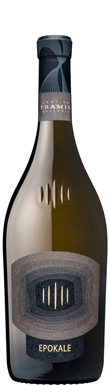

From low-yielding (28 hl/ha) Gewürztraminer vines grown on two plots close to the Nussbaumer estate at Söll and harvested late, at the end October, Epokale...
2016
Cantina TraminAlto Adige/Südtirol

Cantina Terlano, I Primo Grand Cuvée, Alto Adige/Südtirol, Terlaner, Trentino-Alto Adige, Italy, 2018
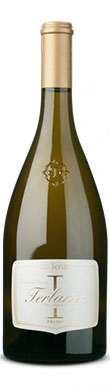
An unabashed attempt to create a white wine with the stature of Le Montrachet, Primo Grand Cuvée is a masterpiece. It has astonishing freshness still:...
2018
Cantina TerlanoAlto Adige/Südtirol
Ignaz Niedrist, Limes Weissburgunder, Alto Adige/Südtirol, Trentino-Alto Adige, Italy, 2021
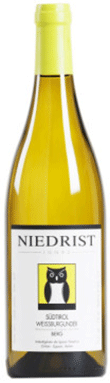
The wine shows impressive concentration of yellow stone fruit flavours backed up with racy acidity. The subtle oak notes of barrel fermentation intermingle with heady,...
2021
Ignaz NiedristAlto Adige/Südtirol
Tiefenbrunner, Feldmarschall von Fenner, Alto Adige/Südtirol, Trentino-Alto Adige, Italy, 2020
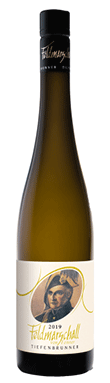
Feldmarschall shows a scintillating breadth of aromas which hint at jasmine, nutmeg and green tea, along with subtle seasoned oak notes. The palate is nimble...
2020
TiefenbrunnerAlto Adige/Südtirol
Kobler, Klausner Grauer Burgunder, Alto Adige/Südtirol, Trentino-Alto Adige, Italy, 2022
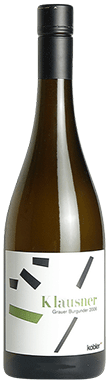
A wine of tremendous freshness and purity, rich in ripe orchard fruit flavours with a dry, mineral-toned finish of notable length. Armin Kobler uses inert...
2022
KoblerAlto Adige/Südtirol
Girlan, Gschleier Alte Reben Vernatsch, Alto Adige/Südtirol, Trentino-Alto Adige, Italy, 2021
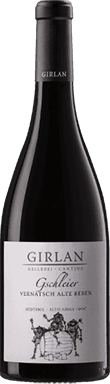
Red berry fruit flavours are enhanced by subtly smoky and savoury notes with a hint of violets; crisp acidity gives the wine real vitality and...
2021
GirlanAlto Adige/Südtirol
Kellerei Bozen-Cantina Bolzano, Taber Lagrein Riserva, Alto Adige/Südtirol, Trentino-Alto Adige, Italy, 2021
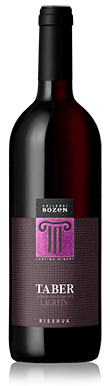
From 80-year-old pergola trained vines Taber shows the classic, almost impenetrable deep blackberry red colour so typical of the variety. Blackberry and sloe fruits dominate...
2021
Kellerei Bozen-Cantina BolzanoAlto Adige/Südtirol
Gottardi, Mazzon Blauburgunder, Alto Adige/Südtirol, Trentino-Alto Adige, Italy, 2019
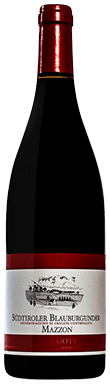
93
A plump and stylish red with ripe red berry fruit flavours and good acidity. Mazzon, lying across the river Adige from Cortaccia, faces due west and is the region’s most prized area for Pinot Nero. Shaded in the morning, the Gottardi vineyards benefit from the afternoon sun and cool nighttime temperatures to maintain an even ripening process. Whole-bunch fermentation and ageing for 12 months in French oak. Sadly, Alexander Gottardi passed away in 2022 and his daughter, Elisabeth has now taken up the reins.
2019
GottardiAlto Adige/Südtirol
