‘Biggest ever’ Canadian Icewine harvest begins

Get our daily fine wine reviews, latest wine ratings, news and travel guides delivered straight to your inbox.
You are now subscribed
Your newsletter sign-up was successful
The Canadian Icewine harvest has begun – in temperatures plummeting to minus 35C.
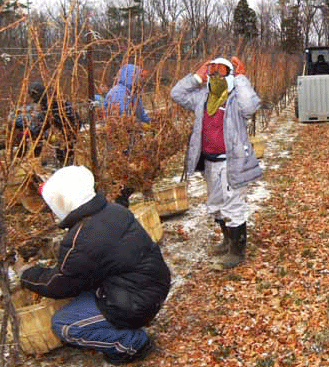
Yesterday at 1pm when pickers went into the vineyards to begin the harvest at Henry of Pelham Estate Winery in Ontario’s Niagara Peninsula, the mercury had dropped below minus 8C, the mark which must be reached before harvest can begin. With wind chill, temperatures reach depths of minus 35C and beyond.
Eight degrees Centigrade is the temperature at which grapes left to hang on the vine will freeze as hard as marbles. Donald Ziraldo, co-founder of Niagara’s Inniskillin, reported that the temperature in his vineyard adjacent to Niagara Falls was minus 12C at noon and by 6pm it had dropped to minus 14C.
Growers are very upbeat about the quality and size of the harvest. Laurie MacDonald, executive director of Ontario’s Vintners Quality Alliance (VQA) said, ‘By our records this is the largest Icewine harvest in history.’
Paul Speck, president of Henry of Pelham, says it’s the biggest Icewine crop of Vidal and Riesling his winery has ever produced.
‘After a small harvest in 2003 we’re trying to recoup the losses from last year so we left more grapes on the vine. The quality looks fantastic and it is rare to be able to do the harvest during the day,’ he said. ‘Usually we don’t hit these temperatures in Niagara until the evening.’
Harvesting in daylight in polar conditions makes it much easier than under floodlights although the biting wind off Lake Ontario made life uncomfortable for the harvesters.
Get our daily fine wine reviews, latest wine ratings, news and travel guides delivered straight to your inbox.
Canada has the most stringent regulations governing the sugar levels for Icewine. To bear the name of the label the grapes have to have a minimum Brix level of 35 degrees but usually the juice comes in at levels of 42 degrees.
Written by Tony Aspler

Tony Aspler has been writing about wine since 1975, and has been wine columnist for The Toronto Star for 22 years. He is the author of 16 wine books, including The Wine Atlas of Canada, and three wine murder mystery novels: Blood Is Thicker than Beaujolais, The Beast of Barbaresco and Death on the Douro. In 2001, Aspler co-founded the charity Grapes for Humanity to raise money through the wine community for victims of landmines and children with disabilities. In 2007 Aspler was awarded the Order of Canada and in 2012 he was elected to the New York Media Wine Writers Hall of Fame.