Now 416 years old, the latest example to come to light was officially certified by Guinness World Records last September as the world’s oldest ‘wild’ grapevine. The plant is found in Zuoba Village, Tibet, at an elevation of roughly 2,400m. Rising to around eight metres, with a ground girth of 2.09m and a trunk diameter of 67cm, the vine’s variety is yet to be determined.
‘We are currently carrying out gene resequencing analysis to determine whether this wild grapevine has a known genetic link to those found in Europe, and the results are not yet available,’ says Dr Wang Haibo (this article follows the Chinese convention of placing the surname first), deputy director of the Institute of Fruit Trees at the Chinese Academy of Agricultural Sciences, who took part in the on-site investigation and the official certification.
‘Based on the fieldwork, however, the vine appears to belong to the Eurasian species, which can be eaten fresh or used for winemaking, and is better suited to the latter.’
While Tibet may not be traditionally associated with wine, this discovery highlights a long-standing winemaking tradition that endures to this day.
‘The Epic of King Gesar contains references to “Chawa grape wine”, indicating that a mature winemaking technique already existed during the reign of King Gesar, who lived from 1038 to 1119,’ Haibo continues. ‘On this basis, it can be inferred that the winemaking history of this region extends back more than a millennium.’
The Old Vine, Slovenia
Of a broadly similar age, though cultivated rather than wild, is Slovenia’s Old Vine. The plant grows against the façade of a house in the Lent quarter of Maribor, once part of the city walls and now surrounded by cafés, restaurants and museums, overlooking the Drava River promenade. The variety of the vine is Žametovka, a local Slovenian grape used to produce light-bodied red wines.
When the specimen was first analysed in 1972, it was estimated to be between 350 and 400 years old, which places it at around 400-450 years old today. Yet, a more precise age could not be determined because the central core had rotted away.
The vine has survived a litany of disasters over the centuries, from fires and phylloxera to the bombings of the Second World War. In 1963 it came close to destruction when a new dam on the Drava River caused the water level to rise by three metres, disturbing its root system and causing the plant to decline.
In the 1980s, however, a group of specialists intervened to prevent both the vine’s removal and the demolition of the dilapidated house it grows against. Their efforts ultimately saved the plant, which was officially recognised by Guinness World Records in 2004 as the world’s oldest vine. Today, it is tended by the city’s viticulturist, and an entire tourism offering has developed around it, from wine tastings to virtual experiences, alongside a wine shop on site.
The centenary vine of Magrè, Italy
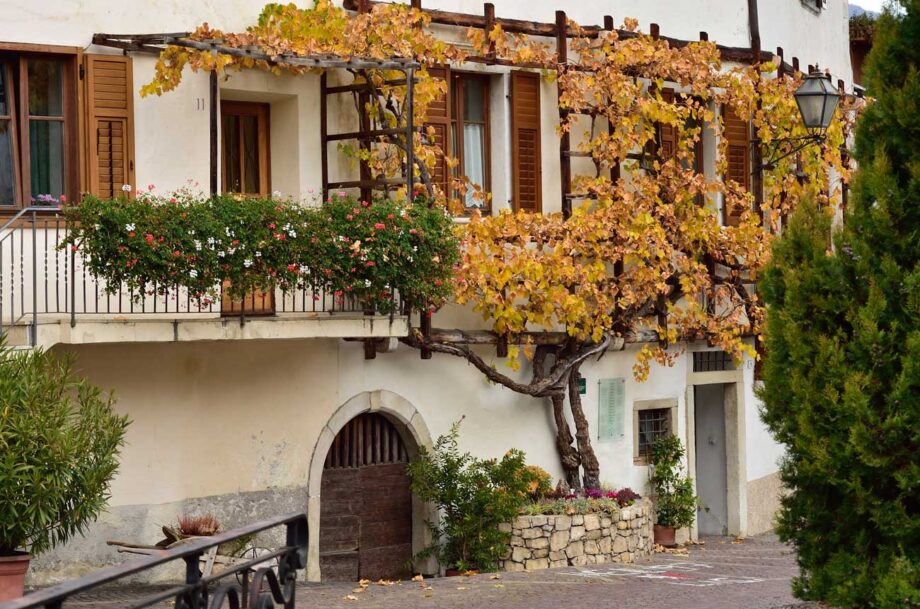
Other exceptionally old vines can be found just across the border in Italy. One such specimen, recorded as having been planted in 1601 by Domenig de Valentini (making it an extraordinary 424 years old), grows in the small village of Magrè in Alto Adige, climbing the façade of the Residenza Augustin.
In modern times, the vine faced the risk of damage due to the relocation of pipes and the canalisation of the nearby river, but it survived thanks to the intervention of public authorities. Today, it continues to thrive under the care of its owner, Robert Cassar.
The plant is of the Hörtröte (or Roter Hörtling) variety, considered suitable both as a table grape and for winemaking. It occupies an impressive 80m², with a trunk circumference of 52cm and a height of 5m, allowing it to produce a remarkable 80kg of grapes annually. Most of the fruit is consumed as table grapes, though small quantities of wine are also produced for personal use.
The Versoaln centenary vine, Italy
The Alto Adige region has another notable contender among the world’s oldest grapevines. Growing over a traditional chestnut pergola at the foot of Katzenzungen Castle in Prissiano, near Merano, a vine of the ancient local white variety Versoaln is believed to be over 350 years old.
‘This grapevine once covered an impressive 350m²’ says Günther Pertoll, head of the Laimburg Winery at the Laimburg Research Centre, which managed the plant until around 2023. ‘However, in the early 2010s it was affected by esca, a type of grapevine trunk disease, which reduced its size significantly to about 180m².’
Wine has been produced from the vine in very small quantities for many years, using biodynamic methods even before the Covid-19 pandemic. Since management of the vine returned to the Pobitzer family in recent years, the wine has been made at Caroline Pobitzer’s winery in Tuscany.
The Great Vine at Hampton Court Palace, London
Venerable vines are not found exclusively in traditional winemaking regions. An exceptionally old specimen of vitis vinifera of the Schiava Grossa variety (also known as Trollinger or Black Hamburg) – believed to be around 250 years old – grows in southwest London, at Hampton Court Palace.
According to the current head gardener, Graham Dillamore, the vine already measured 1.2m in girth at the base in 1887. Today, the base spans 4m, and the longest cane extends 36.5m.
The Great Vine was planted in 1768 by garden manager Lancelot ‘Capability’ Brown, using a cutting taken from Valentines Mansion in Essex. It was trained using the extension method, in which a single plant fills an entire glasshouse, a technique Victorian gardeners believed would maximise the crop. Today, the vine still yields an impressive average crop of around 272kg of grapes, with a peak of 383kg recorded in the autumn of 2001.
Barossa’s centenary vines, Australia
Most of the world’s oldest centenarian vines are unique specimens whose value today is largely historical or scientific. Yet, looking ahead a few decades (or centuries), there are also several examples of entire vineyards of centenarian vines still actively used for commercial winemaking. Australia’s Barossa Valley, in particular, is home to some of the world’s oldest vines that continue to produce wine.
Paul and James Lindner of Langmeil Winery, for instance, work with a plot of Shiraz vines planted in 1843 using plant material brought to Australia from France before phylloxera devastated Europe. The brothers’ ‘younger’ vineyards date back to the pre-1860s and the 1890s.
Similarly, winemaker Marco Cirillo produces single-vineyard bottlings from what may be the world’s oldest surviving Grenache and Semillon vines, planted in 1848.
The world’s centenary vines, still yielding abundant fruit and producing wine, are a testament to the grapevine’s extraordinary character, a remarkable ability to endure wars and natural disasters, outlasting empires and generations of growers.