
Baudains: Giovanni Allegrini’s revolutionary La Poja vineyard
Giovanni Allegrini's La Poja originated as the expression of a native variety from a single vineyard with a very specific sense of place.


La Poja is a single-cru vineyard at the top of the La Grola hill in Sant’Ambrogio di Valpolicella, in the Veneto region of Italy. The romantic explanation of the origin of the name is that it derives from ‘Pojana’, a bird of the falcon family which hovers over the crown of the hill.
More prosaically, it might come from the Longobard word which means ‘ploughed and cultivated land’, suggesting a long history of land use.
Tasting notes and scores for La Poja are listed below
The southeast-facing vineyard covers just under three hectares on the almost flat top of the hill, at an elevation of 320 metres above sea level. The stony, white calcareous soils have a high percentage of active limestone, with good drainage but also good water retention.
Sant’Ambrogio lies on the extreme southwest edge of Valpolicella, with a climate that is tempered by the vicinity of Lake Garda, a mere 15 minutes drive away.
Night/day temperature differences and the constant movement of air across the hilltop allow for late picking at full phenolic ripeness, with high sugar levels balanced by good acidity – in short, all the premises for concentrated wines, with great structure and complex aromas.
An ambitious project
Giovanni Allegrini bought the site and planted it in 1979, with a clear objective in mind. His ambitious project was to produce a wine that – in contrast to the long-standing practice of growing the prescribed varieties (principally Corvina, Rondinella and Molinara) together – was made from just Corvina.
This was revolutionary for the time, and La Poja would go on to break the mould of all the viticultural and winemaking conventions of Valpolicella in the 1980s.
Local producers would typically source three or more wines from the same plot: Valpolicella, Valpolicella Superiore, Amarone, probably a Ripasso, and possibly a Recioto, reserving the best grapes to make Amarone, and cascading down through the denominations to the basic Valpolicella for the rest of the crop.
Allegrini, on the other hand, was going to make a single wine from La Poja; a monovarietal Corvina with the same standing as Amarone, but using fresh and not dried grapes.
In the vineyard too there were radical departures from tradition. In place of the ubiquitous pergola veronese, the vines were guyot-trained, flying in the face of the received wisdom that it was impossible to curtail the natural vigour of Corvina with short pruning.
I recall Giovanni’s son, Franco’s cutting response to the criticisms of the training system, which encapsulated the provincialism of the Valpolicella of the period: ‘People say you can’t prune Corvina short,’ he said, ‘because they have never tried.’
Vinification of the new wine followed the conventional protocols of a top quality red, with around 15 days of skin contact, minimum filtering, and ageing in barriques, mostly new – Allegrini were amongst the first in Valpolicella to introduce small French barrels. La Poja was released after four years, together with the company’s Amarone of the same vintage.
But to set it apart, it came out in a unique and instantly recognisable tall, thin, long-necked bottle that made a powerful visual statement on the break with tradition. The same bottle shape has been used ever since.
Making waves
The first vintage of La Poja was 1983, and it was released onto the market during an exciting period for Italian wine in which new winemaking styles were emerging and the official hierarchies were being challenged by super-premium wines outside the DOC system.
In Tuscany, ground-breaking wines like Isola e Olena’s Cepparello and Fontodi’s Flaccianello were creating reverberations by abandoning the Chianti Classico DOC to make 100% Sangiovese Vino da Tavola.
Allegrini created similar waves with La Poja, which, like its Tuscan counterparts, was bottled as a Vino da Tavola because the DOC norms did not (and in Valpolicella still do not) allow for monovarietal wines.
After Giovanni Allegrini died in 1983, the La Poja project was taken forward in the same spirit by his oenologist son Franco, then in his twenties, and his brother Walter, an agronomist.
Franco sadly passed away in 2022 and, following an internal reorganisation, the company is now managed under the name Allegrini Wines by Franco’s three sons: Francesco, Matteo and Giovanni, together with their cousin Silvia.
In its youth, La Poja has all the hallmark aromas of the Corvina grape, from the typical black cherry, plum and violets on the nose, through to the almonds and savoury herbs of the finish. The fruit is very pure, and the oak is rarely invasive. With age, it evolves notes of pressed flowers and spices, and the tangy, minerally quality of the terroir comes increasingly to the fore.
The palate has density, but seldom gives the impression of being overweight, and for all its richness, it maintains elegance and drinkability – qualities we were able to appreciate during a vertical tasting of seven vintages held in Venice in September this year to celebrate the wine’s 40th anniversary.
Looking back at the project at a distance of nearly half a century, perhaps the most striking thing about La Poja is that, in a region in which the method of production defines the character of its most celebrated wines – Amarone and Recioto – it was conceived, ahead of its time, as a ‘terroir wine’.
Tasting Allegrini’s La Poja
Related articles
Allegrini, La Poja, Veronese, Veneto, Italy, 2018
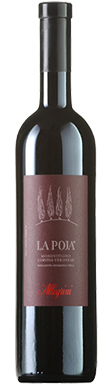

The current vintage, 2018, represents a restyling which takes La Poja in a direction which Francesco Allegrini describes as ‘more contemporary’, with softer extraction and...
2018
AllegriniVeronese

Allegrini, La Poja, Veronese, Veneto, Italy, 2016
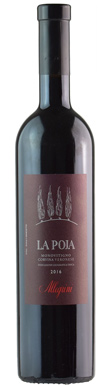
There is great depth of colour in the glass and ripe, late-picked fruit aromas of cassis and prune on the nose, with hints of savoury...
2016
AllegriniVeronese
Allegrini, La Poja, Veronese, Veneto, Italy, 2013
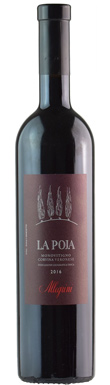
The wines of 2013 are noted for their elegance in northern Italy generally, and La Poja shows off the character of the vintage to perfection....
2013
AllegriniVeronese
Allegrini, La Poja, Veronese, Veneto, Italy, 2009
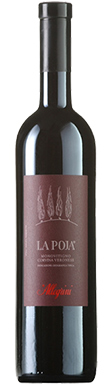
In the glass, this is a vintage with an impenetrable inky, violet shade with no sign of grading at the rim. The toasty nose has...
2009
AllegriniVeronese
Allegrini, La Poja, Veronese, Veneto, Italy, 2006
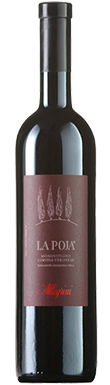
A complex array of aromas, from sour berries and juniper, to violets and eucalyptus, and then leather and sweet spices lead into a palate with...
2006
AllegriniVeronese
Allegrini, La Poja, Veronese, Veneto, Italy, 2001
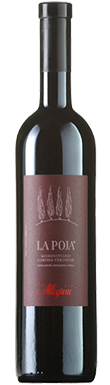
The nose is mature, with aromas of orange peel, tar, leather and incense, and at the back the oakiness is starting to come through. Stylistically...
2001
AllegriniVeronese
Allegrini, La Poja, Veronese, Veneto, Italy, 1997
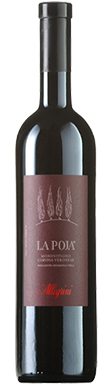
The celebrated 1997 vintage didn’t deceive with this extremely youthful wine. It shows striking complexity with raspberry and cherry fruits leading to black pepper and...
1997
AllegriniVeronese
