
Tasting Château Calon-Ségur vintages from 2008 to 2019
Ambitious efforts in the vineyard and cellar are paying off at Château Calon-Ségur in Bordeaux's St-Estèphe appellation, says Yohan Castaing, who tastes a vertical of vintages from 2008 to 2019.


‘Château Calon-Ségur now produces wines of remarkable delicacy and finesse’
Château Calon-Ségur, the most northern of the classified growth estates of the Médoc, is famous as much for its wines as for the declaration by its former owner, Marquis de Ségur, nicknamed ‘Prince of Vines’ by king Louis XV: ‘I make wine at Lafite and Latour, but my heart is at Calon.’
Still today, the heart remains the emblematic image on the façade of this Bordeaux estate’s cellars and on the label.
Scroll down to see tasting notes and scores for Château Calon-Ségur vintages from 2008 to 2019
Setting the scene
Situated very close to the Gironde estuary, this estate has been back in the limelight for several years among wine connoisseurs, and rightly so, given the stellar quality of both the terroir and the wines now produced here.
Lying at a maximum altitude of 13 metres, the vineyard of Calon-Ségur – most of which is walled – stretches just over 55 hectares (ha), which was the surface area at the time of the 1855 classification, something that is very rare in the Médoc.
The vines occupy three remarkable gravel outcrops, or croupes, composed of thick layers of gravel soil, much of it the type found on Quaternary alluvial terraces known as Peyrosol.
However, what should not be forgotten is that the St-Estèphe appellation benefits from pockets of limestone subsoil, and it is this that gives the wines of Calon-Ségur their distinctive vivacity and refreshing acidity.
It is true that at Calon-Ségur the wines were often in the past off the beaten track in terms of the once fashionable style of powerful, oaky wines.
As a young wine critic, I had the chance to meet Madame Gasqueton, the emblematic owner who had the habit of shortening a tasting that was taking too long by tapping the floor with her cane.
‘Young man,’ she reminded me, ‘we are not here to make competition wines, but to offer the loyal customers for our great wine something pleasant to drink.’
Madame Gasqueton managed her estate with impressive authority, but also with the limited means of an era before speculation brought increased prosperity to the region.
Not long after her death in September 2011, her daughters decided to sell the property. Jean-François Moueix, owner of Petrus and a friend of the family, put them in touch with a buyer likely to preserve the singular spirit of the site while also bringing needed improvements to the vineyard and the infrastructure.
In 2012, the company Suravenir, a subsidiary of the Crédit Mutuel-Arkéa insurance group, bought the estate with Jean-François Moueix and his son Jean as shareholders.
Changes in the Château Calon-Ségur vineyard
The ambition of the new owners was from the start very clear: restore the historical lustre of the estate, and notably by restructuring the vineyard.
They were helped in this by Vincent Millet, who had joined the team here as technical director in 2006 after leaving Château Margaux – where he had overseen research & development. He was given the strategic mission of replanting and increasing the density of the vineyard, as well as increasing the amount of Cabernet Sauvignon.
It is well known that Madame Gasqueton’s husband, Philippe Capbern-Gasqueston, had a strong liking for Merlot and so planted large quantities of it, a choice probably also dictated by the presence of clay in the soil. However, at Calon-Ségur, the well-draining gravel soil runs deep, and so the Merlot planted here often struggled to ripen.
What’s more, there were economic struggles, so investments in the vineyard were limited and vine density was affected, being rather low for the Médoc at around 5,600 vines per ha. However, to comply with the appellation rules of AOC St-Estèphe, the property began to replant in 1998 at 6,500 vines per ha.
This long-term project for the augmentation of vine density, but also the decrease of Merlot, accelerated after the arrival of Vincent Millet, but it was further boosted by the arrival in 2012 of a deep-pocketed insurance group as the new owner.
Now promoted to the position of managing director of Calon-Ségur, Millet expects to complete this mission of vineyard restructuring by 2030.
As he explained during the vertical tasting for Decanter, ‘This is a colossal but crucial project and we want to take our time, because just one error might compromise several decades of effort.’
‘A real quality leap’
In addition to the vineyard, major investments have been made in technical equipment in order to fine-tune the production of the wines.
This includes using more and smaller vats better adapted for a parcel selection of the grapes, which allows for much more precision in the winemaking, as does also a nitrogen cooling tunnel for better handling of the raw material.
Already an improvement in the wines was made evident just two years after Millet’s arrival, by the 2008 vintage in which the wines had greater aromatic expression and precision in the mouthfeel.
Nevertheless, the real quality leap occurred with the 2016 vintage, for which the new winemaking facilities and parcellary approach to viticulture were in place.
From 2016 onwards, the wines benefit from a sharper focus thanks to a smoother, more fine-grained tannic structure even in the sun-drenched conditions that marked vintages such as 2016, 2018 and 2019.
Both in the vineyard and in the cellar, the ambitious efforts have paid off and Château Calon-Ségur now produces wines of remarkable delicacy and finesse, distinguished by bright bouquets that are never overwhelmed by any oak influence.
They are indeed wines of outstanding character that form a tribute to the legacy of Madame Gasqueton.
Tasting Château Calon-Ségur: 2008-2019
Related content
Bordeaux 2016: 30 top-scoring and best-value wines
Investing in Bordeaux wine: Time to buy?
Château Calon Ségur, St-Estèphe, 3ème Cru Classé, Bordeaux, France, 2019
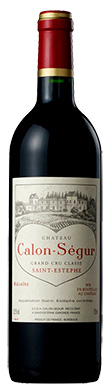

A large-scale palate, dominated by the Cabernets. Combines vivid ripe black fruit opulence with aromatic cedar and violet, delivered with elegant tannins. The wine is...
2019
Château Calon SégurSt-Estèphe

Château Calon Ségur, St-Estèphe, 3ème Cru Classé, Bordeaux, France, 2018
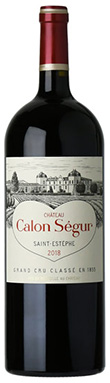
A distinctive bouquet with notes of iodine, flowers, fresh fruit and graphite, but its floral character takes on a dominant role with airing. Gorgeously juicy...
2018
Château Calon SégurSt-Estèphe
Château Calon Ségur, St-Estèphe, 3ème Cru Classé, Bordeaux, France, 2017
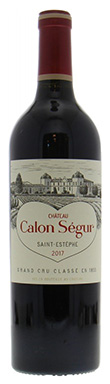
Hints of meat pan juices to the nose fail to materialise on the palate, which has surprisingly rich, ripe, inky depths. Well-knit blackcurrant and berry...
2017
Château Calon SégurSt-Estèphe
Château Calon Ségur, St-Estèphe, 3ème Cru Classé, Bordeaux, France, 2016
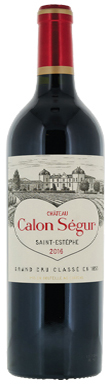
Intense and expressive, concentrated aromas of dark fruit, graphite and herbal nuances. Bold and muscular, with integrated tannins, espresso and cocoa notes, leading to a...
2016
Château Calon SégurSt-Estèphe
Château Calon Ségur, St-Estèphe, 3ème Cru Classé, Bordeaux, France, 2015
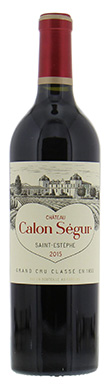
There is phenomenal concentration on the nose here. Dark fruit laced with lifted, soft green herbs. Basil and dill. Incredible complexity. Lovely red fruit and...
2015
Château Calon SégurSt-Estèphe
Château Calon Ségur, St-Estèphe, 3ème Cru Classé, Bordeaux, France, 2014
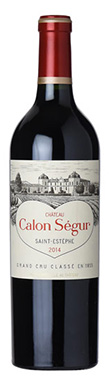
Heady fragrance nose, smells ripe and potent. Thick almost on the palate, this definitely has some sweet fruit aspects, mixed with herbal touches and minerality...
2014
Château Calon SégurSt-Estèphe
Château Calon Ségur, St-Estèphe, 3ème Cru Classé, Bordeaux, France, 2013
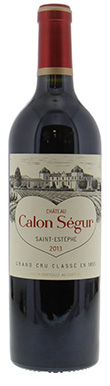
More aromatic than most, with lush, smoky, leafy aromas, suggesting it's just beginning its evolution. Concentrated and velvety, it displays fine balance and no overt...
2013
Château Calon SégurSt-Estèphe
Château Calon Ségur, St-Estèphe, 3ème Cru Classé, Bordeaux, France, 2012
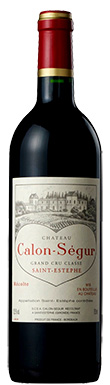
This is the late-harvest year that the insurance group Suravenir acquired Calon Ségur. Picking began on October 1 and ended on October 13. Classy, elegant...
2012
Château Calon SégurSt-Estèphe
Château Calon Ségur, St-Estèphe, 3ème Cru Classé, Bordeaux, France, 2011
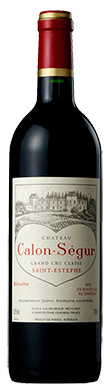
This is from a precocious vintage, with a harvest beginning on September 3, the very day the estate’s longtime owner, the redoubtable Madame Gasqueton, passed...
2011
Château Calon SégurSt-Estèphe
Château Calon Ségur, St-Estèphe, 3ème Cru Classé, Bordeaux, France, 2010
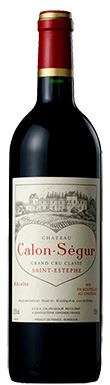
Intense nose, quite herbal and smoky with tobacco, liquorice, sweet spice and dark chocolate. Supple and lithe. Chewy in the best way, with bright, vibrant...
2010
Château Calon SégurSt-Estèphe
Château Calon Ségur, St-Estèphe, 3ème Cru Classé, Bordeaux, France, 2009
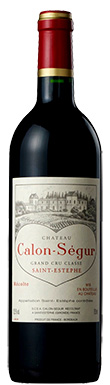
A wine that expresses the sun-drenched and opulent character of the vintage, and yet Merlot does not play a leading role. The multi-layered bouquet has...
2009
Château Calon SégurSt-Estèphe
Château Calon Ségur, St-Estèphe, 3ème Cru Classé, Bordeaux, France, 2008
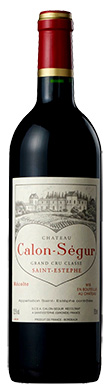
This constitutes for Vincent Millet the first vintage in which he 'wanted to highlight terroir expression by using a higher amount of Cabernet grapes'. The...
2008
Château Calon SégurSt-Estèphe
