
Decanter interview: Château de Saint Cosme’s Louis Barruol
One of the Rhône Valley’s most celebrated winemakers, the Château de Saint Cosme owner has elevated his long-established family winery – and the Gigondas appellation itself – to a new level of prominence in the greater Rhône region, and one of his latest projects sees him striving to do the same in Vinsobres, as Matt Walls discovers


‘I’m 50 this year – oh my God! At 50 you suddenly think, “I’ve passed the half-way mark”. But I don’t feel old at all.’ Neither does he look it. Barruol was playing in rugby tournaments (fly half) until the age of 48, and looks ready to receive a ball and start running at any moment. From a certain angle, his nose betrays his favourite sport. But off the pitch it’s an effective perch for a pair of small, round spectacles, which give him a more clerical air.
Barruol needn’t worry too much about reaching half-time – he’s already achieved more than most vignerons manage in a lifetime. In the space of a few decades he has transformed his family domaine, and with it the appellation of Gigondas. His 50th year marks two major accomplishments – establishing the largest Grenache conservatory in the world and purchasing a historic Vinsobres domaine – that further cement his position as one of the most dynamic winemakers and inspiring leaders in the Rhône Valley.
Family business
The Château de Saint Cosme estate must have been a magical place in which to grow up. It’s not huge, but the site is ancient, with preserved Roman fermentation vats still intact. The estate has been in the family since 1490, and has seen 14 generations of winemaker come and go.
Barruol worked with his father from the age of eight, and managed a harvest at 14. By 16, he had decided wine was his calling. He’s the youngest of four siblings, but there was ‘no pressure, no influence’, he says, for him to take on the estate. While Barruol was studying agricultural business at the Université de Caen his father fell ill, so on completing his studies he returned to support him, eventually taking over the reins in 1992.
At the time, the estate was making wine and selling it to négociants such as Guigal, ‘but our name was never on the label’, says Barruol. He promptly started bottling his own wines,and in parallel developed his own négociant business. The estate was already effectively organic, but he secured certification, as he believes ‘it’s the only way to be credible’.
The 15ha of Gigondas vineyards that surround the property represent the heart and soul of the domaine. Until the early 1990s the winery made only one Gigondas cuvée, but in 1993 this was joined by the old-vine cuvée Valbelle (since discontinued), followed in the mid-2000s by three single-vineyard bottlings: Le Claux, Hominis Fides and Le Poste. They are among the most sought-after wines in the appellation.
The older the better
These wines are built to last. ‘Drinking Saint Cosme before nine or 10 years of ageing doesn’t make sense,’ he says. ‘I think that at least 90% of wines are drunk too young. You miss the complexity, you miss the mellowness, you miss the “friendly” side of wine. In a great old wine, it’s no longer the grape variety that you taste, but the soil.’
He continues: ‘In a region such as Burgundy, it’s accepted. Or if someone drinks a bottle of Château Haut-Brion 2017 now, everyone would say: “Listen buddy, if you wait 15 years, you’ll get much more emotion than you’re getting from it now”. But in regions that are still establishing themselves – such as ours – relatively few people have the knowledge to say: “Hang on – that great Gigondas shouldn’t be drunk yet”.’ A vertical tasting of Barruol’s Gigondas range confirms just how well these wines can age, and how much time they need to fully develop.
Using whole-bunch fermentation is in part what gives his red wines longevity, and he’s noticed more producers in the appellation using this technique. ‘I think that whole bunches give remarkable complexity; a lot of soul, spirit, a particular architecture, a particular texture, a particular freshness… [But] you can only do it in a certain context. You can’t, for example, cultivate productive clones with big green stems, big berries and big yields then turn around the next day and say you’re going to work with whole bunches. It needs to be coming from a heathy plant, with genetic diversity – often old vines, because they have finer stems.’
Barruol describes the proliferation of productive clones in local vineyards as ‘catastrophic’. He explains that officially approved clones were originally selected for their high yields. The bunches would struggle to ripen, resulting in green stems, ‘which led to vegetal wines that didn’t really exist before’. That the destemming machine arrived in the region around the same time is no coincidence, he suggests. He admits he once planted 1.5ha of clones himself (but has since ripped them out).
Guardians of Grenache
On top of managing the family estate, Barruol is also president of the appellation committee. It’s in this role that one of his most important projects has recently come to fruition. His belief in massal selection over clonal selection has led him to spearhead the research and development of what he claims is the biggest Grenache conservatory in the world, planted in Gigondas in 2019.
It has taken six years to get to this final stage. The committee began by criss-crossing the appellation, marking particularly fine- looking Grenache vines. It selected 1,500 exceptional specimens – all planted before 1978 to avoid any modern clones. After further testing for viruses and quality, these were whittled down to 380 plants.
Whereas most local vineyards now contain genetically identical plants, the conservatory vineyard is made up of genetically differing vines – ‘individual plants as different as you and I’, explains Barruol. All are well-adapted heritage Grenache vines from which local growers are free to take cuttings. ‘It will impact the quality of the wines of the appellation for decades. Gigondas is now the guardian of the temple of Grenache,’ he says with a smile.
Gigondas currently only has the appellation for its reds and rosés, but another major development is coming soon: the introduction of white Gigondas. ‘It’s underway,’ he says. ‘The dossier is with the INAO (National Institute of Origin and Quality). We’ve been working on it for five years now. In the best-case scenario, the first vintage of white Gigondas will be the 2021 vintage, but it’s more likely to be 2022.’
With much of the appellation having a relatively fresh climate, thanks to a combination of northwesterly aspect and high altitude, producing white wines in Gigondas does indeed make sense. There is also a high proportion of limestone here, which Barruol believes marries particularly well with the Clairette grape. ‘In the notion of an appellation, there’s always a link between a soil, a climate and a grape variety that feels at home there,’ he comments.
If there are no changes to the proposal, white Gigondas will need to contain 70%-100% Clairette. ‘I want Gigondas to become the home of Clairette,’ Barruol declares boldly.
A new property
When asked which other southern Rhône appellations he finds interesting, Barruol names two. ‘I believe there are zones with great soil and with fresh climates, and with this in mind I’d say Massif d’Uchaux, with its Miocene sandy soils. They’re not always terribly well expressed, but the potential is there for freshness and finesse. And Vinsobres, of course – one of the freshest terroirs of the southern Rhône, perhaps the freshest.’
His belief in the northerly appellation of Vinsobres has led him to a major new investment. Château de Rouanne is a large estate to the west of Vinsobres, comprising 42ha of vines in one block, at 280m altitude. What makes this site special for Barruol is the composition of the soil. A large proportion of limestone is combined with an unusually high amount of iron here. ‘It’s very important for the vine. When you cultivate vines in limestone soils, normally you lack iron… it’s rare to combine the two. So these soils are extraordinary.’ He believes that red wines here have the potential to be ‘truly great’.
Though Vinsobres was granted its own appellation in 2006, making it one of the nine crus of the southern Rhône, it lacks the renown of the others, especially outside France. ‘Sometimes Vinsobres can be forgotten, and it’s a shame. I think Vinsobres deserves to be tasted along with the other crus of the Rhône, sometimes more so than certain others. And I’m going to fight for that. I’m not someone who arrives somewhere and does nothing – I try to move things forward as fast as possible. But in wine, even fast can take a long time!’
When discussing his work for the appellation of Gigondas, he says: ‘There’s no example of a great appellation in France that’s emerged without a leader and without collective work. It doesn’t exist. In all the great French wines, you’ll find great estates, great winemakers, great leaders and people that have worked together.’ Barruol is currently more invested in Gigondas than Vinsobres, but he may be just what the appellation needs to help thrust it forward.
As we walk back to the car from the Grenache conservatory, Barruol says: ‘Looking back, I’ll ask myself, “Was I useful? Did I do well or not?”.’ And he looks momentarily pensive. He glances back for a moment at the young vineyard. ‘But with the conservatory, that’s one thing I know I did really well,’ he says, smiling again. And considering he’s only at half-time, I’m sure there’ll be plenty more achievements to come.
See also: Château de Saint Cosme Gigondas: Tasting the single-vineyard bottlings
Château de Saint Cosme wines for drinking now
Château de St Cosme, Hominis Fides, Gigondas, Rhône, France, 2010
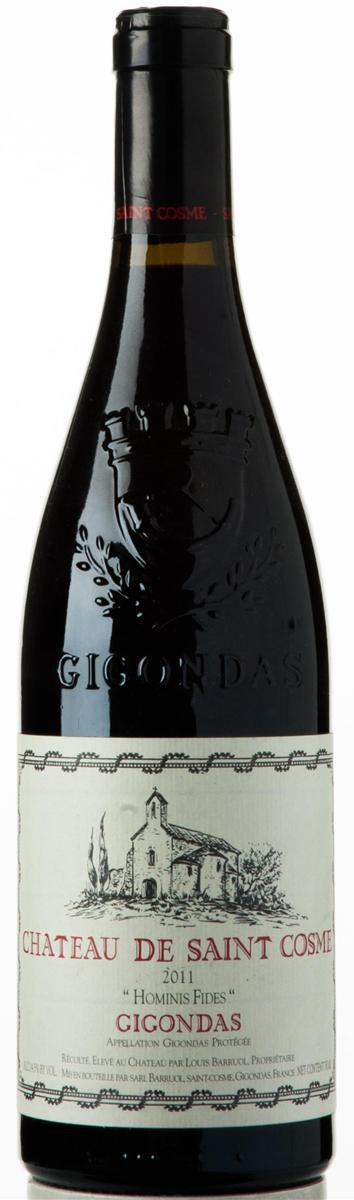

Spicy, smoky, lifted fragrance, real finesse and freshness still to the aromatics. Lovely depth and intensity of fruit. A really attention-grabbing wine - it's almost...
2010
Château de St CosmeGigondas

Château de St Cosme, Le Claux, Gigondas, Rhône, France, 2012
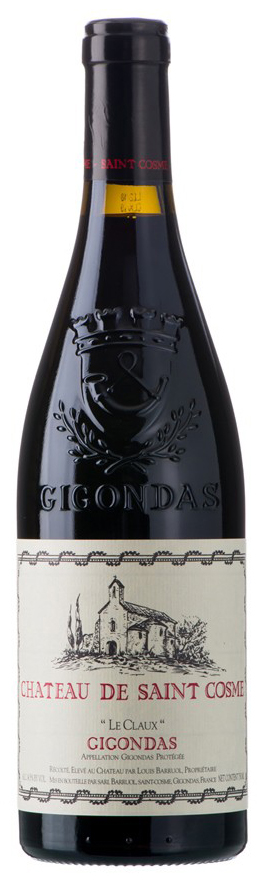
97
A touch of bacon fat and bonfire smoke to the red fruits. Fireworks and autumn leaves. Medium-bodied, spicy, with great liveliness and freshness on the palate. Tight finish still, little grippy tannins. Long finish. Really vibrant and juicy, such a lovely wine. Long finish. What's not to like?
2012
Château de St CosmeGigondas
Château de St Cosme, Valbelle, Gigondas, Rhône, France, 2012
Bright, spicy, lifted cinnamon-laced red fruits. Silky, juicy and rounded on the palate, with sweet raspberry fruit. Harmonious, drinkable, slightly raised in alcohol but great...
2012
Château de St CosmeGigondas
Château de St Cosme, Valbelle, Gigondas, Rhône, France, 2011
Sugar plum, violet, peony, raspberry leaf. A more floral register this year. Soft, yielding tannins. Very well-balanced acidity. Tannins are a little overly grippy and...
2011
Château de St CosmeGigondas
Château de St Cosme, Gigondas, Rhône, France, 2013
Peppery, floral style starting to open now. Woody herbs and a distinct nutmeg element. Softer on the palate, yielding tannins, they're a little dense. The...
2013
Château de St CosmeGigondas
