
Domaine Dujac: Profile and wine ratings


Burgundy master Clive Coates MW tells you everything that you need to know about Domaine Dujac, along with historical tasting notes on wines from top vintages - as part of a series that looks back at domaine profiles from Clive's most recent books.
Unlike most Burgundian estates, whether they have been bottling for a number of decades or only embarked on this path recently, the Domaine Dujac is a recent creation. It dates from 1968. Jacques Seysses, the founder, is in his early 70s, and has now taken a back seat in favour of his sons Jeremy and Alec and Jeremy’s wife Diana, a trained wine chemist (oenologue). They have been working as a trio now for a few vintages.
Jacques Seysses’ father, a rich man in charge of a firm who made biscuits, was a well-known connoisseur of food and wine, at home in three-star restaurants, with a fine cellar of his own.
Scroll down to see Clive’s tasting notes & scores
Jacques remembers as a teenager visits to three-star restaurants in Paris and elsewhere.
‘I can’t tell you exactly what was the first great bottle of wine I had,’ he says, ‘But it was most likely a Rousseau or a Gouges from one of the great vintages we had immediately after the War.
What I do recall was a visit to La Tour d’Argent. My father selected a bottle of La Tâche 1938 (not a great vintage). It was almost rosé in colour. Our guests were rather shocked. But the aroma and intensity of this wine was remarkable. This must have been in 1958 or so, when I was 17. I remember my father ordered that the rest of the stock be reserved for himself.’
Jacques tried banking and working in the biscuit business. But his heart was in wine. (Though, to tell the truth, having had ambitions to be an actor when he was 15, he would also have liked to become an architect – but this is in retrospect).
He spent two years in Burgundy learning the ropes.Land at the time was cheap. Seysses père had been an initial investor in the Domaine Pousse d’Or, when it was set up in 1964. They found a run-down property in Morey-St-Denis. The first vintage was not the 1968.
The wines were too poor to bottle themselves. It was 1969 that the Domaine Dujac arrived on the market. Vines elsewhere were acquired, and within a few years the domaine measured 11.5 hactares spread over 11 different appellations, a typically Burgundian morcellation.
With the help of father’s entrées into the nation’s top restaurants, the Dujac wines soon began to be noticed. Jacques has never had much problem selling his crop.
Jacques remembers the first time the American merchant Colonel Frederick Wildman came to call.
‘He was a gaunt, rather frightening old man. He didn’t say much. And I thought the wines weren’t showing very well that day. He tasted around the cellar in complete silence, and, not hearing any grunts of approval I was beginning to think: well, that’s it. He doesn’t like the wine. And then suddenly he said: I’ll take the lot! I was stunned. But I didn’t want to put all my eggs in the one basket, so I said: ‘I’ll sell you half.’
It was the beginning of a fruitful partnership. Wildmans would represent Dujac in the USA for the next 20 years.
So, who helped you make the wine in the early stages? I ask.
‘Gérard Potel, of the Pousse d’Or; certainly Aubert de Villaine of the Domaine de la Romanée-Conti; but perhaps most importantly Charles Rousseau of Domaine Armand Rousseau.
‘I soon began to realise the importance of the attention to detail in the vineyard: training high, to maximize efficient photo-synthesis, hoeing and ploughing as much as possible, reducing the potential yield from the beginning, and so on. A lot of replanting was necessary.’
Originally Jacques Seysses was a great believer in clones. He’s less convinced now, and he can make his own selection ‘massalle’ from the best of his own old vines.
At vintage time he soon decided to employ a large number of people to collect the fruit. ‘They can take more time, and the triage (sorting through to eliminate the sub-standard) is more efficient.’ In the winery, following the DRC, Seysses vinified with all the stems, and matured his wine in new oak, but bottled quite early.
Jacques and his attractive American wife, Rosalind – she came over to work the vintage and never went back – have three children.
Jeremy, born 1975, and Alec, born 1977, both involved in the business, and their younger brother Paul, who runs an embryonic chain of restaurants in Burgundy called My Wok. Both Jeremy and Alec went to university in England; Jeremy to University Collge, Oxford, Alec to the London School of Economics.
While working at Mondavi Jeremy met his future wife Diana, a Davis graduate, whose family own the Snowden winery up in the hills above Rutherford in the Napa Valley. She is now the winemaker at the Domaine Dujac, and they have two boys; Aubert, born 2007, and Blaise, born 2009.
Whose wines are their yardsticks? I asked Jeremy and Alec.
Frédéric Mugnier and Christophe Roumier, they both echoed, and Jean-Marc Roulot for his whites. I was rather dismayed when Jeremy declared that his first remarkable bottle memory was a Château Guiraud 1975. By no means a great wine, in my view! But apparently Jacques had bought quite a lot of it, and it was always wheeled out on birthdays.
Jeremy was on more comfortable ground with his recollection of the bottles for his 21st: Bâtard-Montrachet 1976 from Ramonet and 1966 La Tâche. Diana’s most impressive early wine is a 1993 Araujo Cabernet, which I confess I have never sampled.
So, who is in charge now, and has anything radical been changed?
‘It is a triumviate,’ says Jeremy, ‘plus Jacques as the Wise Old Man in the background. Diana makes the wine. But otherwise all three of us are involved in the cellar.
‘Alec is in charge of the picking team and the logistics of the vintage – the vineyard manager is Lilian Robin – while I am more responsible for the commercial side, the allocations and so on. But I decide on the date of the harvest.’
Nothing has fundementally altered as far as the wine-making is concerened, but there have been some subtle changes.
‘I feel’, says Jeremy, ‘that hitherto our wines were more ‘Dujac’ than Chambolle, Gevrey or Morey. We are trying to make the family signature less instantly obvious.’ Partly, I suggest, this is because under Jacques it was always 100 whole clusters and 100 percent new wood. Since 1999 the domaine destems on occasion. The cellar is now permanently air-conditioned, so is a little cooler, and as a result the malolactics are later.
This, plus the fact that in the new, enlarged cellar, half the fermentations take place in concrete vats, which retain heat – though it is the later malos which have the greatest influence – results in more colour in the wines than hitherto. The youngest wines, and the village examples, are de-stemmed a little more, and of course see less new oak.
‘The origins of the wines necessitate us to change our techiques,’ says Jeremy. ‘For instance I find that totally whole cluster fruit doesn’t work as well in Gevrey than in the villages further south. However, if we had a parcel where there was lots of millerandage we would not destem at all.’
‘We tend to add nearly all the press wine; keep the wines on their fine lees a year; then rack – as much to liberate excess carbon dioxide as for any other reason; and bottle in February/March. Getting back to the amount of new oak, We normally now use 40 percent for the village wines, 60-80 for the premiers crus, up to 100 for the grands crus.
The tendency is that we use less new oak in the riper vintages, where there is less malo-lactic, more in those less fortunate.’ But then he points out that you have to order your casks early, well in advance of the vintage, at a time when you might have no idea whether your vintage is going to be generous or not. And you can’t leave a cask unused.
In 2005 Jacques and Jeremy were approached by Etienne de Montille. Through his banking connections – he used to be a merchant banker before returning to Burgundy to take over the family estate on a full time basis (he also runs the Château de Puligny-Montrachet) – Etienne had heard that the Domaine Charles Thomas was for sale.
It was an undertaking he couldn’t afford on his own. Were the Seysses interested in sharing the estate? They were. So the Thomas vineyard holdings were acquired and shared, with Dujac basically taking over the northern end, chiefly Romanée-St-Vivant, Chambertin, Vosne-Romanée, Les Beaumonts and a large slice of Vosne-Romanée, Les Malconsorts. Some of these are owned and leased back by outsiders, such as Wilfred Jaeger in the Romanée-Saint-Vivant. A few lesser parcels were disposed of to help finance the deal, and the first vintage was 2005. The Dujac domaine now covers 15.25 hectares. Hence the extention to the cellar.
The Dujac style has always been one of great elegance and purity, wines of poise and balance, and this has been enhanced of late, as much because the average age of the vines has increased as to any nuancing of the wine-making processes. Though not biodynamic, the viticulture is, and always has been, firmly ecological.
Judging by the 2005s and most of the vintages since – though I am rather suspicious about the 2006s (the Clos de la Roche as well as the Clos St-Denis) – the wines are even better than they used to be. What I like about them is that they are always ripe, fresh and fragrant without ever hinting at excess acidity. This is one of the great Burgundy domaines.
I have been fortunate in the past to have participated in at least three important vertical tastings of Dujac Clos de la Roche, so this time I opted for Clos St-Denis. Before we sat down to taste I asked Jeremy how he would describe the difference between these two adjacent climats.
‘Aromatically they are both unmistakably Morey-St-Denis.’ Jeremy began. ‘That is there are suggestions of nutmeg and cinnamon to go with the cherry-raspberry-strawberry. But texturally they are quite different. Clos de la Roche (where the Dujacs have 1.95 hectares in six parcels with an overall average age of 45-50 years) has more structure, more tannin, and is generally more masculine. There is a minerally graphite aspect I don’t find in Clos St-Denis.’
‘In the Clos St-Denis (1.45 hectares in two parcels; also an average age of 45-50 years) the silky tannins are first and foremost. There is intensity without weight. Texturally there are similarities with Chambolle but in character our Clos St-Denis is quite different. There are aromatic fireworks to be found and a ‘peacocks tail’ as the wine opens out in the mouth that I find most appealing.’
See Clive’s wine ratings for top Dujac vintages:
Where to buy Clive Coates MW’s ‘My Favorite Burgundies’ book:
Domaine Dujac, Clos de la Roche Grand Cru, Burgundy, France, 2009
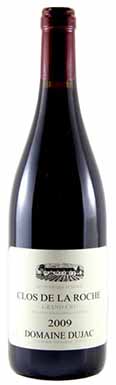

Fullish body. Lots of depth and style. Lots of dimension and very lovely fruit. Rich and flamboyant. Very fine.
2009
Domaine DujacClos de la Roche Grand Cru

Domaine Dujac, Clos de la Roche Grand Cru, Burgundy, France, 2005
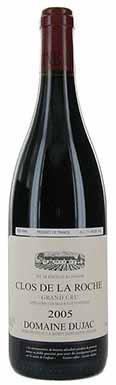
Full colour. Rich, concentrated nose. Nice and fat. Compared with earlier Dujacs this has more backbone and intensity. Excellent fruit and really profound. Very fine.
2005
Domaine DujacClos de la Roche Grand Cru
Domaine Dujac, Clos de la Roche Grand Cru, Burgundy, France, 2001
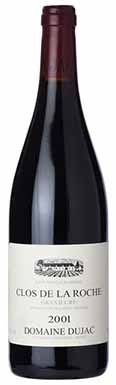
Medium-full colour. A little fuller-bodied than their Clos Saint-Denis. Meatier. Slightly less sweet but more vigour and a better grip. Will last longer. Lovely.
2001
Domaine DujacClos de la Roche Grand Cru
Domaine Dujac, Clos de la Roche Grand Cru, Burgundy, France, 1999
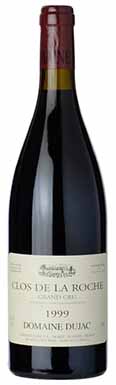
Retasting the 1999 at the domaine in 2024, I am struck by how much it is opening up. Always great, the wine now shows astonishing...
1999
Domaine DujacClos de la Roche Grand Cru
Domaine Dujac, Clos de la Roche Grand Cru, Burgundy, France, 1990
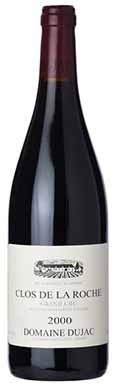
Full, rich, vigorous colour. Lovely fragrant nose. Lots of quality and lots of energy. On the palate ripe and medium-full bodied. Plenty of vigour. Long,...
1990
Domaine DujacClos de la Roche Grand Cru
Domaine Dujac, Bonnes-Mares Grand Cru, Burgundy, France, 2000
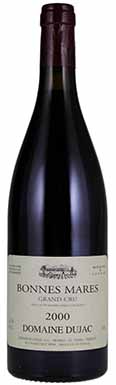
Magnum. This is a fuller and more vigorous wine than the Clos de la Roche. Better grip. Medium-full body. Very lovely complex fruit. Very classy....
2000
Domaine DujacBonnes-Mares Grand Cru
Domaine Dujac, Bonnes-Mares Grand Cru, Burgundy, France, 1995
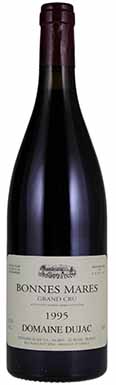
Good fullish colour. Ample, fresh, ripe, juicy nose. Profound and stylish. Medium-full body. The tannins now resolved. Delicious fresh, balanced fruit and lots of class....
1995
Domaine DujacBonnes-Mares Grand Cru
Domaine Dujac, Echézeaux Grand Cru, Burgundy, France, 1990
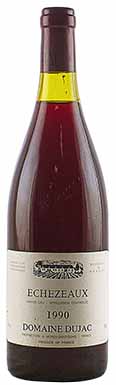
Good fullish colour. Ripe, fragrant, fat and rich on the nose. Lovely fruit. Medium-full body. Vigorous nevertheless. Sophisticated, intense and beautifully balanced. Fine plus.
1990
Domaine DujacEchézeaux Grand Cru
Domaine Dujac, Vosne-Romanée, 1er Cru Malconsorts, Burgundy, France, 2009
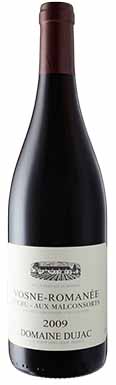
Delicious fruit. Lots of depth and energy. Fullish body. Very harmonious. Great style. Very fine.
2009
Domaine DujacVosne-Romanée
