
Domaine Leroy: Profile and wine ratings


Burgundy master Clive Coates MW tells you everything that you need to know about Domaine Leroy, along with historical tasting notes on wines from top vintages - as part of a series that looks back at domaine profiles from Clive's most recent books.
Almost a century and a half ago, in 1868, François Leroy set himself up as a wine-merchant in his native village of Auxey-Duresses, just round the corner from Meursault. The business was expanded by his son Joseph, who took over at about the turn of the century and further developed by the next generation in the person of Henri, born in 1894, who entered the family affair in 1919.
Henri diversified into eaux de vie and cognac, establishing a model distillery at Ségonzac and as well as fine wine, sold lesser bulk wine to Germany, where it was made into sekt, and brandy in the same direction particularly to Asbach.
During the 1930s Henri became, firstly a client of the Domaine de la Romanée-Conti, and then a good friend of Edmond Gaudin de Villaine, the gérant and co-owner with his brother-in-law Jacques Chambon.
These were hard times. The DRC was a bottomless pit necessitating yearly expensive investment on the one hand, but yielding no profit on the other. It seemed inevitable that it would have to be sold. And if it were to pass out of the Chambon-De Villaine hands, Henri Leroy and his friend knew only too well, it would be the start of the slippery slope.
Before too long the vineyards of Romanée-Conti and La Tâche would be as morcellated as that of Clos Vougeot.
Some years later, in 1942, with the financial structure of the domaine having been changed to a Société Civile, Jacques Chambon decided to sell out.
Henri Leroy bought the Chambon share and became co-owner of the Domaine de la Romanée-Conti. For the meantime, however, he was content to take a back seat, at least officially.
It was not until 1950, after Edmond Gaudin de Villaine’s death, that he became co-gerant alongside Edmond’s son, also Christened Henri. The two were to run the DRC jointly until 1974. Henri Leroy passed away on 21st February, 1980. As he had commanded the domaine’s Richebourg 1952 was opened after his funeral in his memory.
Find all Clive Coates MW’s Domaine Leroy tasting notes here
Henri Leroy and his wife Simone (née Brun) had two daughters, Pauline (b 1929) and Marcelle (universally known as Lalou) in 1932. It was the latter, adored and adoring younger daughter, who was to inherit her father’s passion for wine.
Lalou, born in Paris, was brought up in Meursault, in the mansion today occupied by her daughter Perrine. ‘From the word go I was fascinated,’ she says. ‘I was a cellar rat, watching and helping the cavistes rack the wines, taste them, bottle them. My mother kept calling me to come out of the cellar to play with my friends like a normal schoolgirl, but as soon as I could I crept back’.
Henri Leroy, his attention diverted by the DRC, had somewhat neglected his négociant business. Lalou remembers 1937s still in cask long after the war. In 1955 she persuaded her father to let her take over. She was 23.
‘He gave me carte blanche,’ she says. ‘I started as I meant to go on. I bought finished wine, and only that which pleased me. I insisted on having no contracts, no moral obligations. If the wine wasn’t extra, I didn’t buy it’.
The turnover of Leroy wines has always been modest, the stock to back it up enormous: totally uneconomic. But it has always been subsidised. Firstly by the bulk German business, later by the Leroy sales exclusivity of the DRC wines. Except for the UK and the USA, this all passed through Leroy. Three-quarters of the Leroy turnover came from selling DRC wines.
In 1974 the co-managership at the DRC passed down a generation, to Lalou, representing her sister (they both owned 25 percent) and Aubert, son of Henri de Villaine, representing his brothers, sisters and cousins (there are 10 of them).
From the start this was a fiery relationship. Lalou is not an easy character: emotional, insecure, arrogant, temperamental and combative, she must have been a trial to the pacific, intellectual Aubert. It was a fire awaiting a match. Early in 1992, following a boardroom dispute, Lalou was relieved of her position as co-gérante, and the Domaine de la Romanée-Conti took over responsibility for selling and marketing its wines throughout the world
Meanwhile, at the other end of Vosne-Romanée, lay the head-quarters of the Charles Noëllat domaine. The landholdings were impressive: nearly a hectare of Romanée-Saint-Vivant, over a hectare and a half of very well-placed Clos-de-Vougeot, 78 ares of Richebourg, substantial premier cru vineyard in Nuits-Saint-Georges, Les Boudots and Vosne-Romanée, Aux Beaux-Monts and Aux Brûlées.
Charles Noëllat had died in 1969, and despite some of the land passing the other members of the family, notably what are today the Alain Hudelot-Noëllat and J.J. Confuron estates, the residue still amounted to 12 hectares. But it was moribund. Quality was unremarkable and inconsistent. Yet the potential was high.
‘Yes, the wines they produced were terrible,’ says Lalou, ‘But the quality of the vines were great. All honour to Charles Noëllat. The vines were old, reproduced by sélection Massale. And in the Romanée-Saint-Vivant they are particularly superb, giving very small fine berries. Yardstick Pinot Noir fruit. I have never seen anything so fine in all of Burgundy’.
In 1988 the estate came on the market. It is said that AXA were interested. But Leroy made a better offer. Subsequently, in July, Lalou and Pauline sold one-third of their interest in Leroy to their Japanese agents Takashimaya in order to finance the 65 million franc acquisition of Charles Noëllat, including buildings and stock (After a number of years offering the plums of this stock around the trade the residue was sold at jumble sale prices in an auction in Dijon in 1992).
Find all Clive Coates MW’s Domaine Leroy tasting notes here
At a stroke, the addition of the Charles Noëllat domaine to that of Leroy, mainly based in Auxey and Meursault, but with tiny holdings in Chambertin, Clos-de-Vougeot (at the bottom) and Musigny, transformed it into one of Burgundy’s major players.
But things did not stop here. In 1989, for 19 million francs, Lalou acquired the Gevrey-based 2.5 ha Domaine Philippe Remy. This added 40a of Chambertin, 57a of Latricières, 67a of Clos-de-la-Roche, as well as premiers crus in Gevrey-Chambertin, Les Combottes and village land in Gevrey and Chambolle. It neatly complemented the Noëllat estate.
A year later Lalou increased her holding in Le Musigny by buying a parcel from the Moine-Hudelot family. Some Corton, both red and white, has followed, as has some Volnay, Santenots. Today the domaine measures just under 22.5ha.
At the same time, in her own right, Lalou has made further acquisitions. High up on the plateau above Saint Romain is an ancient farm – records go back to a donation from Raynaud, seigneur of Saint Romain, to Messieurs de La Ferté in 1180 – known as the Domaine D’Auvenay. It used to belong to Henri Leroy’s bachelor brother. It is here that Lalou lives with her husband Marcel Bize, who sadly died in 2004 . While she occupied herself with wine, he ran the farm, biodynamically, of course.
Under the name of Auvenay Lalou has added on to the land in Auxey and Meursault that she inherited from her father: 51a of Puligny-Montrachet Les Folatières in 1989, 6.4a of Criots in 1990, 16.3a of Chevalier-Montrachet (from Jean Chartron) in 1992, 26a of Bonnes-Mares in 1993, and, then 26a of Mazis-Chambertin (Lalou had always bought the wine) from the Collignon family in 1994.
A further purchase occured in 2011: seven ouvrées of Bâtard-Montrachet and some village Puligny, Les Enseignères. The total is now just about four hectares. Vinification of this has to be separate from that of Domaine Leroy. In 1994 a brand new cuverie was installed up at Auvenay.
In many ways the seemingly hard-nosed Lalou Bize is the last person you would expect to be seduced by any new fad. That bio-dynamism is not a fad is proven by the fact that the Domaines Leroy and Auvenay have joined the increasing number who have gone not just biologique but the full way.
Nicolas Joly’s Coulée de Serrant at Savennières was Lalou’s Road to Damascus. ‘I shall never forget,’ says Nicolas. ‘There was Lalou, dressed up as if she had just stepped out of some maison de haute couture in Paris, on her knees, running the soil of the Coulée de Serrant through her fingers, and exclaiming, “Ça, c’est la vérité.“‘ Actually, Lalou maintains she was probably wearing jeans.
‘The soil was alive,’ says Lalou. ‘Everything was alive, and in place, in harmony with one another: the earth, the plants, the fruit and the wine. I really do believe that cosmic rhythms should determine when we do things. And that we should encourage the vine to build up its own resistance and allow it to express its own terroir. So we have proscribed all chemical treatments except very minimal doses of sulphur against oidium and copper sulphate against mildew.’
In 1993, to avoid further compacting the soil with yet another tractor treatment, Lalou sprayed against mildew by helicopter. Sadly this proved ineffective, and as a result her crop was reduced almost to nothing.
In many ways the Leroy wine-making methods are deeply traditional. When she took over at what was to become the Domaine Leroy, Lalou inherited some magnificent examples of old, high quality Pinot Noir vines, but vineyards which were in many cases only half full. Yields naturally were cut to shreds, averaging 15 hectolitres per hectare or so.
She took her time about replacing the holes with new vines, these being propagated by selection massale from her own plants. Pruning is excessively strict. But now, except in 2008, when she lost a majority of her crop to rot and mildew and in some cases made only11he/ha, yields are 25 he/ha or so, a little more economic.
As much as possible the land is now ploughed using horses. For the last ten years the Leroy vines have not had their excees folaige clipped back in the summer, Lalou believing this stresses the plant. Instead the shoots of two vines are looped round one another. It makes it easy it identify a Leroy vine.
In the cellar there is no destemming, a severe triage, two pumpings over at the beginning of the fermentation and then two or three pigeages a day – there were automatic plungers but they have now reverted to pigeage à pied – and a long cuvaison at temperatures up to 33°. Each vat at Vosne-Romanée is equipped with an internal temperature-controlling stainless-still coil.
After the cuvaison the press wine is incorporated, the lees are retained and the wine transferred to cask. One hundred percent new wood is used. There is no filtration, and not always a fining either. Lalou Bize says she wants to preserve the fruit, so bottling tends to be early, often after only 12 to 15 months or so.
The range of the Domaine Leroy wines is a roll-call of all that is great in Burgundy, the monopolies excepted, of course. There are eight red wine grands crus: Chamberin, Richebourg, Romanée-Saint-Vivant, Musigny, Clos de Vougeot, Latricières-Chambertin, Clos de la Roche and Corton, Renardes. And there is some Corton-Charlemagne. Add to this eight premiers crus, from Gevrey-Chambertin, Les Combottes to Volnay, Santenots, and some very good single-vineyard village wines, and we have a mouth-wateringly impressive list.
And quality is generally very high indeed, if perhaps not as invariably ‘extra !’ as Lalou will pronounce they are when you taste alongside each other out of cask. But the prices ! There is absolutely no concession here. Nevertheless, there being more than enough millionaire collectors about, what Madame Bize produces is snapped up the moment it is put on the market.
Where to buy Clive Coates MW’s ‘My Favorite Burgundies’ book:
My Favorite Burgundies, Clive Coates – Available at Amazon UK
My Favorite Burgundies, Clive Coates – Available at Amazon USA
Domaine Leroy, Richebourg Grand Cru, Burgundy, France, 1999

Medium-full mature but vigorous colour. Ripe, rich meaty nose, slightly clunky at first, lacking high tones. Full bodied, earthy and opulent on the palate. Improved...
1999
Domaine LeroyRichebourg Grand Cru

Domaine Leroy, Richebourg Grand Cru, Burgundy, France, 1990
Full, vigorous colour. Very lovely concentrated fruit. Cool and balanced. Lots of finesse. Fullish body, excellent grip, lovely fruit. A profound, classy wine, but more...
1990
Domaine LeroyRichebourg Grand Cru
Domaine Leroy, Richebourg Grand Cru, Burgundy, France, 2009
A bigger wine than the Romanée-Saint-Vivant. And because it is slightly reduced it's a bit clumsy today on the attack. But there is very promising...
2009
Domaine LeroyRichebourg Grand Cru
Domaine Leroy, Chambertin Grand Cru, Burgundy, France, 2009
Very closed in but very profound and promising. Rich, meaty in the best sense. Full bodied. Abundant. Lots of wine here. Very, very ripe; but...
2009
Domaine LeroyChambertin Grand Cru
Domaine Leroy, Chambertin Grand Cru, Burgundy, France, 2007
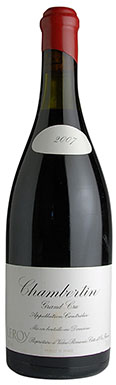
Good nose. Rich and full, profound and classy. A lot of wine here for a 2007. Splendid fruit and a lot of depth and concentration....
2007
Domaine LeroyChambertin Grand Cru
Domaine Leroy, Chambertin Grand Cru, Burgundy, France, 1998
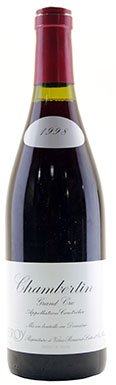
Medium-full colour. Still quite youthful. Interesting exotic nose with a touch of coffee. Certainly rich and opulent. Fine balance and high quality. Full body. Splendid...
1998
Domaine LeroyChambertin Grand Cru
Domaine Leroy, Romanée-St-Vivant Grand Cru, Burgundy, France, 2009
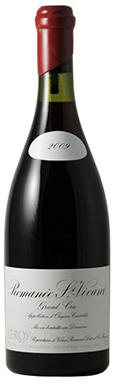
Very lovely, perfumed, Chambolle-ish nose. Fullish body. Very complex. Lovely harmony. Very high class fruit. Splendid, long, lingering finish. Excellent.
2009
Domaine LeroyRomanée-St-Vivant Grand Cru
Domaine Leroy, Romanée-St-Vivant Grand Cru, Burgundy, France, 2007
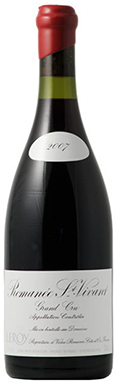
This is very, very lovely. Splendidly concentrated, poised fruit. Very good grip. Only medium-full body, but intense and elegant, long and complex. Very fine indeed.
2007
Domaine LeroyRomanée-St-Vivant Grand Cru
Domaine Leroy, Musigny Grand Cru, Burgundy, France, 2009
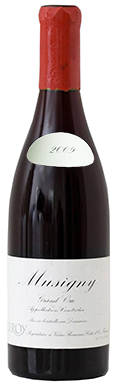
Still very, very closed. Fat, rich and concentrated on the nose. Very lovely, balanced, fragrant fruit. This is very complex and the finish is excellent.
2009
Domaine LeroyMusigny Grand Cru
Domaine Leroy, Clos de Vougeot Grand Cru, Burgundy, France, 1995
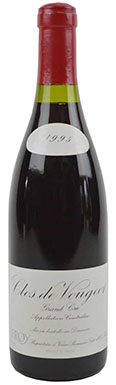
Medium-full colour. Just about mature. Rich, fresh, harmonious nose. Round and concentrated. Very good grip and class. Fullish body. Just about ready. Lots of vigour....
1995
Domaine LeroyClos de Vougeot Grand Cru
Domaine Leroy, Clos de Vougeot Grand Cru, Burgundy, France, 2005
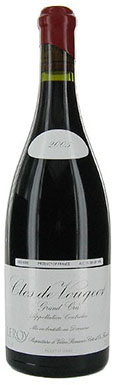
Full, immature colour. Full, rich, concentrated, pure, stylish nose. Fullish body. Very energetic. A lovely, classy wine and one of the wines of the tasting....
2005
Domaine LeroyClos de Vougeot Grand Cru
Domaine Leroy, Clos de Vougeot Grand Cru, Burgundy, France, 1999
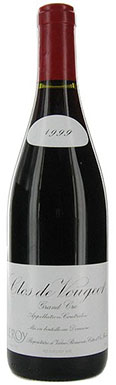
Fine, full, immature colour. Rich, abundant, harmonious, three-dimensional nose. Very lovely fruit here. Fullish body. Quite meaty, very ripe and rich on the palate. Lots...
1999
Domaine LeroyClos de Vougeot Grand Cru
Domaine Leroy, Clos de Vougeot Grand Cru, Burgundy, France, 1993
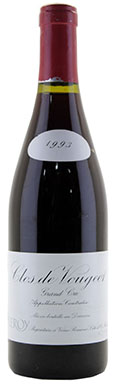
Splendid full, immature colour. The nose is still closed. Very rich and concentrated. Some tannin still to resolve. On the palate this is essence of...
1993
Domaine LeroyClos de Vougeot Grand Cru
