
Finding value in St-Emilion
It really needn’t be seen as a contradiction in terms, explains James Lawther MW, who selects 15 great wines that offer both quality and fair pricing from this much-admired Bordeaux Right Bank region.

Write a feature on finding value in St-Emilion, the editor said. It doesn’t exist was my instant reply. The name alone carries a premium, conjuring up everything from images of the heavily visited medieval town itself and the accolade of UNESCO World Heritage site, to legendary names like Châteaux Ausone and Cheval Blanc. Properties are small, 8ha the average size, and land prices rarely fall below €200,000 per hectare with some running to millions. Value: you must be joking.
But then I gave the subject some thought. Scratch below the surface and you do find growers and négociants that make an effort on quality at a certain price. Then you have châteaux that are part of a stable that includes star-studded names, which benefit from the top-down expertise. There are châteaux where a new generation or new investors are pushing harder but prices remain reasonable. And, of course, there are the second wines from some of the premiers grands crus classés – OK, they aren’t given away, but compared to the price of the grand vin, these can offer both value and stylistic affinity. A little insider information helps put this into focus, so with that in mind, here are some of my thoughts.
Stable basis
The most celebrated négociant on the Right Bank is Ets Jean-Pierre Moueix. The house was originally founded in 1937 as a merchant specialising in bulk wines, but it is better known today for its ownership of St-Emilion premier grand cru classé Château Bélair- Monange, as well as a host of top-flight Pomerols including La Fleur-Pétrus, Hosanna and Trotanoy. Sourcing decent wine from around the region was one of founder Jean-Pierre Moueix’s skills and today the house continues to produce an own-label St-Emilion from bought-in wines. ‘The wines have to fit our style, which is one of fruit, balance and freshness – and can come from a range of terroirs,’ explains Edouard Moueix, general manager of the family-owned company.
Production of the Jean-Pierre Moueix St-Emilion bottling temporarily ceased in 2011, but the wine was relaunched with the 2015 vintage and a new art-deco label. The 2016 followed and then 2018, the 2017 absent due to frost. The wines are blended and aged at the company cellars, so benefit from the expertise of the technical team. It’s the perfect introduction to St-Emilion at a very reasonable price. The same wine with a slightly different label is part of the Marks & Spencer portfolio.
Also doubling as négociant and grower, Denis Durantou’s reputation is closely linked to the rise of leading Pomerol estate Château l’Eglise Clinet. Other properties in the same stable include Châteaux Les Cruzelles in Lalande de Pomerol and Montlandrie in Castillon. He also produces a St-Emilion brand, Saintayme, the wine sourced annually (since 2003) from the same vineyard and producer in St-Etienne-de-Lisse. Durantou selects the wine and acts in an advisory capacity, certain practices used at L’Eglise-Clinet applied. This generous 100% Merlot definitely hits the value theme and is approachable relatively early. The same wine is sold by Lay & Wheeler as Château Amélisse (£20 for the 2014 vintage).
‘We use similar winemaking techniques to those used at Ausone, but the contrast is in the terroir’ – Pauline Vauthier, Château de Fonbel
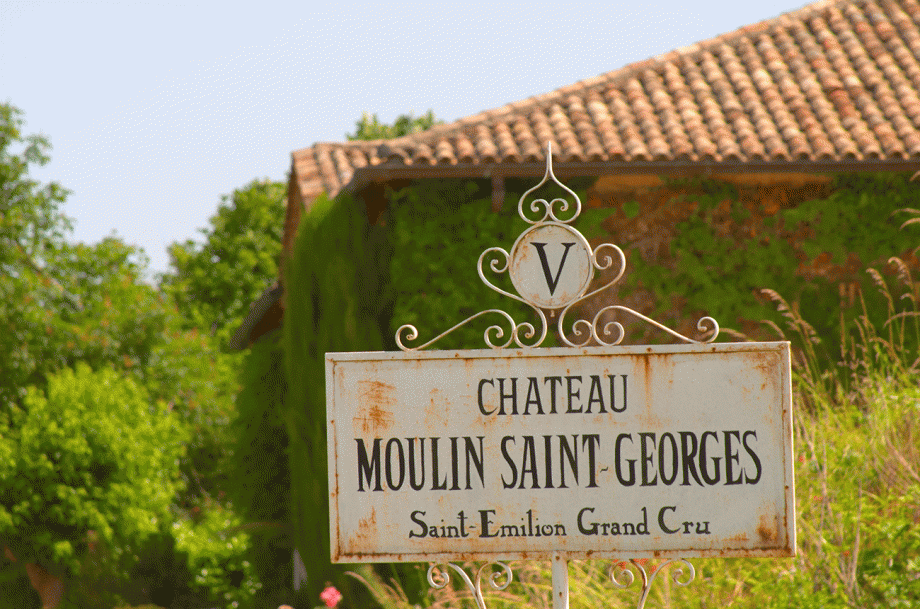
Speaking of stables of properties, the one owned by the Vauthier family definitely deserves a mention. The jewel in the crown is clearly the intense, long-ageing, highly priced Château Ausone. The other châteaux (Fonbel, La Clotte, Moulin St-Georges, Simard) fall into a more affordable bracket, none more so than Château de Fonbel. The majority of the 16ha vineyard is located on the alluvial Dordogne plain, making this an example of how technical expertise can make the most of a more limited terroir. The parcels have been drained, density for part of the vineyard is at 8,300 vines per hectare, and the Vauthier-Ausone team is at work in the vines and cellar throughout the year. ‘We use similar winemaking techniques to those used at Ausone, but the contrast is in the terroir,’ explains winemaker Pauline Vauthier.
Yields, of course, are different as well, an average of 30hl/ha for Ausone compared to 50hl/ha for Fonbel, but this remains one of the most refreshing and consistent entry-level St-Emilions around. The same wine has also doubled as Berry Bros & Rudd’s own-label St-Emilion for a number of years. This will change with the 2017 vintage, with crop loss due to frost inciting a change to Château Simard. One last word on the Vauthier stable: make a note of Château Moulin St-Georges. It’s a more serious, long-ageing wine produced from grapes grown on clay-limestone soils opposite Ausone and therefore more expensive. But there’s value here. The only reason it has never been classified is that it shares a cellar with Fonbel. Ausone’s fellow premier grand cru classé (A), Château Cheval Blanc, also has a sister St-Emilion, Château Quinault l’Enclos. The property was bought by luxury goods group LVMH in 2008 and since then has shared the same seasoned winemaking team and philosophy. ‘We try to produce the best grapes possible and not damage them in anyway,’ outlines technical director Pierre-Olivier Clouet.
In practice that has meant analysing the sandy-gravel vineyard, replanting certain parcels of vines, augmenting the percentage of Cabernet Sauvignon, harvesting the grapes earlier, building a new cellar and using 500-litre barrels (50% new oak) for ageing. It’s not Cheval Blanc, but Quinault l’Enclos is finer and more balanced than in the past and offers good value as a grand cru classé.
St-Emilion: know your vintages
2017 Worst frost attack since 1991 led to heavy crop loss. St-Emilion plateau fared best, otherwise variable.
2016 Later harvest but both quality and quantity. High tannin, acidity and alcohol but, nonetheless, wines that are pure, balanced and precise.
2015 Great year for Merlot. Wines with a sunny disposition: rich, powerful and opulent. Lower acidity than 2016.
2014 Saved by an Indian summer. Medium-bodied wines are fragrant, elegant and classic in style. Can provide value.
2013 Most taxing vintage in the last 20 years. Difficult flowering and rot in the Merlot. Light and early drinking.
2012 Up and down season, but Merlot generally harvested before October rain. Fruit and charm for earlier drinking. Some wines offer value.
2011 Challenging year with varied quality. Initially hard and ungiving but they are softening and opening now. Can surprise.
2010 Outstanding year – powerful and concentrated wines with the potential for long ageing.
The idea of finding a suitable substitute for a ‘dream’ château such as Cheval Blanc at a less inflated price is probably wishful thinking. These are one-off estates with a special terroir and history, but here are a couple of suggestions, both grands crus classés. Château Jean Faure is located less than 100m away from Cheval Blanc, has sand and clay soils similar to part of the Cheval Blanc terroir and a vineyard planted with 60% Cabernet Franc. The property has been renovated and restructured since Olivier Decelle acquired it in 2004 and is now organically certified. Once again, this is not Cheval Blanc, but the dominant Cabernet Franc provides a parallel.
Château St-Georges Côte Pavie shares a name, terroir (the Côte Pavie) and boundary with neighbouring premier grand cru classé (A) Château Pavie. There’s a similar force to the wine if not the same intensity and precision, but things are on the move here, with a new generation at the helm. A new cellar is planned for 2020 and a little more Cabernet Franc (presently 80% Merlot, 20% Cabernet Franc), so keep an eye on this estate.
Second best?
Probably the closest shot to finding an affordable replacement for these top wines is to opt for the second label. The ownership and technical know-how are the same. Stylistically the two wines are often similar, and price-wise you are likely to pay anything up to four or five times less for a second wine. Admittedly, intensity and longevity are reduced – often the result of young vines, or a parcel or cuvée that doesn’t quite make the grade – but for earlier drinking this could be a bonus.
Three second wines that I feel offer value and interest all come from premiers grands crus classés that either have had or are currently having extensive investment and restoration. Petit-Figeac is the second label of Château Figeac, and with its hallmark blend of Merlot, Cabernet Franc and Cabernet Sauvignon, really does offer an introduction to the grand vin. Château Troplong Mondot, like Figeac, is having a new winery built. It is also changing to a more elegant style, as is the second wine, Mondot – the 2017 is the first vintage in the new form. Château Canon already has refined lines and since 1996 has established a separate winery and vineyard for the second label, Croix Canon (formerly Clos Canon until 2011).
Committed to quality
Finding unfamiliar names that offer quality and value is a more difficult task. There are 638 producers in St-Emilion, so an ear to the ground and some inside information helps. Château Pindefleurs is an exclusivity of Jean-Pierre Moueix for export markets and the merchant has made a sound choice.
Dominique Lauret bought the 5ha property in 2006, gradually adding other parcels to take it to the present 20ha located on the sand, gravel and clay soils below St-Emilion town. Her daughter Audrey joined as winemaker in 2009 (as well as son Pierre in 2016) and is now turning out some really succulent, approachable wines.
In the past the search for aspiring châteaux was focused close to the town of St-Emilion, but now the net can be cast throughout the region to find quality and value. Château Mangot is located in the eastern sector at St-Etienne-de-Lisse. The neighbouring vineyards are those of Valandraud, Faugères, Fleur Cardinale and Pressac, all châteaux that proved their worth in the 2012 St-Emilion classification. This is a later-ripening zone and the vineyards need careful management – something that brothers Karl and Yann Todeschini have taken in their stride as they build on their parents’ labours. There’s real commitment here and wines with structure and character.
The same can be said for Châteaux Haut-Brisson and Tour St-Christophe, both part of the group Vignobles K. Hong Kong-based owner Peter Kwok has been both patient and perceptive, realising viticulture and winemaking need a long-term approach. Investment has been generous but specific, and a professional winemaking and management team assembled under the orders of manager Jean-Christophe Meyrou.
Originally located on the sand and gravel soils of St-Sulpice de Faleyrens to the southwest of St-Emilion, Château Haut-Brisson was purchased by Kwok in 1997 but evolved in 2015 with the addition of vineyards and a new winery on the limestone-clay soils of St-Etienne-de-Lisse (it is now owned by a private investor but still managed by Vignobles K). The 20ha Château Tour St-Christophe in St-Christophe-des-Bardes (limestone-clay again), just to the town’s east, was acquired in 2012 and has been transformed from obscure cru to grand cru classé in all but name. Both offer value within the context of St-Emilion, as for the moment does grand cru classé Château Bellefont-Belcier, which is also managed by Vignobles K.
Clearly, prices vary among the châteaux mentioned, but hopefully there is something for everyone’s pocket. There’s value to be found, you just need to set a limit.
Lawther’s pick: Top-value St-Emilion
Château Moulin St-Georges, St-Émilion, Grand Cru, Bordeaux, France, 2015

A revelation: at once sumptuous and pristinely balanced and focused – it puts some grands crus classés in the back seat. Bright and juicy blackberry...
2015
Château Moulin St-GeorgesSt-Émilion

Château Quinault L'Enclos, St-Émilion, Grand Cru Classé, Bordeaux, France, 2016
Attractive nose, floral notes with a hint of mint, the palate is gourmand but fresh. Stays on the fruit and is really harmonious, with a...
2016
Château Quinault L'EnclosSt-Émilion
Château Tour St Christophe, St-Émilion, Grand Cru, Bordeaux, France, 2016
<p>Ripe, almost jammy nose but falls shy of overripe. Palate suave and opulent – big tannic frame coated in generous fruit. Energy and tension helps...
2016
Château Tour St ChristopheSt-Émilion
Château Troplong Mondot, Mondot, St-Émilion, Grand Cru, Bordeaux, France, 2017
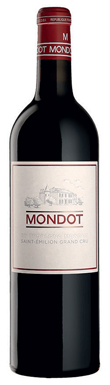
<p>First vintage of the new, elegant style. Lighter, more linear than in the past with greater precision. Fresh and appetising with crunchy fruit and a...
2017
Château Troplong MondotSt-Émilion
Château de Fonbel, St-Émilion, Grand Cru, Bordeaux, France, 2016
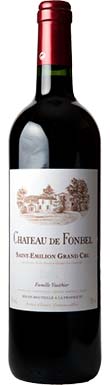
Rich autumnal hedgerow packed with ripe blackberry fruits and overlaid with a fresh, herbal, spicy edge that pulls the mid-palate inwards and allows it to...
2016
Château de FonbelSt-Émilion
Château Canon, Croix Canon, St-Émilion, Grand Cru, Bordeaux, France, 2014
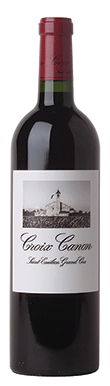
Long, linear and refreshing in style with juicy fruit and vigour. Blueberry and spice aromatics, and a certain grip on the finish which drives it....
2014
Château CanonSt-Émilion
Château Grangey, St-Émilion, Grand Cru, Bordeaux, France, 2016
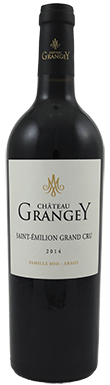
Formerly with the cooperative but making its own wine since 2013. A certain power, but round and civilised. Morello cherry and vanilla notes. Palate suave...
2016
Château GrangeySt-Émilion
Château Haut-Brisson, St-Émilion, Grand Cru, Bordeaux, France, 2016
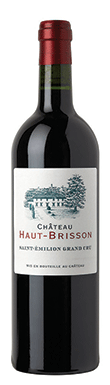
Blackcurrant and dark fruit notes with a hint of quality oak. Palate appetising with fresh grainy tannins on the finish. Lovely balance.
2016
Château Haut-BrissonSt-Émilion
Denis Durantou, Saintayme, St-Émilion, Grand Cru, Bordeaux, France, 2016
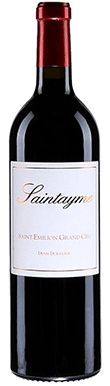
Slightly reserved but has plenty of crunchy dark fruit. There’s Morello cherry as it opens and the palate is structured and persistent, with drive and...
2016
Denis DurantouSt-Émilion
Château Mangot, St-Émilion, Grand Cru, Bordeaux, France, 2016
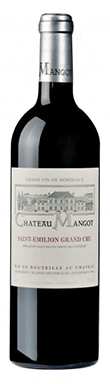
A neighbour of Château Faugères, expected to be classified next time around. It has exceptional terroir, and is now run by the two Todeschini brothers,...
2016
Château MangotSt-Émilion
Château Jean Faure, St-Émilion, Grand Cru Classé, Bordeaux, France, 2014
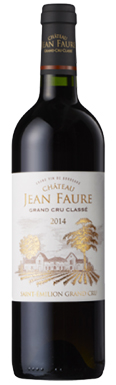
50% Cabernet Franc as well as a little Malbec. Fragrant and expressive: dark fruit, cherry and liquorice notes. Beautiful texture. Fine but strong tannins. Lovely...
2014
Château Jean FaureSt-Émilion
Château St-Georges Côte Pavie, St-Émilion, Grand Cru Classé, Bordeaux, France, 2015
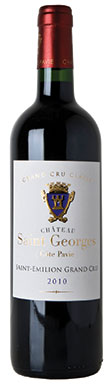
Aromatically reticent but shows lots of minerality. Tight and firm palate with a dry, saline finish. Good but austere.
2015
Château St-Georges Côte PavieSt-Émilion
Château Pindefleurs, St-Émilion, Grand Cru, Bordeaux, France, 2016
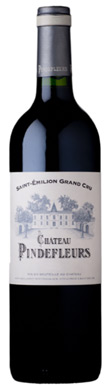
This 17ha vineyard in the Moueix stable has produced a cherry-red wine with careful extraction that makes everything feel extremely well held in check. There's...
2016
Château PindefleursSt-Émilion
Jean-Pierre Moueix, St-Émilion, Bordeaux, France, 2016
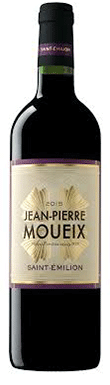
Juicy and fresh with well-worked tannins. Limited complexity but adequate fruit and flavour. Satisfying entry-level St-Emilion.
2016
Jean-Pierre MoueixSt-Émilion
