
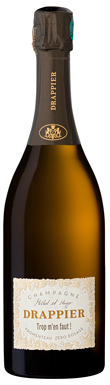
First taste: Drappier ‘Trop m’en faut!’
Yohan Castaing tastes a special Champagne cuvée made from an unexpected grape variety.


100% Fromenteau is not the answer you’d expect when enquiring about a Champagne blend. But ‘Trop m’en faut!’ isn’t a run-of-the-mill Champagne, a fact hinted at by the quirky name, a Rabelaisian phrase that translates as: ‘It is so good that one cannot have too much of it!’.
See the tasting note and score for Drappier ‘Trop m’en faut!’
Rare variety
More commonly known as Pinot Gris, the Fromenteau grape variety makes up just 0.3% of the Champagne AP area, along with other lesser known varieties Petit Meslier, Arbane and Blanc Vrai – but account for 6% of Drappier’s plantings.
The brainchild of Hugo Drappier, the idea with this new cuvée is to provide a rich expression of the Drappier terroir, through a wine produced using traditional Champagne methods, which at the same time is part of a new generation of authentic, natural Champagne.
The Drappier family has been based since 1808 in the village of Urville, situated in the southern part of the Champagne region known as the Côte des Bar. Michel Drappier and his children Charline and Hugo all believe in spreading the word about the ancient grape varieties of the Champagne region that still exist alongside the classic trio of Chardonnay, Pinot Noir, and Pinot Meunier.
Blend of two vintages
‘Trop M’en Faut!’ is a blend of two vintages, 2017 and 2018, in equal proportions, and only 5,500 bottles were produced.
It was made as naturally as possible. The base wine underwent malolactic fermentation, but no enzymes were added. Half of it was aged in once-used barrels while the other half went into larger casks called demi-muids that had already been used for three previous vintages. The oak is sourced from a regional wooded area known as the Forêt du Temple in the sector of Aube.
There is scant use of sulphur for this cuvée and no dosage at all.
Chablis-like soils
The Champagne is produced with grapes from a small Drappier parcel named Truchots, the vines planted on prime Kimmeridgian limestone soils, which are, as Hugo Drappier likes to point out, similar to the soils found in the grand cru sector of Chablis.
It is a sunny, southwest-facing site lying at an altitude of 280 metres – ‘quite high for the Champagne region,’ according to Drappier.
Farming is organic and horses are used to work the land. Only one grape variety is planted on this plot, the aforementioned Fromenteau, but the Champagne appellation rules do not allow any mention of it on the label.
Creative thinking
To get around that restriction, Drappier creatively pulled out of his hat the rhetorical device known as paronomasia to play on the phonic similarities between the name of the grape and a catchphrase originating from a text in old French by Rabelais to designate his Champagne that aspires to be ‘too good to be true’.
As for the specific nomenclature of the grape itself, ‘I insist on using Fromenteau and not Pinot Gris, because it is in fact a cousin of Pinot Gris sourced from grafts found in the Champagne region,’ explains Drappier.
Recent DNA analysis has shown, however, that they are in fact one and the same. The wines made from either grape variety certainly share characteristics, among which Drappier emphasises ‘the pink hue of the must as well as notes of Mirabelle plums and even exotic fruits in the wine’. He also alludes to the low acidity and high alcohol.
Trop M’en Faut!’ is an unusual and attention-grabbing cuvée, with notes of exotic fruit such as guava, and a tannic sensation that provides structure to a long but oh so elegant finish.
The wine is distributed in the UK by Berkmann Wine Cellars.
See the tasting note and score for Drappier ‘Trop m’en faut!’
Related content
From non-vintage to multi-vintage: Champagne rips up the rule bookFirst taste: Salon 2012 and Delamotte 2014First taste: Piper Heidsieck, Hors-Série 1971
Drappier, Trop m'en faut!, Champagne, France

An understated nose of ripe apricots touched with honey, beeswax and dried flowers. The texture is dense and waxy; the finish is long. It is...
Drappier

