
First taste: Fleur de Miraval ER2
Elizabeth Gabay MW visits Brad Pitt’s Provence wine estate to attend an exclusive tasting of the second release of the Fleur de Miraval rosé Champagne, named ER2.


When Brad Pitt and Angelina Jolie purchased Chateau Miraval, in the hills of northern Provence, in 2008, they purchased a working vineyard as well as a home.
Rather than continue making the same wines, they decided to take a more proactive approach and went into partnership with the Perrin family (based in the Rhône Valley and, most famously, owners of Château de Beaucastel).
Scroll down to see the tasting note and score for Miraval’s newest Champagne release ER2
Focus on rosé
By 2012 the bulk of the wine production had moved away from producing all three colours to producing one rosé, Miraval.
In its distinctive squat bottle, and with its famous Hollywood owners, the wine became an instant success. Decisions were made to expand the range and seven years later, there is now a second label, Studio, and a premium rosé, Muse, available only in magnum, made from the best fruit on the estate.
Early on, Pitt was interested in also adding a pink Champagne to the portfolio. He and Perrin tasted and researched different styles of rosé Champagne, looking for a style they liked.
They approached Rodolphe Péters, of the Champagne house Pierre Péters, who had acted as a consultant to the Perrin family in the creation of their Rhône sparkling pink.
Champagne expertise
Péters, an established house for six generations, has 20 hectares, including 16ha of grand cru vineyard, mainly around Mesnil-sur-Oger, on the Côte des Blancs. Together, Perrin, Pitt and Péters created a new enterprise, Fleur de Miraval, to make a single pink Champagne, called ER (Exclusively Rosé). As a non-vintage Champagne, the years are numbered from the first year.
ER1 was released in 2020 and ER2 in 2021.
Pitt’s vision was to make a rosé Champagne that had the maturity of an old vintage and the freshness of a young wine, blended with rosé rather than red wine for a pale colour and a delicate fruit.
Chardonnay styles
Looking through the overly dramatic descriptions and marketing hype surrounding Fleur de Miraval, the details on how the wine is made are interesting.
The method used involves 25% young fresh Pinot Noir rosé from Vertus, added to 75% Chardonnay. The Chardonnay is made up of three different styles.
One third is vintage (2016 for ER1 and 2017 for ER2), predominantly from Le Mesnil and some from plots on the Côte des Blancs.
One third comes from the Péters perpetual reserve, which includes wine going back to 1998 aged in 140hl casks. The final third is seven year-old blanc de blancs purchased sur latte – almost finished Champagne in bottle. These bottles were emptied and added to the base blend. The combined wines are then bottled and undergo a second fermentation.
The wine is then aged on the lees for three years with a dosage between 4 to 4.5 g/L.
The bottles are lacquered to prevent lightstrike, with the moulded initials P of all three families, and the wine is presented in a pink box. Production is limited: 20,000 for ER1 and 22,000 for ER2.
Fleur de Miraval is distributed in the UK through Liberty Wines, at a recommended retail price of £320.
See the tasting note and score for Miraval’s newest Champagne release Fleur de Miraval ER2
Related content
Dom Pérignon Rosé 2008 releasedFirst taste: Salon 2012 and Delamotte 2014From non-vintage to multi-vintage: Champagne rips up the rule book
Fleur de Miraval, Fleur de Miraval NV (ER2), Champagne, France
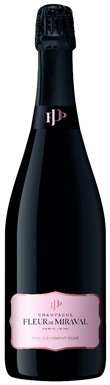

Fleur de Miraval, a rosé only Champagne house, is a collaboration of three families: the Perrins, the Pitts, and the Péters. Medium salmon in colour....
Fleur de Miraval

Fleur de Miraval, Fleur de Miraval NV (ER1), Champagne, France
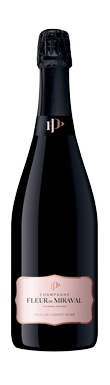
Very pale pink, almost creamy white. Dominant leesy autolysis on the nose. On the palate, full-bodied mature weight with some opulent red fruit richness, blood...
Fleur de Miraval
