
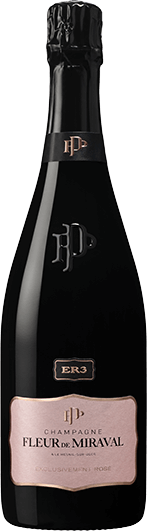
First taste: Fleur de Miraval ER3
Elizabeth Gabay MW tastes and rates the newly released, third iteration of Fleur de Miraval Champagne, ER3, finding it 'more vibrant and freshly youthful than ER1 and ER2'.


It comes as no surprise that many Champagne houses have invested in Provence, with their similar marketing image of luxury, lifestyle and quality. Brad Pitt and Marc Perrin moved in a slightly different direction, starting with a Provence rosé and then taking their passion for rosé to Champagne.
Scroll down to see the tasting note and score for Fleur de Miraval ER3
Inception
With a sparkling rosé in mind, and following a blind tasting of pink sparkling wines from around the world, they decided to focus on Champagne. They started by tasting white prestige Champagnes alongside the rosé equivalent, from their favourite producers, discovering that the rosés were often dissimilar to the whites. Particularly keen on the qualities of aged Chardonnay, their vision was to make a rosé Champagne with the maturity of an old vintage and the freshness of a young wine, blended with dark rosé rather than red wine.
They approached Rodolphe Péters, of the Champagne house Pierre Péters (an established house for six generations which owns 20ha, including 16ha of grand cru vineyard in the Côte des Blancs).
Together, Perrin, Pitt and Péters created a new company, Fleur de Miraval, focusing on a pink Champagne called ER (Exclusively Rosé).
The wine
The blend is made of 25% young Pinot Noir vinified as a rosé de saignée from the same parcel every year in Vertus (the premier cru village immediately south of Le Mesnil), for vivacity and bright chalky Pinot aromas.
As for the backbone of the wine, 50% of the blend comes from a perpetual reserve of grand cru Chardonnay which has been aged on the lees in oak casks, tank and concrete, going back to 2007.
The final 25% of the blend comes from aged bottles of grand cru blanc de blancs from the Côte de Blanc, sourced from different vintages. This process is called remise en cercle and involves uncorking and adding these bottles back into the base wine.
The variations
The vintages of these aged bottles vary with each edition of Fleur de Miraval ER:
- ER1: included 2002 and 2008.
- ER2: included 2004 and 2006, both rich vintages
- ER3: includes 2000 (a difficult vintage for Chardonnay, but contributing here some creamy texture) and 2009 (a hot, dry year with more cooked, rich fruit).
The blended wine is then aged on the lees for three years with a dosage between 4 to 4.5 g/L.
As it is a non-vintage Champagne, each iteration is numbered: ER1 was released in 2020, ER2 in 2021, and ER3 in 2023. Production is limited: 20,000 bottles for ER1, 22,000 for ER2 and 20,000 for ER3.
Fleur de Miraval is distributed in the UK through Liberty Wines, at a recommended retail price of £320.
Fleur de Miraval ER3 tasted and rated:
Related articles
- Brad Pitt reopens Miraval Studios at Provence wine estate
- Brad Pitt launches skincare range using ingredients from Rhône Valley vineyard
- First taste: Brad Pitt and partners reveal rosé Champagne ‘Fleur de Miraval’
- First taste: Fleur de Miraval ER2
- Champagne crusader Pierre Péters: producer profile
Fleur de Miraval, Fleur de Miraval (ER3), Champagne, France

Pale salmon pink in the glass, with very pretty floral aromas and delicate hints of autolysis. This progresses to delicate fruits and a zesty, crisp,...
Fleur de Miraval

