
Leclerc Briant: the biodynamic house every Champagne lover should know
Yohan Castaing tastes wines from this pioneering estate...


The Leclerc Briant Champagne house was reborn in 2012, rising like a phoenix from the ashes. Its origins date back to 1872, when Lucien Leclerc, from a family of grape growers, created a domaine in the village of Cumières, not far from Aÿ. This formed the basis of the family enterprise before its move to Epernay in 1955, where Bertrand Leclerc and his wife, Jacqueline Briant, transformed it into an officially recognised Champagne house.
It was this same Bertrand, representing the fourth generation, who took the first steps to switch to organic farming in the 1960s. At that time, few grape growers – and even fewer Champagne houses – were inclined to adopt organic practices.
In 1990, Bertrand’s son Pascal took over and soon devoted half a hectare of the vineyard to biodynamic farming. However, Pascal turned out to be ‘more of a dreamer and less suited to the role of manager,’ as Frédéric Zeimett, the current director of Leclerc Briant, puts it. Despite its biodynamic certification, the house struggled to survive, and after Pascal’s death in 2010 his descendants put the enterprise up for sale.
A new chapter
An American couple, Mark Nunnely and Denise Dupré, who today also own both Domaine de la Commaraine and Domaine de Belleville in Burgundy, acquired the moribund house but without the majority of its vineyards, which had been divided between two other major producers, Lanson-BCC and Louis Roederer. All they retained was one small but prized parcel right in Epernay, named La Croisette, which Roederer allowed the couple to add to their new holdings. Roederer also made other parcels available to be farmed organically by Leclerc-Briant.
It is surely thanks to this relationship with Roederer, but especially to Frédéric Zeimett – who had previously worked for 23 years as a grape buyer at Moët & Chandon – that organic but also biodynamic vine contracts were rapidly put into place. A few well-known independent Champagne producers also aided the revival of the house, including Ruppert-Leroy and David Leclapart. Thanks to his experience as director of Maison Chapoutier from 2009 to 2011, Zeimett was not unfamiliar with biodynamics, but he also brought on board as cellar master the oenologist Hervé Jestin, native of Bordeaux but former cellar master for Duval-Leroy, who was well-experienced with such an approach.
The house was soon reinvigorated and quickly garnered critical success around the world. Allocation became the rule for the 3,000 bottles produced for the site-specific cuvée named after the La Croisette plot. Zeimett and Jestin get along wonderfully and have lost no time in improving the production both qualitatively and quantitatively. Today, Leclerc Briant is the only 100% organic Champagne house to source grapes from three emblematic regions of Champagne: Côte des Blancs, Montagne de Reims and Côte des Bar. With nearly 13 hectares in production, mainly in grand cru villages (Mailly, Le Mesnil) and premier cru villages (Hautvillers, Cumières, Mareuil sur Aÿ, Bisseuil, Rilly la Montagne, Villers-Allerand, Trépail), the house also uses bought-in grapes from 15 organically or biodynamically farmed hectares.
Pioneering approach
To consolidate the reputation of Leclerc-Briant, this dynamic and bold duo does not hesitate to innovate. A case in point is the cuvée named Abyss that is bottle-aged for a spell under water at a depth of 60 metres in the Atlantic off the Breton island of Ouessant. As for the flagship La Croisette cuvée, it now undergoes a three-stage ageing process, first in oak barrels, then ceramic egg-shaped containers, before a final period in stainless steel vats lined with 24-carat gold. Wine tourism is also part of the game plan, and guest rooms located right on the Avenue de Champagne, the region’s equivalent of the Champs-Elysées, are now available to clients and tourists.
With the help and encouragement of the owners, the two sixty-something cohorts are acting as if they were twenty-somethings leading a young start-up at the forefront of the winds of change sweeping through the Champagne region, as much as through the house they work for.
Tasting Leclerc Briant
Leclerc Briant, Grand Blanc - Cramant/Chouilly, Champagne, France, 2013
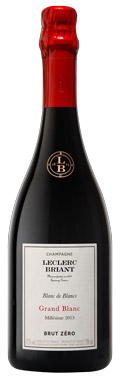

Disgorged June 2019. 100% Chardonnay. Zero dosage. With notes of pear, menthol, gentle spices, and a hint of smoke, the bouquet impresses from the start...
2013
Leclerc Briant

Leclerc Briant, Abyss, Champagne, France, 2014
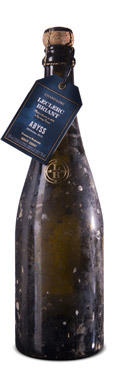
Bottle-aged for 18 months at a depth of 60 metres under sea, this cuvée is composed of one-third Pinot Noir from Villers-Allerand, one-third Chardonnay from...
2014
Leclerc Briant
Leclerc Briant, La Croisette - Blanc de blancs, Champagne, France, 2015
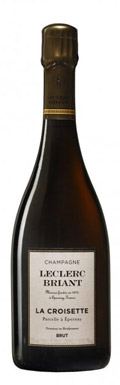
Disgorged in May 2019, this offers a superb nose of pear, white peach, flowers, citrus zest along with a sea breeze freshness. The vibrant palate...
2015
Leclerc Briant
Leclerc Briant, Champagne, France, 2013
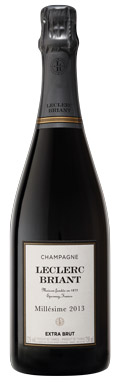
Disgorged April 2019. Dosage: 0g/L. Residual sugar: 2g/L. This cuvée is made from 40% Pinot Noir, 40% Chardonnay and 20% Pinot Meunier. The aromatics are...
2013
Leclerc Briant
Leclerc Briant, Blanc des Meuniers - 1er Cru, Champagne, France
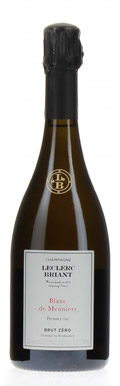
Produced from vines planted on limestone in Chamery. Base wine from 2015 vintage. Disgorged June 2019. The mineral-infused nose offers marked notes of flint, chamomile...
Leclerc Briant
Leclerc Briant, Brut Réserve, Champagne, France
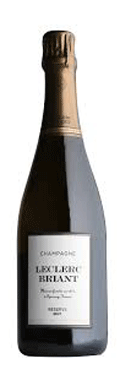
Disgorged July 2019. Dosage 4g/L. Base wine from 2015 vintage (90%). Lively and energetic nose full of floral and herbal scents, including chamomile. A full,...
Leclerc Briant
Leclerc Briant, 1er Cru Extra-Brut, Champagne, France
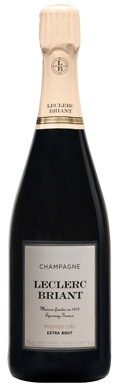
Disgorged April 2019. 30% barrel-aged. Dosage: 2g/L. This blend of 70% Pinot Noir, 15% Chardonnay and 15% Pinot Meunier offers an elegant and fresh nose...
Leclerc Briant
