
Anson: Inside Lafite’s China project – The road to Long Dai
Jane Anson reports from an exclusive visit to newly launched Domaine de Long Dai and gives the inside story on how the owner of Château Lafite Rothschild created its first Chinese winery.


As we were leaving Paris, a message came from Baron Eric de Rothschild to secure 1kg of foie gras.
Chinese officials due at the launch of Domaines Barons de Rothschild’s Long Dai winery the following evening would be expecting to sample France’s unofficial national dish.But with 24 hours to go, finding a supply in Penglai was proving tricky.The doors of our plane had just closed, leaving the connection in Seoul as our best bet. It turned out that the closest Incheon airport came to French delicacies was a croissant at Paris Baguette café, but a colleague at the Rothschild bank in Shanghai stepped in to save the day. The officials got their foie gras.They also got a first look at the most anticipated wine project in China.A whole industry in Penglai, in northeast China’s Shandong province, is riding on the success of this one 35-hectare estate.
Pressure to complete it has been constant pretty much since the project’s inception in 2008.Local officials in China have a four to five-year term, and successive ones wanted the reflected glory of the Domaines Barons de Rothschild (DBR Lafite) project opening under them. One by one, their terms came and went, but the wine was not deemed ready.
It also made me curious. I visited China’s other high profile foreign wine investment, Ao Yun, four years ago. By coincidence, Jean-Guillaume Prats is now managing director of DBR Lafite but was at the time with Ao Yun owner Moët Hennessy Estates & Wine.
That project, despite all of the logistical contortions of making a wine at 2,300m in the Himalayan mountains, took just a few years from identifying the site to releasing the inaugural 2013 vintage. With all of the investment power of Lafite, what took so long here?
While they might seem similar, the two projects couldn’t be more different.
Perhaps most importantly, although it takes imagination and perseverance to make Ao Yun in such a remote location, the vines themselves had been in existence since 1992, originally planted by the local government. And the extreme altitude of the location meant strong sun and low humidity.
DBR Lafite’s project began with a blank piece of paper, and so a different set of challenges.
A maritime climate in eastern China
Shandong Peninsula, where Penglai sits, juts out towards Korea on the eastern side of China between the Bohai Sea to the north and the Yellow Sea to the south.
There are mountains here – the most sacred being Mount Tai, which has given part of the name to Long Dai – but most of the terrain is closer to 100 to 200m above sea level.
You see the benefits and drawbacks of a maritime climate, not least the tail-end of a monsoon that hits with regularity for three weeks each summer.
It took a joint research project with the universities of Beijing and Bordeaux to identify and then find a response to the disease issue that arose from this short burst of high rain. There is mildew here, but no oidium, little rot and no need for pesticides.
The Long Dai terrain
Initial investigations were carried out by the late Gérard Colin, who worked at Grace Vineyards before coming onboard, and Olivier Trégoat, a terroir consultant at the time who is now full-time technical director across all non-Bordeaux DBR estates.
The French company – at first in a joint project with CITIC Group but since 2016 sole owners – had been granted a 400ha ‘exclusion zone’ to plant in, and Trégoat dug close to 500 soil pits over two years to find the best places for vines.
They decided on a spot in the Qiu Shan valley near to a reservoir, with the first vines planted in Spring 2011.
The terraced land, with sandy-clay soils, had previously been given over to growing fruit trees, mainly apples and apricots, as well as peanuts, corn and soy beans.
Looking to higher ground
But where most vineyards in the area have been planted on the fertile valley floors, Lafite chose the higher spots with the thinnest soils, ranging from 60cm to 1.2m over hard granite bedrock.
The winery itself came later, set in the middle of vines that are spread across 350 terraces, some as narrow as three metres wide. They are mainly south and southeast facing, although others look north.
The Cabernet Sauvignon has been planted on the poorest soils that share much of the potential drainage and heat retention as gravel. Cabernet Franc and Marselan lie on the more clay-heavy sections. Merlot and Syrah are mainly located on cooler north-facing terraces.
The first harvest came in 2013, with constant adaptation in both vineyard and cellar as the team learnt more about the climate and soils.
Nothing would be released until they were sure that the wine would deliver not just in one vintage but over time.
Protecting the name
The wait was not, however, just for viticultural reasons. There was also the need to ensure all the right protections were in place, not helped by the intense interest in all things Lafite in China.
DBR had to create a third-party company to register the brand to protect its identity, and non-disclosure agreements were signed by the lawyers, the designers and the printers back in Bordeaux.
Even with all of this, the first name chosen was leaked and immediately copied. Another one reportedly sounded a little too like ‘Putin’ when said out loud.
Once ‘Domaine de Long Dai’ was decided upon, it then had to be registered and protected in the myriad different systems used in China, and the packaging designed with the highest level of anti-counterfeit measures at every step.
Not even the staff knew the final choice until it was unveiled last week.
Starting a trend
Certainly the interest in Lafite in China doesn’t seem to be slowing down if the pace of local building works is anything to go by.
It’s surely no coincidence that, just standing on the terrace of Long Dai, you see four or five newly completed wineries, with others on the way. All are lavish projects with names that include Napa Village, Santa Fe, Runaway Cow.
There is even a wine tourism centre due to open that has been built to resemble the Coliseum.
Inside the Long Dai winery: Echoes of Lafite
All of this makes the Long Dai something of the fixed point of a turning world, from the wine itself to the pared-down elegance of the winery building and villa.
There are Lafite touches, of course. For example, the five arrows that represent the Rothschild family are carved into a slate wall.
In the Grand Hall dining area there are copies of the same family portraits that you find at Lafite in Pauillac; the 19th century faces of Baron James, Baroness Betty and her daughter, Charlotte.
The barrel cellar, too, is a replica of the circular cellar at Lafite, only here the pillars are painted a vibrant red.
But overall the winery is simplicity itself. There is slate, limestone, oak, teak, walnut, whitewashed walls and traditional Chinese pavilion-style architecture, with interior courtyards and open-framed timberwork.
The interiors are designed by Maria-Beatrice Caracciolo di Forino, Baron Eric’s artist wife, with no outside design agency. As ever, Lafite feels no need to go all out to impress.
The style of the wine
It’s why, after tasting the wine, I realised that I had been wrong to be sceptical of whether they were going to deliver on expectations.
Lafite’s power has always been an ability to work extremely hard at making things seem effortless, and they have achieved that again here.
The wine feels respectful of the fact that this is a peninsula, with coastal breezes and a sunshine-filled late season that allows for long slow ripening. As the vines age, they will deliver increasing complexity, too.
Flavour-wise, think cool climate Cabernet, like Hawke’s Bay or Sonoma Coast, and also Bordeaux; more so than Ao Yun, for instance, which for me is more Mendoza or Napa, or Ribera del Duero.
It may surprise those that expect a wine that is built to immediately seduce, but will not surprise those that know Lafite.
‘It was never our idea to create a French wine in China,’ says Saskia de Rothschild, Baron Eric’s daughter and now in charge of the family estates, at the launch.
‘But [we wanted] to make a great Chinese wine. It’s why we were more than happy to wait while we tried to understand what this particular site needed.’
Full tasting note for Long Dai, Qiu Shan 2017
Long Dai will be released to the Chinese market in September 2019, and to a few key spots internationally in January 2020. It will be priced at around US$250 (‘above Duhart, below Carruades,’ as they say).
Domaine de Long Dai, Qiu Shan Valley, Shandong, China, 2017
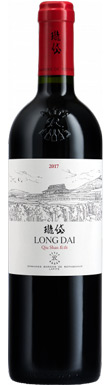

A sweet blast on the attack gives way to savoury black fruits and gentle spice. The Marselan seems like a very smart addition to this...
2017
Domaine de Long DaiQiu Shan Valley

