
From the archive: Producer profile: Domaine Georges Vernay
This famous estate played a key role in the survival of the Condrieu appellation. Today the third-generation winemaker is not only cementing the family’s reputation for Viognier but making a name with its Syrahs, too. Matt Walls reports.


Originally published in Decanter magazine in 2015.
Autumn is the perfect time to visit Condrieu. Sunlight hits the vines side on, illuminating their yellowing leaves. Your mind can’t help but turn to the languid, golden nectar soon to slide its way into your glass. For a dry wine it has an opulence that borders on the narcotic. To think this style was nearly lost forever is chilling.
Georges Vernay, who passed away at the age of 92 in 2017, played a vital role in its history, and the domaine that bears his name remains the appellation’s most famous. However, while Condrieu made the Vernay name, its Côte-Rôties have also been turning heads.
Scroll down for Matt Walls’ top five Georges Vernay wines
When I visited in the autumn of 2014, it was sunny but wet. There had been a torrential storm; pop-up waterfalls splashed from one tall terrace down to the next before they found their way to the swollen Rhône. The waters don’t have far to run – the village of Condrieu lies on the flat between the river and the crumpled granite that rises up behind the houses. Some of the dry stone walls that hold them up had toppled.

Despite the extra graft this promised, Georges’ daughter Christine was in high spirits. This will be her 19th vintage; at 89, Georges was happily retired. As they both knew, to make wine in Condrieu is to be accustomed to hard work.
When the appellation was granted in 1940 there were 170 hectares under vine; Condrieu is always made of pure Viognier, and at this time the variety was unique to the Rhône. But as growing industrialisation offered better paid, less arduous employment than working these slopes, growers abandoned the vineyards. By the 1950s there were just 6ha left.
The cornerstone of Domaine Georges Vernay is the vineyard planted by Georges’ father, Francis. Like many vignerons in the Rhône in the 1930s, Francis grew grapes alongside other crops. It was well known that vines grew best on the slopes and vegetables on the flat. Living at the foot of Condrieu’s Coteau du Vernon, he planted a hectare of vines on the hillside. Facing south, it happened to be one of the best sites in the village. Recognising its quality, he took the unusual step at that time of bottling the wine himself and selling it to nearby restaurants.
Georges Vernay at a glance
Location Condrieu, northern Rhône
Winemaker Christine Vernay
Vineyard area 22ha, farmed organically
Average vine age 40 years
Grapes 50% Viognier, 50% Syrah
Wines Condrieu: Coteau du Vernon, Les Chaillées d’Enfer, Terrasses de l’Empire
Côte-Rôtie: Maison Rouge, Blonde du Seigneur
St-Joseph Rouge: La Dame Brune, Terre d’Encre
Côtes-du-Rhône Rouge: Ste-Agathe
Vin de Pays des Collines Rhodaniennes
Viognier: Le Pied de Samson
Vin de Pays des Collines Rhodaniennes Syrah: Fleurs de Mai, De Mirbaudie
Georges took over from his father in 1953 when the vineyards of Condrieu were all but abandoned. He promptly cleared the other fruits and vegetables to concentrate solely on wine. ‘Nowadays it’s very fashionable to talk about terroir, but I grew up with it. My father really had this conviction,’ says Christine. Georges cleared dense oak and acacia woodland from the Coteau du Vernon slope, built terraces and planted another hectare.
During his 30 years as president of the Condrieu growers’ association, he helped to restore the appellation in a wider sense. An imposing character with a booming voice and a strong personality, he strived to convince the next generation that Condrieu was worth fighting for. The appellation’s fortunes finally started to improve in the 1970s, but it wasn’t until the 1980s that its future felt assured.
Strength to strength
Christine manages the estate alongside her husband Paul Amsellem. Amsellem is chatty, animated and slightly mischievous – quite a contrast to his wife. Serious and thoughtful in manner, Vernay speaks about her wines with eloquence; it’s no surprise that she’s a former language teacher. She feels more at home among the vines than hosting tastings: ‘I’m a free spirit… you have to come and find me.’
When Georges retired in 1996, he asked if either of his two sons or his daughter might want to take on the estate. Only Christine was interested. It was a surprise to the rest of the family; she helped out at the domaine when she was young, but never in the vineyards or the cellar – it wasn’t considered suitable work for a young woman at that time. ‘But it was my childhood, my roots,’ she says. ‘Paul was ready to follow me, and my children were young so it was possible to bring them along on the adventure.’ When she arrived at the estate, she had to teach herself everything.
Formerly more famous for whites, it is the red wines that Vernay has really developed during her tenure at the domaine, with holdings now in St-Joseph and Côte-Rôtie. ‘My father was so emblematic,’ she says. ‘I really had to find my own place. Syrah was something for me to discover; it had mystery for me. Now we make as much Syrah as Viognier. But they are two different worlds.’
For Vernay, making red wine is about energy, movement and immediate attention. She describes the process as ‘carnal, masculine’. Making whites, in contrast, is a much calmer and more delicate practice; when making whites, the winery feels more ‘like a church’, she says.
Viognier is not an easy grape to work with. Vernay explains that it’s capricious, sensitive to climatic conditions, prone to coulure (the failure of grape clusters to form properly after flowering) and gives irregular yields. It can also be overtly aromatic, overly alcoholic and lacking in acidity. The key, she says, is to avoid overmaturity. ‘You have to be very attentive. In just one or two days your alcohol levels can rise too high. What I look for is freshness, complexity and subtlety.’
Slopes and salinity
Georges Vernay was convinced that the slopes were crucial for quality. Not only do they offer good drainage, but they aid full ripening of the grapes. Soils are also a major factor. The estate’s holdings centre around the original heart of the appellation on a particular type of granite called biotite. Amsellem claims it is this soil type, coupled with vine age, that sets the best Condrieus apart from other Viogniers. ‘[The soil] gives the effect of salinity in the mouth,’ he says. ‘It’s a good example of minerality.’ The best wines have a refreshing, mouthwatering character despite their low acidity.
Viognier is now planted around the world, but Vernay believes it doesn’t reach the same heights of quality as in Condrieu. ‘It can be explosively aromatic,’ she says, ‘but this isn’t its raison d’être. This exuberant personality is what people know now, but these wines are heavy and lack freshness. It’s possible that people may not like Viognier but love Condrieu.’ Other Viogniers may have raised awareness of the variety, but they haven’t necessarily done Condrieu any favours.
The Vernay house style is lean and tailored, even for Condrieu. And the wines age surprisingly well; a 1996 Coteau du Vernon we tasted was still delicious and full of life. The Côte-Rôties are fine, delicate and fragrant. ‘I don’t look for body-builder wines,’ she says. For her ‘Syrah is the cousin of Pinot Noir’.
The plans for the estate for now are to build on its strengths. They have finally finished clearing and planting a third plot of Coteau du Vernon and also purchased another parcel of Côte-Rôtie – an additional block of the Maison Rouge lieu-dit in the southernmost part of the appellation. This will increase the domaine’s total holdings across all appellations to 22ha. All the wines are made from estate fruit and there are no plans for this to change.
One of the biggest challenges is managing endless terraced vineyards without using herbicides. Much of the weeding has to be done by hand, which is punishing work in the heat of summer. But having recently been elected to join the Académie du Vin de France, Vernay feels a certain responsibility. ‘It takes a lot of manpower, and that is expensive. But you have to – we can’t continue to pollute. I need to be an example for other vignerons.’
All wine has a hedonistic attraction, but it’s particularly true of the voluptuous charms of Condrieu. It’s thanks to energetic visionaries like Georges Vernay that it still exists. ‘Wine is a pleasure, but it also tells a story,’ says Christine. A statement particularly true of Condrieu, and even more so of this domaine.
Georges Vernay: a timeline
1926 Birth of Georges Vernay
1938 First hectare of Coteau du Vernon planted by George’s father Francis Vernay
1940 Condrieu and Côte-Rôtie both awarded AC status
1953 Georges takes over from his father and Domaine Georges Vernay is established on the basis of the 1ha of Coteau du Vernon
1957 Birth of Christine Vernay
1960 Second hectare of Coteau du Vernon planted
1970 Purchase of small parcel of the Maison Rouge lieu-dit in Côte-Rôtie
1996 Last vintage vinified by Georges
1997 First vintage vinified by Christine
2000 First vintage of La Blonde du Seigneur, Côte-Rôtie
2001 First vintage of La Dame Brune, St-Joseph rouge
2014 Christine is elected to join l’Académie du Vin de France
2017 Georges Vernay passes away aged 92
See Matt Walls’ top five Georges Vernay wines
You may also like
Condrieu ageing- Ask DecanterRegional profile: Cairanne10 of the most exciting southern Rhône estatesRegional profile: Vinsobres
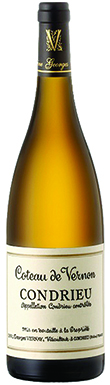
Domaine Georges Vernay, Coteau du Vernon, Condrieu, Rhône, France, 2012
96
Warm spice under the yellow peach and pineapple fruit and heady jasmine aromas. Full and rich. A generous, hedonistic wine but not without finesse and elegance, and it finishes with a tailored, saline, mouthwatering finish. Fresh honey and apricot on the long, long finish. Just gorgeous.
2012
Domaine Georges VernayCondrieu
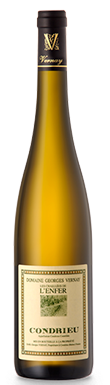
Domaine Georges Vernay, Les Chaillées d’Enfer, Condrieu, Rhône, France, 2012
93
More yellow peach in fruit with some warm spices. Full-bodied but not fat. The wine has tension although the acidity is fairly low. Gentle but powerful, long and pure. Luxurious texture; lots to enjoy.
2012
Domaine Georges VernayCondrieu
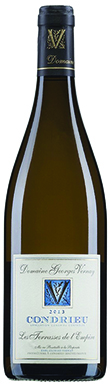
Domaine Georges Vernay, Terrasses de L’Empire, Condrieu, Rhône, France, 2013
92
<p>Almond, apricot flesh and white peach aromatics. Medium-bodied but ample with a firm thread of acidity and a fresh edge. Compact and very drinkable, with a pleasing bitter twist on the finish.</p>
2013
Domaine Georges VernayCondrieu
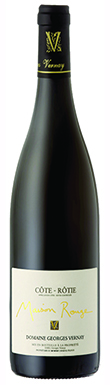
Domaine Georges Vernay, Maison Rouge, Côte-Rôtie, Rhône, France, 2011
93
<p>Darker in colour and character than the Blonde du Seigneur. Nose showing complexity already; rose and violets, raspberry and blackberry, pink peppercorns and juniper, and wood smoke. Round, full and satin-textured with intense fruit and super-fine tannins. Seductive and satisfying, balanced and fresh.</p>
2011
Domaine Georges VernayCôte-Rôtie
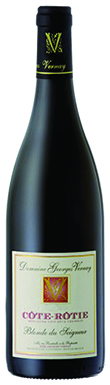
Domaine Georges Vernay, Blonde du Seigneur, Côte-Rôtie, Rhône, France
92
95% Syrah, 5% Viognier. Bright, peppery, aromatic raspberry fruits. Silky and elegant. Light and fine in style, but with subtle power on the finish and extremely well-judged use of oak.
Domaine Georges VernayCôte-Rôtie
