
Signorello Estate: Meeting winemaker Priyanka French plus four current releases tasted
Signorello Estate's winemaker Priyanka French reflects on her unique journey into the wine industry and how she's been shaping the future for the Napa Valley winery.


To date, much of Priyanka French’s wine career appears to have come full circle – she currently works side by side with Celia Welch at Napa Valley’s Signorello Estate – one of the female winemakers she included in a presentation she compiled for her reluctant, academic parents about her shift to wine.
Scroll down to see tasting notes and scores for four current releases from Signorello and winemaker Priyanka French
When French came to Napa to study at UC Davis in 2009, she rubbed elbows with Linda Bisson, Roger Boulton and Andrew Waterhouse, professors who appeared in her first study materials, Principles of Winemaking. Though her dad may have been sceptical of her wine career at first, he’s now taking wine classes, and she admits that he has ‘a really good palate’.
Yet, French would describe her path as very ‘one directional’ – from the moment she visited her first winery, Sula Vineyards while studying food technology as an undergraduate student at the University of Mumbai, she pivoted to follow this new path in viticulture and winemaking, and it’s been linear forward ever since.
Unlikely beginnings
‘My curiosity for wine began before my passion,’ French recalls. Growing up in Mumbai, India, she says wine wasn’t present on the dinner table. If anything, her father would enjoy a Scotch in the evening. ‘I was thinking, what is this, and how can I get into it.’ So, she began reading Sommelier India, wine blogs and studying from the latest edition of Principles of Winemaking.
French even dedicated one of her university projects to winemaking and technologies. ‘From the very beginning, I knew I wanted to approach it from the production side,’ she shares.
After graduating from her programme at the Institute of Chemical Technology at the University of Mumbai, she left the east for the Far West and UC Davis. Her enrolment marked the first time she left the country alone and the first time she’d partake in a harvest.
‘My job was to drop the charts of the brix in the wine to the winemaker every morning,’ says French on her first internship at the Louis M. Martini branch of E. & J. Gallo Winery. ‘I took it so seriously!’
French recalls multitasking – studying, working in the lab, experiencing harvest and working on her master’s project at the same time – much like you’ll find her today. In fact, that’s one of her favourite parts of her job: ‘to have full control and focus from vineyard to bottle.’

Redefining legacy
Estate winemaking is what initially piqued her interest when Signorello approached her to join the team in 2019, after spending the previous five years at Dalla Valle Winery.
Prior to that, she spent two years post-college hopping from Hospices de Beaune to Louis Royer, then Saint Clair Family Estate and Framingham Wines in Renwick, New Zealand.
When she ultimately started at Signorello, the winery was in the early stages of rebuilding after it was burned down in the Atlas Fires of 2017. This was something that added to her excitement about the role.
‘You don’t get a lot of chances to look at the legacy of a brand,’ she explains. ‘Ray Signorello Jr. had an amazing perspective of what he wanted to see for the next step for Signorello, and to be a part of that story was a huge opportunity.’
Over the past six years, French has worked with Signorello not just to rebuild the winery but to reanalyse the entire operations of the vineyard and winemaking for sustainability and the future.
Signorello had already been farming organically since 2008. Still, she helped focus on converting to renewable energy with the new build, spot planting and conforming to regenerative farming with sheep, goats, beehives and vegetable gardens throughout the property.
French also worked with her winemaking team, Welch and viticulturist Steve Matthiasson, to decide ‘how to tell the story of the property’. This resulted in Signori, ‘the most unique Cabernet that we can make,’ says French about the wine made from fruit sourced only from the eastern side of the vineyard.
‘Then we make about 35 to 36 wines that we blend to put together the Padrone… It’s the best way to get a taste of the entirety estate without actually visiting it,’ says French.
Complexities of the estate
Signorello Estate comprises 17 planted hectares, which are divided between eastern and western-facing slopes. The latter is what guests see as they approach the estate, and the former is on the backside of the hill that runs into the canyon. As the eastern vineyard’s orientation results in limited exposure, French says the management systems are the exact opposite of the western side.
‘What we get between the two sides is a dramatic difference in tannin profile but also in aromatics,’ says French of the west side’s concentrated black and blue fruit, and dense wines versus the east side’s blue and red fruit with a plethora of spices and herbs that result in French’s moniker for Signori – ‘Christmas in a glass.’
Signori duly joined the line-up of Signorello’s featured estate wines, including Padrone, the flagship Cabernet Sauvignon, and Hope’s Chardonnay.
The Chardonnay is created from a one-hectare parcel planted in 1980. These are the oldest vines on the property and what French refers to when she talks about spot planting – replacing older vines that are no longer producing at their prime with new vines. French appreciates working with these particular vines, saying: ‘There’s an inherent characteristic of something that’s been in a place that long.’
French acknowledges that she’s responsible for highlighting that innate characteristic in the wine, and to do so she works with minimal intervention, uses native fermentation – they’ve isolated a native yeast from the Hope strain – and keeps the wine unfined and unfiltered to ‘let the wine speak for itself’.
Being a bit bold
In the same breath, though, French assures she’s ‘not afraid of bold, big flavours’ in wines. To achieve this in the Signori blend and Padrone Cabernet, she evaluates phenolic ripeness as an indicator for maturity to pick on the earlier side of harvest compared to other Napa Cabernets.
This ensures the wine is not overpowered by high alcohol. ‘I’m from India, so I’m used to bold flavours. I don’t think my wines are shy by any means, but they’re really expressive of site and vintage…of what the year tells us in terms of the story of wine.’
In other words, French prefers character in the wine. She says these are the sips that are ‘fascinating and intriguing and keep you going back to the glass’ to discover more. Outside of Signorello, wines that tell a story – including the vision of the winery that makes the wine – are the wines she enjoys exploring.
On the brink of the new Signorello winery opening later this year, French is once again in a unique position. She shares: ‘Having a brand new winery as a place to bring old-vine fruit is a cool juncture for any winery – we hope that our wines tell this story.’

Leading in new ways
Though French started at Signorello working alongside her mentor, Celia Welch, French has become a mentor herself – not only for Ray Signorello’s two daughters, who he hopes she inspires to join the family business but also for members of underrepresented communities in the industry.
‘When you think about winemaking and the industry we’re in, sometimes it feels like “what’s next?” We’re not curing sickness here. I’ve always felt that I need to have something more and for the industry to mean something more for me,’ she says. French began working with Wine Unify, a scholarship foundation for WSET (Wine & Spirit Education Trust) courses and Bâtonnage, a mentorship program in 2020.
It was just after the George Floyd crisis, and French says as a woman of colour and an immigrant, she became reflective of her place in the country, as well as her role in the future and evolution of the next generation.
Now she believes her efforts in philanthropy in social change all feed into her work at the winery. ‘When you talk to someone who’s just about to enter the wine trade, and they’re so excited, it reminds you how fortunate you are to be in the industry.’
Signorello Estate: tasting notes and scores for four current releases
Related articles
- Californian wine investment: Growing pains on the market?
- Napa and Sonoma 2023: Harvest forecast
- Bella Oaks Vineyard retrospective: A 15-vintage vertical
Signorello, Hope's Cuvée Estate Chardonnay, Napa Valley, California, USA, 2021
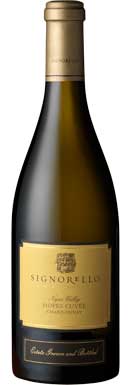

The 2021 Hope's Cuvée is a dialled-in masterclass in balance. The aromatics are a thing of beauty, intricate, delicate, and so well woven together. Priyanka...
2021
SignorelloNapa Valley

Signorello, Hope's Cuvée Estate Chardonnay, Napa Valley, California, USA, 2019
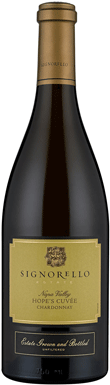
The nose is distinctly smoky and toasty, but it's not overblown. The attack is fresh and suave, with good if not exceptional acidity, and the...
2019
SignorelloNapa Valley
Signorello, Padrone, Napa Valley, California, USA, 2019
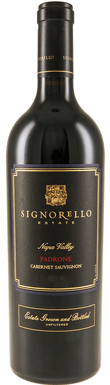
Evidently youthful, this is still reserved and undemonstrative on the nose, although it became more fragrant with aeration. Flamboyant and spicy, this is very concentrated...
2019
SignorelloNapa Valley
Signorello, S, Napa Valley, California, USA, 2019
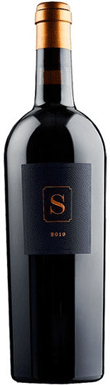
There are bright cherry aromas lifting this 91% Cabernet Sauvignon-based blend, a mix of estate and purchased fruit. The attack is fresh, lively and spicy,...
2019
SignorelloNapa Valley
