
The red behind Moët & Chandon rosé
Rosé Champagne usually takes its colour from a small percentage of still red wine added in. But far from being an afterthought, a lot of work goes into getting this component just right...


When Moët & Chandon cellarmaster Benoît Gouez arrived in the Champagne region more than 20 years ago, rosé accounted for just 2- 3% of the house’s production. Since then, reflecting the boom in popularity of the rosé category in general, the importance of rosé at Moët has rocketed and it now accounts for 20% of the portfolio – in comparison, rosé accounts for 10% of production in the region as a whole.
In the early days of March, before lockdown began, Gouez flew into London to explain the role played by the still red base wines in Moët’s most important rosés: the non-vintage Imperial and the vintage wine – the current release being Grand Vintage Rosé 2012.
In common with most other Champagne houses, Moët makes its rosé by adding a percentage of still red wine to the white blend before the second fermentation in bottle. (The other, less common method is maceration.) But Moët sets itself apart when it comes to the non-vintage rosé, choosing to use thermovinification in its still red wine production.
‘We’re the only house in the region to use this technique for our red wines,’ says Gouez, who admits that it used to be associated with mediocrity. ‘It was used historically at Moët partly to guarantee red wine production even when conditions were less than ideal. It was abandoned in the 1990s, but we chose to reintroduce it the following decade, adopting a premium approach instead.’
The thermovinification is used for the three rosés in the Imperial range – the NV, the demi-sec Nectar and the Imperial Ice, created to be enjoyed over ice – all use the same still red base wine; it’s the white blend that varies.
The still red base wine for the Grand Vintage Rosé is 100% Pinot Noir and is still made without thermovinification.
The thermovinifcation process today involves heating the red grapes to 70˚C, to explode the cells and release the colour and aromas in the juice, before lowering the temperature for a short (two-hour) maceration, and pressing to produce red juice.
The objective is to help provide a variety of styles, and to limit the tannic extraction. ‘We want the non-vintage rosé to be easy to drink,’ adds Gouez, ‘and this also explains why we use both Pinots (Noir and Meunier) in the non-vintage still red base wine. Most houses only use Pinot Noir, but we feel that the Meunier adds a welcome suppleness.’
Wine educator, author and consultant Sally Easton MW explains why thermovinification might appeal to a Champagne house producing high volumes of rosé: ‘It is typically associated with larger scale wine production to make early-drinking, primary-fruitful, still, red wines with rich colour, soft tannin texture and low astringency. It is quicker than a traditional red vinification, though the initial capital outlay can be sizeable.
‘As a technique, it is just one way, of many, to aid breaking down cell walls in black- grape skins to release their contents – mainly colour and tannin. Total tannin concentration is usually lower than other maceration techniques because, unusually in red wine production, the thermovinification juice is usually pressed off the skins before fermentation starts. While colour is rather quickly extracted, tannins take longer, thus a short maceration brings colour but not much tannic structure, which fits well for Champagne production. A challenge might be to extract enough tannin to help stabilise the colour over time.’
Moët’s red wines are produced at two winemaking facilities in the region, one dedicated to Pinot Noir and Pinot Meunier from Vallée de la Marne, the other reserved for Pinot Noir from Côtes des Bar. And even though the Imperial Rosé NV contains just 9% of red wine, and the Grand Vintage Rosé 13%, Moët produces around 40-50 different red base wines to choose from, growing double the volume of Pinot Noir grapes that it needs, and harvesting 150% of its needs, to ensure that choice. ‘We play with grape variety, origin and process to generate diversity, and we want as many nuances as possible at our disposal,’ Gouez explains. ‘We’re looking for some base wines that are fresh, fruity and supple; and others with more concentration.’
Anne Krebiehl MW tasted the vintage and NV Moët & Chandon rosé for Decanter
See also: Top rosé Champagne: Panel tasting
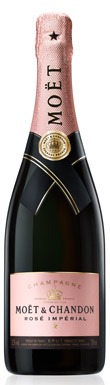
Moët & Chandon, Rosé Impérial, Champagne, Champagne, France
90
A blend of 50% Pinot Noir and 35% Pinot Meunier (of which 10% were added as red wine) with 15% Chardonnay, this opens with a very fruity, ready, vivid nose and reveals a touch of cherry and a hint of red apple. This is rather aromatic, primary and fresh. The palate is very light, juicy, foamy, easy and fresh. It comes with a soft body on light feet; it is refreshing while remaining rounded, pliable and supple.
Moët & ChandonChampagne
Moët & Chandon, Grand Vintage Rosé, Champagne, Champagne, France, 2012
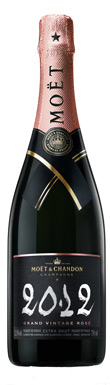

Made from a blend of 42% Pinot Noir, of which 13% was vinified red, 35% Chardonnay and 23% Pinot Meunier and aged for five years...
2012
Moët & ChandonChampagne

