It's a rock thing: Meeting Georges Truc, the Rhône’s wine geologist
Matt Walls sits down with the man that has done more than anyone to map the Rhône Valley's complex terroir.


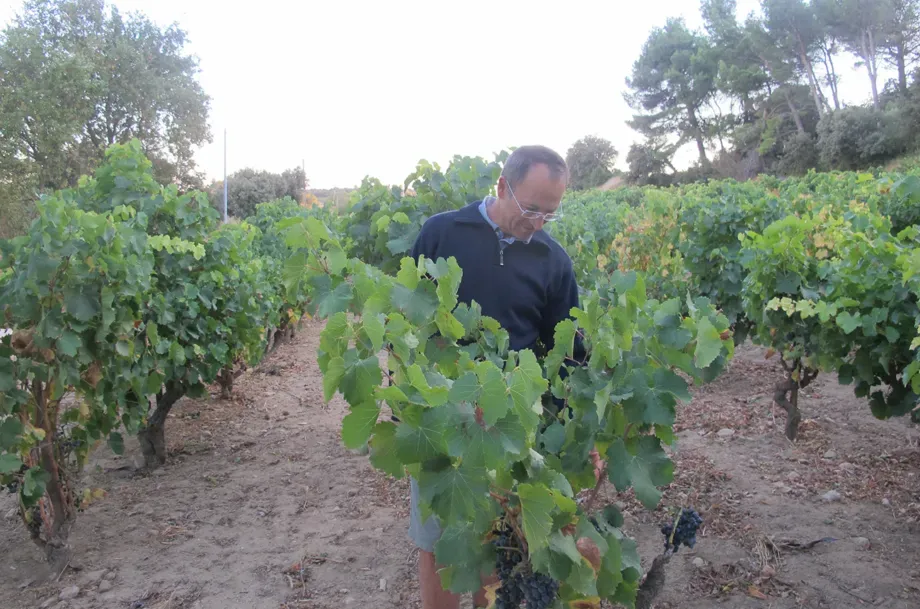
When Rhône winemakers want to understand the ground beneath their feet, the person they turn to first is Georges Truc.
He has done more than anyone to increase our collective knowledge of the geology of the southern Rhône, and much of my own understanding of this complex terroir is thanks to him.
Despite his local prominence, outside France he doesn’t always enjoy the renown that he so richly deserves.
‘I was born in a cellar’

Georges was interested in rocks and stones from an early age
Born in 1942, Georges spent much of his childhood playing in his father’s winery in the village of Visan, 30km northeast of Châteauneuf-du-Pape.
His family never owned vineyards, but local growers would bring their crop to Georges’ father who vinified and sold the wine to negociants.
The landscape was different then. In the early 1960s, neither Syrah nor Viognier had yet arrived in this part of the Rhône. Grenache was even more dominant than it is today.
Despite decades of winemaking evolution, the winery that Georges remembers is remarkably similar to what’s considered fashionable today.
Wines were made and matured in concrete tanks and old foudres, they used natural yeasts, and, since the destemmer hadn’t yet arrived on the scene, all wines were whole-bunch fermented.
I wondered if, before this era of climate chaos, the wines his father made were lower in alcohol. Not really; Georges remembers in 1952 the potential alcohol of some tanks reached 17.2% abv. Back then, growers competed to bring in the ripest grapes they could.
‘I could have continued my father’s work,’ says Georges, but his teachers encouraged him to continue studying. ‘I was interested in rocks and stones from an early age,’ he says, and he went on to teach geology at the University of Lyon, where he taught for 40 years.
‘But this love of wine, and winemaking, never left me,’ he says, and since then he has collaborated with countless Rhône appellations and producers to create soil maps of their terroirs.
He’s also written and co-written some invaluable books on subjects such as Gigondas and, most recently, Châteauneuf-du-Pape.
What soil does to wine
Georges describes himself as an ‘oeno-geologist’, given his interests in both wine, rocks, and the relationship between the two. He has a warm and calmly authoritative manner and is generous with his knowledge.
He describes the southern Rhône as ‘a great mosaic’ of soil types, and says that the best way to understand it is through the lens of Grenache.
‘It is the king of the grape varieties,’ in the southern Rhône, ‘and the best for communicating terroir.’
To understand the wines of the southern Rhône, he says the first step is to memorise the taste and mouthfeel of pure Grenache.
The next step is to taste Grenache on different soils: how it tastes on limestone, galets roulés, sand.
And from there, to taste different blends: 80% Grenache with 20% Syrah or perhaps 20% Mourvèdre, and so on with different varieties and proportions.
He points out that traditional wine education starts with smelling first, but he believes this only helps us to identify the grape variety – not the terroir.
For this, he insists that the sensation of touch is more important. ‘We’re all conditioned to start with the nose… but start with the palate,’ he says, ‘so not to overwhelm the mind.’
An additional benefit of concentrating on touch, is that this is a sensation we all share, while our personal aromatic touchpoints vary depending which part of the world we are from.


How to taste soil
Training your palate to identify different tannic structures is the key to tasting for terroir. He believes there is a similarity to how the soil types feel on your fingers to how the wine will feel on your palate.
He describes tannins as 'like little balls' that are varied in size and texture, and that 'tannins will reveal the terroir'.
He points out that plants grown on galets roulés will have their roots in the accompanying clay that is found underneath the stones.
He describes clay as ‘a mineral treasure trove for the vine,’ and that it imparts a velvety texture to wines, along with ‘richness and complexity’.
Sand, however, produces wines of ‘delicacy and finesse’. When it comes to limestone, he says, ‘you don’t feel richness and complexity' – though they can be fine and delicate.
This substrate gives wines without much volume, and instead they have ‘a straight axis in the mouth,’ that often have tannins that give a texture reminiscent of denim.
Rather than having favourite appellations, George has preferred soil types. He is a particular fan of wines grown on stony marls (composed of clay and limestone) that were laid down by lakes.
These can be found around villages such as Cairanne, Rasteau, Vinsobres, Visan and Valréas.
‘They give the most fine, complex, sensual wines…’ he says, ‘they transport me.’
What he doesn’t like is heavy-handed barrel maturation. ‘What is a barrique?’ he asks. ‘It’s a container for transporting wine,’ he says, not something to flavour it. Particularly not Grenache with new oak.
He may be in his 80s now but Georges is busy and energetic – and his ideas are still pushing boundaries. He has helped countless winemakers to better understand their terroir, and in doing so to make better wines.
For that reason, it’s hard to name many individuals working in wine today that have had more of an influence on the Rhône Valley and its wines than Georges Truc.
Related articles

Six Rhône producers on the down-low you need to know about
Château Rayas: The enduring winemaking mysteries behind this Rhône icon
Our expert’s top 25 Côtes du Rhône 2024 wines
