
Anson: Visiting Vinding-Diers’ Sicily project
Jane Anson pays a visit to the Montecarrubo project from Peter Vinding-Diers...


Peter Vinding-Diers is an adventurer of the old school. Itinerant, an explorer, always ready with a story, blunt in his opinions and thoroughly good company. Before becoming a winemaker he was a war correspondent, and you can easily imagine it came naturally to him.
‘I could tell you a load of bulls**t,’ was pretty much his opening line when we met. I was asking him about the conditions of his Montecarrubo vineyard as we walked through it under a burning July sun on Sicily’s hottest day of the year. It made me like him straight away.The vineyard is set on the crater of an extinct volcano near Melilli (the more lively Mt Etna is around 20km to the north) with views, I am told, over the Ionian Sea and the Bay of Augusta – but the heat has made things so hazy that I’m not quite getting the full effect.
I’m also going to have to take it as given that they get wind here ‘pretty much year round’ as things are monumentally still right now, and the usual 10-degree drop between day and night temperatures seems unlikely to materialise.
What I can see, and taste in the wines, is that this is an exceptional and unusual site. To be honest I was a little disappointed to have come all the way to Sicily to visit a vineyard that grows Syrah rather than Nero d’Avola, or one of the more unusual local varieties like Nerello Mascalese, Frappato or Perricone. Even more so when I heard that Montecarrubo bottles a Cabernet Franc and Merlot blend.
But it turns out that Syrah has a 250-year history in Sicily, and I’d been told this was the best Syrah on the island. It was quickly clear in the tasting room that it was worth the drive down from Catania, even with the temperature climbing towards 40 degrees.
Vinding-Diers has been here since 2003, making it one of his longest stays in a wine region. Over the years he has made wine in South Africa, Brazil, Kenya, Spain, Chile, Hungary and Bordeaux. He lived in Bordeaux for 25 years, where he managed or part-owned first Château Loudenne and later Château Landiras and Château Rahoul with Len Evans and Peter Fox – getting Rahoul, an AOC Graves, elected into the prestigious Union des Grands Crus.
He might not be as recognised today as his nephew Peter Sisseck – who got his first job working with Vinding-Diers at Rahoul, and who was also persuaded by his uncle to leave Napa where he was working at the time, to head to Ribera del Duero to run a new vineyard, El Monasterio.
But he’s been witness to some of the wine world’s most interesting chapters, from the Experimental Research Institute in Stellenbosch in the late 1960s, to being a founding member with Hugh Johnson of the Royal Tokaji company in Hungary in the 1990s. His father was a writer (as well as a wine lover, importing hogsheads of Lynch Bages into Denmark), and his son has clearly inherited a love of books. His library at Montecarrubo could easily have taken up my entire summer.
The first stop after leaving Bordeaux in 1999 was Tuscany, (‘but I hate Tuscany’ he adds cheerfully), before ending up first in Etna than Melilli, searching out the perfect vineyard site. The land here was almond trees, grass, boulders and hardened lava at the time. It had seen hundreds of years of cattle and sheep grazing, but never vineyards before Peter and his wife Susie arrived.
Their neighbour, the late Giuseppe di San Giuliano (winemaker at Marchese di San Giuliano), lent them a bulldozer for them to rip everything out, finding underneath volcanic sand and loamy soils with fragments of coral reef and fossils spread over two plots; one facing east looking over the Ionian sea, and one facing west where the granite and limestone subsoil is full of oxygen.
It took time to prepare the land, including converting the former cow shed into a winery, but in 2010 they planted 4ha of Syrah from massal selection vines from Hermitage in the Rhône. The benefits of genetic diversity from massal selection against using clones of a single vine has long been a passion of Vinding-Diers, who wrote a fascinating paper on the issues with ‘politically-correct virus free clones’ a good decade ago.
Everything is dry farmed, kept to a low yield, certified organic and farmed biodynamically. Natural yeasts are used for fermentation, with ageing in barrels that at first came from Pingus but are now sourced from Bordeaux – either Moueix or Batailley, I am told. All wines are bottled unfiltered and unfined.
They also farm 10ha of old vines near Noto (just under 70km from here, also Syrah but a local clone of unknown origin), which is situated on pure limestone, and provided grapes while they were waiting for their own vines to come into play. Their first vintage here in 2006 saw a production of 16,000 bottles, and even today with all vineyards producing they have only climbed up to 45,000 bottles – still a relatively small production, particularly as his status as one of the world’s great insider winemakers means they are highly sought after.
‘I spent 10 years trying to get Nero d’Avola right in Notto,’ he admits, ‘but I just couldn’t tame it, the tannins were just too coarse for me to fall in love with’.
He’s more excited about the possibilities of Alzano vines from the Marsala region of Sicily, with 60 vines about to be planted in the Montecarrubo site.
‘This is a white variety with a DNA that dates back 6,000 years, with origins in Georgia, but t’s been in Sicily for maybe 3,000 years. It can get to full maturity at 12%abv and with a pH of 3,’ he says, recognising the fact that in heat like we are getting today, these qualities would be extremely useful. ‘If it works out, this will be our Vignolo white’.
Something about this wild and remote spot seems to have tamed the restless spirit in him for while, even if the volcano under his feet seems entirely fitting.
Tasting Vinding Montecarrubo
Vinding Montecarrubo, Vignolo, Terre Siciliane, Sicily, Italy, 2018
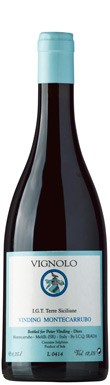

100% Syrah from the single vineyard site at Montecarrubo, planted in 2010. The best in the line up for me, it's so fragrant, full of...
2018
Vinding MontecarruboTerre Siciliane

Vinding Montecarrubo, Vigna Grande, Terre Siciliane, Sicily, Italy, 2018
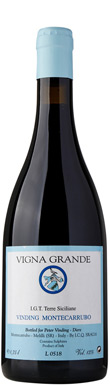
This feels austere in comparison, with less natural sweetness to the fruit and with a wild herb and spice character that's totally captivating. Only made...
2018
Vinding MontecarruboTerre Siciliane
