
Behind the label: Georges de Latour Private Reserve 2018
Napa Valley's Beaulieu Vineyard will release its latest Georges de Latour Private Reserve this month, from the 'dream' 2018 vintage, and we spoke to chief winemaker Trevor Durling about the wine label's celebrated history, Rutherford terroir and using technology in the winery.

Beaulieu Vineyard is one of Napa Valley’s oldest wine estates, best-known for the legendary Georges de Latour Private Reserve Cabernet Sauvignon, first produced in 1940.
This month sees Georges de Latour 2018 being launched at a special 82nd anniversary dinner held at the family-owned Beaulieu Garden in Napa Valley.
Decanter tasted the 2018 vintage at the Maison Joanne négociant house in Bordeaux, and recently spoke via video call to Trevor Durling, the general manager and chief winemaker. He succeeded Jeffrey Stambor in 2017 to become only the fifth person to hold the esteemed title in the 121-year history of the winery.
Scroll down to see our tasting note and score for Beaulieu Vineyard’s Georges de Latour Private Reserve 2018
A ‘dream’ 2018 vintage
‘I can tell you in the almost 20 years under my belt now in California, 2018 is one of the strongest that I’ve seen,’ Durling says. ‘It was really a winemaker’s dream of a vintage.’
The vines saw lower-than-average rainfall, albeit enough to make up for the drought in 2017, with a relatively early bud break, even fruit set and no frost issues.
Cool weather during the remainder of the growing season allowed for greater hang-time before harvest, improving the development of tannins and the phenolic ripeness of the grapes.
For the Cabernet grapes going into the Georges de Latour, Durling says, ‘The acidity was retained and the sugar levels were kept in balance because we didn’t have any outrageous heat spikes.
‘It was just a very balanced season – one of those years that really signalled to me as a winemaker that once the grapes were harvested I didn’t have any concerns around poor tannin quality or that I would have to control my extraction.
‘We were able to open the floodgates in terms of extracting as much of those beautiful phenolics as we could for the year.’
How is the Georges de Latour made?
Harvests are completed by hand with grapes collected in half-tonne macro bins, which are loaded individually onto optical sorting tables before being gently transferred by peristaltic pump – to preserve whole grapes – into tanks.
Both stainless steel tanks and concrete vats are housed in the ‘Reserve winery’, a former barrel warehouse that benefited from two lots of investment in 2008 and 2017 to become a dedicated space for Georges de Latour.
Durling says he will typically use a cold soak for between five and eight days, with daily circulation to get extraction of tannins and colour and capture the aromatics. Yeast inoculation will follow for fermentation lasting between 10 and 14 days, before the juice is drained off the skins.
Juice will then settle for 48 hours before going into barrels for the winter and to undergo malolactic fermentation.
In January or February of the following year, the barrels are racked back to tank. Sulphur is added and the young wine is then put back in barrels for further ageing. Another two to three rackings generally take place over a two-year period before final bottling.
Durling also practises a small proportion of barrel fermentation on skins, a labour-intensive method that began in 2007.
Grapes are put into 225-litre Bordeaux barrels for cold soak and fermentation where they are rolled to fold the cap – replacing the act of pumping over or punching down. This method gives ‘better extraction from the skins’ because it retains more heat and gives a specific flavour profile with soft and round tannins that is only achieved from ‘earlier oak integration’, Durling says.
Barrel fermentation can mask some terroir expression, says Durling, but when creating a big wine that has the ability to age and lay down for many years, it can be used as a tool to help give the final blend a ‘roundness’ and ‘approachability’.
He adds, ‘We have some of the latest and greatest technology available in winemaking. It’s interesting because it’s such an old building, built in 1885, which of course is very old by California standards, and so you have this tremendous history with so much preservation and then we also have a very flashy, technologically-advanced reserve winery. It’s just a wonderful contrast that works really well.’
Technology in the winery
There have been several new developments in the winery since Durling took the helm.
He was one of the first in the US to install a number of 10-tonne, cubic-shaped stainless steel vats made by Canadian company La Garde. Their design creates a thinner cap and so minimises unwanted heat and subsequent extraction of tannins and phenolics.
‘This makes your pump overs much more efficient,’ Durling says. ‘You don’t have to run the pumps as long so you’re not beating up the skins as much and you retain less heat up there. It just basically gives you full control over extraction as a winemaker and that is really a wonderful thing.’
When it comes to pumps, every one of the 64 differently-sized fermenters has its own dedicated centrifugal pump that can be controlled remotely and with a specialised sensor able to calculate specific gravity and brix.
This turns the winery into a ‘24-hour operation’, but Durling says ‘it’s actually a pretty simple thing’. He explains how the probes fitted to the back of the tanks in the reserve winery give a pressure differential reading and map of the fermentation process in real time so any necessary adjustments can be made quickly and efficiently.
‘We have a tremendous amount of data that’s coming back to me as a winemaker, that allows me to get in and make the best decision to adapt towards the season.
‘I make all of my winemaking decisions based on a sensory instinct, but this is just data that is wonderful to have in my back pocket so that I can better predict what’s actually happening. We’ve seen a tremendous quality uptick and success rate.’
The Georges de Latour blend
Georges de Latour was historically a 100% Cabernet Sauvignon, with the fact proudly presented via a distinct red bar across the back label.
However, since the mid-1990s it has become common for the team to use small amounts of other varieties. Petit Verdot is the main contributor, and it features alongside Malbec in the 2018 blend.
‘I have been a big fan of Malbec on the Rutherford bench, and so we’ve gone into the vineyards with a little bit more Malbec than we had before and it’s something that I think complements the blend very well in a small percentage,’ says Durling.
The Petit Verdot used in the Private Reserve always comes from the 32-hectare (80-acre) Beaulieu Number One block, which is part of the original property purchased in 1900. They are relatively old vines for Rutherford, at a little more than 30 years old.
‘In the Napa Valley most Cabernet, or Bordeaux varietals, will be replanted every 25 to 30 years so these are definitely on the older side, [with] tremendous concentration, colour and phenolic power,’ says Durling.
‘But a little bit goes a long way so it’s just something that is dosed in at the very end through various blend trials to see – is it adding something to the wine, or is it pulling something away? So certain vintages, yes, I will do that and other vintages I won’t, it’s just seasonally dependent.’
When asked if there is a taste profile that Durling is looking for when creating the Georges de Latour blend he says, ‘the core winemaking philosophy here and something that is always at the centre of my brain is the need to express that beautiful Rutherford terroir.’
Rutherford and Georges de Latour terroir
Beaulieu Vineyard has one of the largest land holdings in Napa Valley, with around 400 hectares. Vineyards are located in the south, in the cooler Carneros district, and to the north in the warmer Calistoga district.
Roughly half are situated in the Rutherford district in the middle of Napa Valley, which is where the majority of the Cabernet for Georges de Latour Private Reserve is planted.
Beaulieu’s Rutherford vineyards are located on the Western Rutherford Bench, an alluvial fan that spans a 20-mile area from north to south on the western side of the valley that hugs the Mayacamas mountain range. Well-drained vineyards are gently sloped to the east towards the Napa river with a microclimate that gives sun exposure both in the morning and evening.
‘It’s one of those scenarios where you have just enough richness in the soil to keep the vines happy but there’s also just enough stress on them to create that concentration that we’re looking for,’ Durling says.
‘And I think a combination of that soil profile plus the microclimate that we have here in Rutherford gives that perfect scenario for getting beautiful phenolic ripeness while keeping the flavour profile in check.’
Alongside the Beaulieu Number One plot on the western Rutherford bench, the 56.6ha (140-acre) ‘number two’ plot that was purchased in 1910 is crucial. Around 90% of this plot goes into the final wine.
The southern block of Beaulieu Two is where the Rutherford and Oakville districts meet, with part of the plot also bordering the famous To-Kalon vineyard. Since the 1960s, the Private Reserve has also included grapes from the prized Hewitt vineyard further north in Rutherford – and from which a single-vineyard wine is also made.
Across these vineyards, Durling says, ‘I’m really trying to express that famous Rutherford dust, which is a subjective thing but to me it’s more of a textural element.’
He adds, ‘There is a uniqueness and a fineness to the tannin profile that we get here in Rutherford and so there’s tremendous power and concentration, but there are also very rounded tannins. That’s a very unique thing because it allows us to enjoy these wines that are quite ageable – you know you can lay these down for many, many decades – but it allows you to enjoy them relatively early on because of that round texture.
‘My number one priority is to express a strong sense of place with all of these wines that we make at Beaulieu and I think that’s something that has really been kind of ingrained in the winemaking DNA here from the very beginning.’
Durling says he’s fortunate to be only the fifth winemaker to produce Private Reserve and sees his role as an honour and responsibility.
While technology plays its part, so does research and development. Beaulieu Vineyards was one of the first to work with the department of viticulture at UC Davis on clonal trials of Cabernet Sauvignon in the early 1980s, the findings of which continue to benefit them today.
Durling is also experimenting with sap flow monitoring and irrigation efficiency, as well as sustainable farming methods more generally, to conserve resources and ‘be kind to Mother Nature’.
Keeping it classic: the Georges de Latour style
Durling describes the style of Georges de Latour as ‘classic’, with a focus on dialling the needle back from where the flavour profile of Napa wines was in the early 2000s.
Basing decisions on flavour and balance, Durling is looking for phenolic expression. He says it’s about getting ripeness with tannin and enough natural acidity that will allow the wines to stand the test of time while keeping the sugar levels as low as possible. In a year like 2018, he says, that was ‘easy’ but vineyard management can also help, including irrigation decisions, de-leafing and shade cover.
‘Every vintage is a little bit different and that’s the other important thing philosophically for me is that I would like to express the year itself. We’re given a different set of rules every year from Mother Nature and there are no two vintages that are the same,’ he says.
‘We’re going to have the consistency of the terroir, we’re going to have the consistency of the winemaking style, but there will be differences based on what the growing season was like, and in 2018 it was just one of those years where everything came together so beautifully. So in my opinion, it was one of the most balanced years and balanced vintages, certainly for Georges de Latour, that I’ve ever seen.’
The winery launch of the 2018 in Napa Valley will take place on Sunday 19 September.
See our tasting note on Georges de Latour Private Reserve 2018
More articles in this September 2021 series:
Behind the label: Château Palmer 2011 – new release
Behind the label: Wynns John Riddoch 2018 release
Beaulieu Vineyard, Georges de Latour, Napa Valley, California, USA, 2018
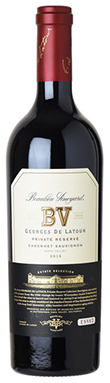

An excellent 2018 from one of the oldest and most historic estates in Napa filled with just the right amount of density, power and structure....
2018
Beaulieu VineyardNapa Valley
