
Top Château L’Evangile wines and estate profile


Read a full profile of this individualist Pomerol estate, including an exclusive interview with Baron Eric de Rothschild, plus tasting notes on top vintages.
Pomerol is an appellation that manages to embody all that is small-scale and artisan in a region that is often accused of being overly interested in corporate gloss.
My recent in-bottle reviews of Pomerol 2016 wines are a good demonstration of this.
Pomerol is also a place that takes the Merlot grape, dismissed for being fruity, easy-drinking and not quite serious, and turns it into stubbornly long-lasting liquid poetry.
Look into L’Evangile’s history and you start to see why all of these things are true.
For a start, although it’s one of the oldest châteaux in the appellation, with a mention in the land rolls of 1741, it has only been permanently known under its current name (meaning ‘the gospel’ in French) since the mid-19th century.At that time, then-owner Paul Chaperon selected that title over the decidedly less sexy former name of Domaine de Fazilleau – for the previous 50 years it had switched between the two.The estate remained in his family for the next 130 years, until Baron Eric de Rothschild of Domaines Barons de Rothschild (Lafite) bought a majority stake in 1990 from the formidable Simone Ducasse.
And okay, maybe having the Rothschild name attached discounts L’Evangile from being truly small-scale, but even their arrival happened in a decidedly Pomerol way.
L’Evangile at a glance
Founded: 1741
Area planted: 22ha
Varieties: Merlot, Cabernet Franc; some Cabernet Sauvignon planted
Annual production: 2,000-3,000 cases
Soils: Gravel, subsoils of heavy clay with sandy sections that produce the second wine
Key wines: L’Evangile, Blason de L’Evangile
Subtle difference
‘There was no way that Madame Ducasse was going to be impressed by the idea of a fancy name coming all the way over to Pomerol from Pauillac,’ is how Baron Eric puts it, as he describes the early discussions for co-ownership.
‘I knew that it was a sensitive subject, because although her husband had died several years earlier she was an extremely proud and capable woman and was still overseeing every aspect of running L’Evangile. So I sent in what I thought would be my secret weapon to do the talking.’
He is referring to Christophe Salin, the debonair, ex-rugby playing CEO of Château Lafite, who took charge of convincing Madame Ducasse of their suitability.
‘I thought I had her in the palm of my hand,’ Salin says with a smile, taking up the story as the two of them guide us through a retrospective of the wines dating back to 1982.
‘She was always extremely polite and agreeable to my suggestions when we chatted. But the next day, she would act as if we hadn’t even had the conversation. I’m not sure I ever got her to budge an inch on anything.’
This meant that from 1990 to 1998, when DBR (Lafite) became sole owners, any investments were done slowly, and often extremely discreetly.
A second wine was introduced with just 4% of the crop for the 1989 vintage – the Rothschilds were present for the ageing of it – and the percentage of new oak barrels being used nudged up from 10% to 20%, but no more – unlike the 70% new oak that is routine today.
‘Madame Ducasse was extremely unwilling to sign off on the investment for new oak barrels,’ says Baron Eric.
‘So we ended up bringing them in from Lafite over the winter of 1993 to 1994, at night-time when nobody was around to see us. We brought in barrels and pumps from Lafite, but never a bill. And she simply pretended that it wasn’t happening, so we were all happy.’

New impetus
This unwillingness to invest may have led to a reputation for uneven quality for a while, but there’s no doubt that the Ducasses were visionary owners.
Long-time consultant Michel Rolland remembers how Simone’s husband Louis Ducasse was the first château owner to come to his laboratory in Pomerol with grape samples, at a time when no other owner ever set foot in oenological laboratories, or even really believed in getting their wines tested at all.
Rolland joined more seriously as consultant in 1982, just after Ducasse’s death during the harvest of that year, because Louis suggested to his wife that she might benefit from his help.
Rolland was the first to suggest adding a smattering of new oak barrels during the ageing (a year earlier in 1981 there had been none at all) and was a great ally for the Rothschild team on their arrival.
Vineyard replanting and serious winery investments were left until they were fully in control, with a beautiful circular cellar, not unlike the one at Lafite, completed in 2004.
Herbicide use in the vineyard was halted as of 2001, with organic viticulture introduced in 2007, and full ISO 14001 environmental management certification in place today, along with increasing moves towards biodynamic farming.
Another shift is now underway at L’Evangile, as one generation of Rothschilds hands over to the next – but this time there’s considerably less subterfuge.
Baron Eric has handed over to his daughter Saskia de Rothschild, while Salin has passed on his own role to new CEO Jean-Guillaume Prats, formerly of Château Cos d’Estournel and latterly LVMH.
At the same time L’Evangile’s long-term technical director, Jean-Pascal Vazart, is still in place, as is Rolland.
There will inevitably be evolutions under the new team, but the full potential of L’Evangile is already being realised – as is the final piece of the puzzle that makes this estate so emblematic of all that is exceptional about Pomerol.
Well positioned
L’Evangile is nestled on the far southeastern corner of the Pomerol plateau as it tips into St-Emilion. Its handsome limestone château building looks directly out at Château Cheval Blanc, with little more than a small road separating the two in parts – and its soils form a gravel corridor over subsoils of heavy clays, along with a few sandy areas that tend to now go into the second wine Blason de L’Evangile.
The first wine’s blend is almost always close to 80% Merlot and 20% Cabernet Franc, a combination that delivers its signature intense, silky and concentrated flavours, its exuberantly juicy black fruit expression and tender, airbrushed tannins.
You find high Merlot plantings all over the Right Bank, but usually on cooler clay soils that tame its exuberance.
‘L’Evangile is always a very early-picking location,’ says Rolland. ‘It’s among the first places to ripen in Pomerol – a distinct advantage as there are so often September rains in Bordeaux.’
The highly unusual combination of the early-ripening Merlot on early-ripening soils partly accounts for the seductive quality of fruit and tannins in L’Evangile. It works because the clay subsoil plumps up the power and keeps a freshness that allows for ageing.
Cabernet Franc adds elegance and complexity, although Vazart explains that even though better clones of Cabernet Franc are currently being planted to slightly increase its presence, the dominance of Merlot will remain.
Perhaps those soils also mean that this particular family had another secret weapon when crossing over to the Right Bank from their customary home in Pauillac. Because gravel is a soil most closely associated with the great Cabernet Sauvignons of the Médoc. And everyone agrees that the Rothschilds know a thing or two about those…
L’Evangile – a timeline
1741 Estate founded by the Léglise family under the name Fazilleau
1798 Pierre-Raymond Isambert purchases the estate, changes name to L’Evangile
1862 Estate bought by négociant Paul Chaperon
1874 Current château building designed by architect Charles Lallemand
1930s Jean-Paul Ducasse killed during World War II. His son Louis takes over the business, becomes a prisoner-of-war, so his wife Simone manages L’Evangile, initially with other family members
1957 Simone and Louis Ducasse take sole charge of L’Evangile
1982 Louis Ducasse dies just before harvest, having recommended that Simone hire Michel Rolland
1990 Simone Ducasse sells a 70% stake of L’Evangile to DBR (Lafite), remaining at the estate after the sale
1998 DBR (Lafite) assumes full ownership, with the property standing at 16ha
2000 Simone Ducasse dies
2001 Jean-Pascal Vazart becomes director. Replanting programme introduced
2004 New cellars built
2012 DBR (Lafite) buys 6ha of vines from Châteaux La Croix de Gay and La Fleur de Gay – the L’Evangile vineyard expands to 22ha
2018 Saskia de Rothschild takes over from Baron Eric at the head of DBR (Lafite)
Top scoring Château l’Evangile wines
All tasted by Jane Anson, apart from the 1982 vintage, which was tasted in 2017 by Andrew Jefford.
You may also like:
How Bordeaux 2016 tastes now on the Right Bank – Updated November 2018
Top La Conseillante wines: 21 vintages tasted
Château Lafleur vertical: 1993-2013
The three Léovilles of Bordeaux: Full profiles and ratings
Château L'Évangile, Pomerol, Bordeaux, France, 2005
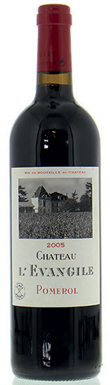

85% Merlot, 15% Cabernet Franc, 70% new oak. A nearperfect growing season, and this approaches perfection as it glides across the palate, with sweet fig...
2005
Château L'ÉvangilePomerol

Château L'Évangile, Pomerol, Bordeaux, France, 2009
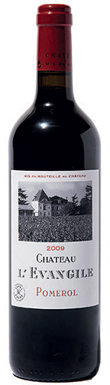
95% Merlot, 5% Cabernet Franc. A vintage that managed to tick all the boxes set down by the Bordeaux oenology school for great years, even...
2009
Château L'ÉvangilePomerol
Château L'Évangile, Pomerol, Bordeaux, France, 2016
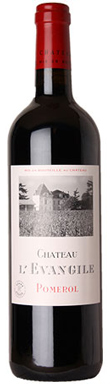
For me, this is going to be every bit as great as the 1989, and is a worthy follower to the 2015. It's tight and...
2016
Château L'ÉvangilePomerol
Château L'Évangile, Pomerol, Bordeaux, France, 1989
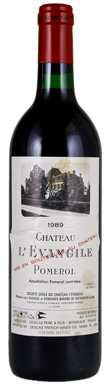
Utterly gorgeous, wonderful white truffle notes coming through the fruit, alongside leather, liquorice and tobacco and pure, juice-filled black cherries. The last year with just...
1989
Château L'ÉvangilePomerol
Château L'Évangile, Pomerol, Bordeaux, France, 2015
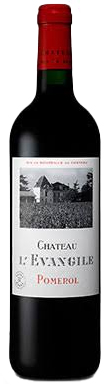
Beautiful, seductive red fruit on the nose, loaded with strawberries and cherries. Wonderfully floral with a lovely savoury edge. Plump fruit on the palate with...
2015
Château L'ÉvangilePomerol
Château L'Évangile, Pomerol, Bordeaux, France, 1982
Another dark wine, with a rich and exotic scent: lots of sweet spice and incense here. Still very sturdy on the palate, too, with its...
1982
Château L'ÉvangilePomerol
Château L'Évangile, Pomerol, Bordeaux, France, 1998
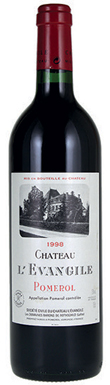
72% Merlot, 24% Cabernet Franc. This has real depth of flavour and intensity that keep you gripped from start to finish. Near to its perfect...
1998
Château L'ÉvangilePomerol
Château L'Évangile, Pomerol, Bordeaux, France, 2017
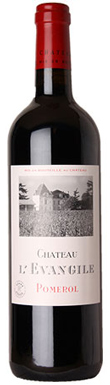
This has a lovely silkiness to it, one of the real successes in the appellation in terms of the texture and the quality of the...
2017
Château L'ÉvangilePomerol
Château L'Évangile, Pomerol, Bordeaux, France, 2001
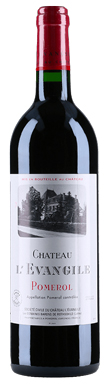
79% Merlot, 21% Cabernet Franc. A wine that unfolded fairly early in its life, and has remained at that deliciously appealing stage pretty much ever...
2001
Château L'ÉvangilePomerol
Château L'Évangile, Pomerol, Bordeaux, France, 2000
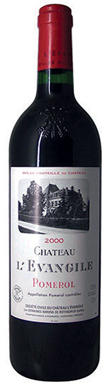
91% Merlot, 9% Cabernet Franc. Needs aerating and remains a touch closed, even after 17 years. Clearly displays the rich black fruit and sexy Pomerol...
2000
Château L'ÉvangilePomerol
Château L'Évangile, Pomerol, Bordeaux, France, 1990
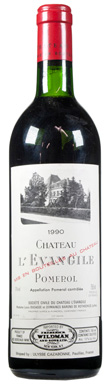
1990 was a very good vintage, although a bit more difficult to manage than the 1989. Flowering was uneven and as crop thinning was not...
1990
Château L'ÉvangilePomerol
Château L'Évangile, Pomerol, Bordeaux, France, 2012
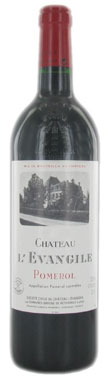
A deep-coloured wine with real Pomerol ‘flesh’ and structure. This is a wine that grows in the glass, showing its class as it opens up;...
2012
Château L'ÉvangilePomerol
Château L'Évangile, Pomerol, Bordeaux, France, 2005
85% Merlot, 15% Cabernet Franc, 70% new oak. A nearperfect growing season, and this approaches perfection as it glides across the palate, with sweet fig...
2005
Château L'ÉvangilePomerol
Château L'Évangile, Pomerol, Bordeaux, France, 2009
95% Merlot, 5% Cabernet Franc. A vintage that managed to tick all the boxes set down by the Bordeaux oenology school for great years, even...
2009
Château L'ÉvangilePomerol
Château L'Évangile, Pomerol, Bordeaux, France, 2016
For me, this is going to be every bit as great as the 1989, and is a worthy follower to the 2015. It's tight and...
2016
Château L'ÉvangilePomerol
Château L'Évangile, Pomerol, Bordeaux, France, 1989
Utterly gorgeous, wonderful white truffle notes coming through the fruit, alongside leather, liquorice and tobacco and pure, juice-filled black cherries. The last year with just...
1989
Château L'ÉvangilePomerol
Château L'Évangile, Pomerol, Bordeaux, France, 2015
Beautiful, seductive red fruit on the nose, loaded with strawberries and cherries. Wonderfully floral with a lovely savoury edge. Plump fruit on the palate with...
2015
Château L'ÉvangilePomerol
Château L'Évangile, Pomerol, Bordeaux, France, 1982
Another dark wine, with a rich and exotic scent: lots of sweet spice and incense here. Still very sturdy on the palate, too, with its...
1982
Château L'ÉvangilePomerol
Château L'Évangile, Pomerol, Bordeaux, France, 1998
72% Merlot, 24% Cabernet Franc. This has real depth of flavour and intensity that keep you gripped from start to finish. Near to its perfect...
1998
Château L'ÉvangilePomerol
Château L'Évangile, Pomerol, Bordeaux, France, 2017
This has a lovely silkiness to it, one of the real successes in the appellation in terms of the texture and the quality of the...
2017
Château L'ÉvangilePomerol
Château L'Évangile, Pomerol, Bordeaux, France, 2001
79% Merlot, 21% Cabernet Franc. A wine that unfolded fairly early in its life, and has remained at that deliciously appealing stage pretty much ever...
2001
Château L'ÉvangilePomerol
Château L'Évangile, Pomerol, Bordeaux, France, 2000
91% Merlot, 9% Cabernet Franc. Needs aerating and remains a touch closed, even after 17 years. Clearly displays the rich black fruit and sexy Pomerol...
2000
Château L'ÉvangilePomerol
Château L'Évangile, Pomerol, Bordeaux, France, 1990
1990 was a very good vintage, although a bit more difficult to manage than the 1989. Flowering was uneven and as crop thinning was not...
1990
Château L'ÉvangilePomerol
Château L'Évangile, Pomerol, Bordeaux, France, 2012
A deep-coloured wine with real Pomerol ‘flesh’ and structure. This is a wine that grows in the glass, showing its class as it opens up;...
2012
Château L'ÉvangilePomerol
