
Capezzana’s Trefiano: Quintessential Carmignano
Michael Apstein takes a look at what's behind this benchmark Carmignano Riserva, with tasting notes and scores for six vintages.


To celebrate the 40th anniversary of Trefiano – Tenuta di Capezzana’s stunning take on Carmignano Riserva – a vertical tasting of a handful of vintages ranging from 1988 to 2019 (the current release) was held in Florence this February.
In preparation for the tasting, I opened a bottle of the 2015 from my own cellar, so I have included my impression of that below, along with the wines from the tasting. Spoiler alert: Trefiano, like other great wines, takes at least a decade to reveal its considerable charms and stature.
Scroll down to see tasting notes and scores for the Capezzana Trefiano
Carmignano, the original ‘Super Tuscan’, is the only DOCG that has always required blending Sangiovese with Cabernet, with Sangiovese comprising at least 50% of the blend. Cabernet — either Franc or Sauvignon — must comprise at least 10% but no more than 20%. Today, most producers favour Cabernet Sauvignon over Cabernet Franc.
Although Carmignano falls within the greater Chianti area and the same grapes can be used for the wines, Carmignano typically displays more structure, minerality, and savoury features, along with a panoply of red and dark fruit flavours.
Of the 20 or so producers in this small, 116-hectare DOCG, Tenuta di Capezzana – owned by the Contini Bonacossi family – is at the top of the heap. Filippo Contini Bonacossi, who describes his role at the estate as, ‘a little bit of everything,’ explains that their location in front of the Apennines affords them rain in late August, which he says, ‘is precious for elegant wines,’ adding that their ‘microclimate of wind and rain is crucial.’ He emphasises the water-holding ability of the clay in the soil, which has been especially helpful in the last few dry vintages.
Winemakers use their best grapes for Carmignano Riserva, which must be aged for three years before release – a year longer than for Carmignano. With more structure and wood influence, Riservas need more bottle ageing to show their grandeur, making them good candidates for the cellar.
Villa di Trefiano
The grapes for Capezzana’s Trefiano Carmignano Riserva come from a small five-hectare site that surrounds the villa of the same name, built in the 16th century by Florentine aristocrat, Giovanni di Pandolfo Rucellai.
The Contini Bonacossi family acquired Villa di Trefiano and its vines shortly after purchasing Tenuta di Capezzana in the 1920s. The site includes three distinct parcels: two larger ones, Le Croci and Pietraia; and a smaller one named after the villa itself. Here, all three varieties used for Trefiano are grown: Sangiovese, Cabernet Sauvignon and Canaiolo.
Filippo points to the need to continue working on softening Sangiovese’s tannins, whose firmness can be accentuated when the grape is stressed by heat and dryness. He explains that the Cabernet Sauvignon vines originally came from Château Lafite-Rothschild and are a massale selection. With a broad smile he says: ‘Plants know how to evolve, better than we! They have a memory.’
Hector Contini Bonacossi, whose mother, Benedetta, is the estate’s winemaker, notes that their Canaiolo is a unique biotype, Canaiolo Rossa Raspo, named because the stalks (raspo, in Italian) are red. It adds colour, and its lower acidity balances and enhances the cherry-like fruitiness of Sangiovese, and they believe it adds elegance to the wine.
He describes the site as having a, ‘chaotic soil composition, which enhances the different notes in the glass,’ while Beatrice Contini Bonacossi, the commercial face and ambassador of the estate, underlines the uniqueness of the site by describing it as a ‘microclimate within a microclimate.’
Trefiano in the cellar
Since 2008, Trefiano has been farmed organically, and the entire Capezzana estate received organic certification in 2015. Since the varieties ripen at different times, they are fermented separately, always using native yeasts, before being blended.
The blend is consistent from year to year: 80% Sangiovese, with Cabernet Sauvignon and Canaiolo each contributing 10%. Ageing occurs in 350-litre tonneaux, equally split between new and one-year-old wood, for around 18 months, depending on the vintage. The average production ranges from 6,000 to 12,000 bottles.
Capezzana opts to bottle Trefiano only in the best years, which means, since its introduction in 1979, they’ve bottled it 28 times – roughly once every three years on average.
At the tasting
One of the best lessons learnt from a vertical tasting is to see when the wines enter their window of drinkability, which, of course, is personal and different for everybody. For me, the 2008 Trefiano was drinking beautifully. For many of the others at the tasting it was the 2012 – it’s personal preference.
In 2019, Beatrice told me that Trefiano was her brother Vittorio’s idea. He had died tragically a year earlier at only 66. To honour him, ‘Vittorio Contini Bonacossi’ appears on the label above ‘Trefiano’. His daughter, Serena told me: ‘The soul of my father is in this wine.’
A taste of Trefiano:
Wines are listed oldest to youngest
Related articles
- Il Caggio’s Ipsus: A Tuscan wine legend in the making
- Castello di Fonterutoli’s Concerto: A Sangiovese-dominant SuperTuscan in its 40th vintage
- Isole e Olena’s Cepparello: the Paolo de Marchi effect
Capezzana, Trefiano, Carmignano, Riserva, Tuscany, Italy, 1988
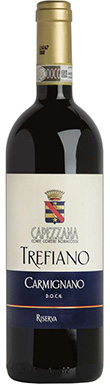

Haunting and engaging aromas from this brick-hued wine predict greatness – and it doesn’t disappoint! A wondrous and seamless combination of leafy notes of evolution with...
1988
CapezzanaCarmignano

Capezzana, Trefiano, Carmignano, Riserva, Tuscany, Italy, 1998
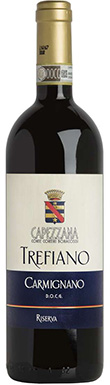
Benedetta took over from her father as winemaker starting with the 1998 vintage. Reflective of a warmer vintage, weighing in at 14.4 % alcohol, this...
1998
CapezzanaCarmignano
Capezzana, Trefiano, Carmignano, Riserva, Tuscany, Italy, 2008
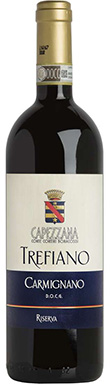
Subtle smoky notes add allure to the robust and energetic 2008. Youthfully vigorous, it is easy to savour now because the well-integrated, fine tannins give...
2008
CapezzanaCarmignano
Capezzana, Trefiano, Carmignano, Riserva, Tuscany, Italy, 2012
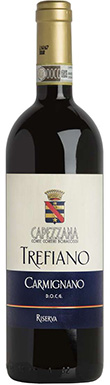
At a decade-plus of age, the still-youthful 2012 displays both charm and stature. Its succulent fruit profile dominates at this stage, but the underlying mineral...
2012
CapezzanaCarmignano
Capezzana, Trefiano, Carmignano, Riserva, Tuscany, Italy, 2015
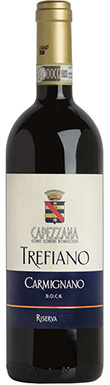
Savoury notes that emanate from the glass, along with its bricky colour, suggest maturity, but the 2015's youthfulness is still apparent on the palate. An...
2015
CapezzanaCarmignano
Capezzana, Trefiano, Carmignano, Riserva, Tuscany, Italy, 2019
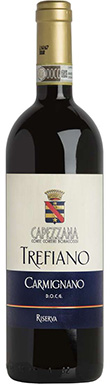
Fabulous fruity aromatics of red cherries leap from the glass and belie the wine’s tightly coiled structure – but the elegance cannot be hidden, shining through...
2019
CapezzanaCarmignano
