
Cervaro della Sala: Creating a world-class white wine


Our exclusive report on a vertical tasting of Cervaro della Sala, Antinori’s famous white wine blend of Chardonnay and Grechetto, with vintages ranging from 2005 to 2015.
Close to the border of Tuscany lies Castello della Sala, Antinori’s Umbrian outpost and home of its flagship white, Cervaro della Sala. Although the historic estate near Orvieto dates back to the 14th century, its wine producing history is relatively recent in terms of Antinori time lines.
‘My grandfather, Niccolo, bought the property in the 1940s, renovated the castle and began to restructure the white wine vineyards,’ said Allegra Antinori at a special tasting organised in London earlier this year.
Today, the estate has 170ha of Italian and international varieties including Procanico, Sauvignon Blanc, Semillon, Viognier, Traminer, Riesling and some Pinot Noir.
Scroll down to see John’s in-depth report, tasting notes & scores for Cervaro della Sala
But the two key varieties for Cervaro are Chardonnay and Grechetto, and this was almost entirely due to the work of a young Renzo Cotarella, who went on to become Antinori’s director of winemaking.
From crude to sensational
In 1979, Cotarella was just out of oenology school when he joined Antinori at Castello della Sala. At the time, the company didn’t have a top class white wine in its portfolio, so Piero Antinori (Allegra’s father) gave Cotarella free rein to create a great white vin de garde from the property.
Cotarella began experimenting with Chardonnay and a number of local varieties in much the same way that Giacomo Tachis had experimented with Cabernet Sauvignon and Sangiovese over in Tuscany.
According to Allegra, ‘back then, white wines were traditionally delicate. We wanted to change that in order to make a mark.’
Unfortunately, the early Chardonnay prototypes that Cotarella came up with were ‘disastrous’, she candidly admitted. ‘They were raw, alcoholic and crude.’
A major turning point was 1981, when Cotarella experienced a white wine epiphany in a Nice restaurant on his way back from a visit to Bordeaux.
The wine in question was a 1971 Corton-Charlemagne. Cotarella couldn’t believe that the wine wasn’t oxidised. ‘It was a revelation. I didn’t think there could be a wine like this.’
Cotarella went back to the drawing board and in 1985 produced something seriously worthwhile using a blend of Chardonnay and the local Grechetto. The latter stood out for its complimentary qualities of freshness and minerality.
The following year saw another significant improvement, as the 1986 went into entirely new French oak. Purely by chance, the wine also went through malolactic fermentation following an unusually warm December.
The results were sensational and set Cervaro on its path to international acclaim. Since then a few more winemaking modifications have been made, including a cold maceration and adjusting the percentage of Grechetto in the blend.
Early vintages could include up to 30% of Grechetto, but from 2004 that dropped to 15%, and since 2010 it can comprise as little as 10%, depending on the vintage. Importantly, the Grechetto is not fermented or aged in barriques and does not go through malo, in order to preserve freshness.
Even in the last 10 years the winemaking has continued to evolve, moving from power to more elegance. Vintages such as 2013 and 2015 have a lighter winemaking touch, with less batonnage and less oak ageing – designed to accentuate Cervaro’s freshness, texture, balance and complexity without compromising on its legendary ageability.
Tasting six vintages of Cervaro della Sala:
You might also like:
Ten of the best Italian vineyards & terroirs
Barolo 2010 panel tasting results
10 hidden gems in Southern Italy
Franciacorta: For those in the know
Antinori, Cervaro della Sala, Umbria, Italy, 2015
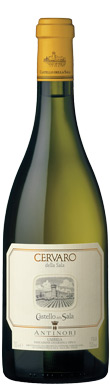

2015 was a textbook vintage and this is a great Cervaro. Citrus, cream and white flowers on the nose lead seamlessly onto the palate, where...
2015
Antinori

Antinori, Cervaro della Sala, Umbria, Italy, 2013
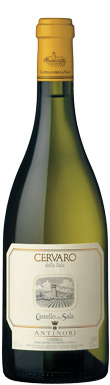
This has green and yellow tints and an intense nose of fresh hay, beeswax and butter. The palate is classy and complex, showing flavours of...
2013
Antinori
Antinori, Cervaro della Sala, Umbria, Italy, 2011
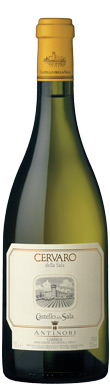
This feels a bit more generous, expansive and tropical in both flavour and texture thanks to the warm conditions in 2011. It has a slightly...
2011
Antinori
Antinori, Cervaro della Sala, Umbria, Italy, 2009
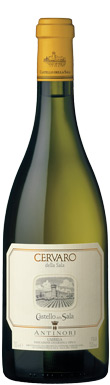
2009 is a critical juncture for the style of Cevaro, as this was the transition vintage in which the style changed from power to elegance....
2009
Antinori
Antinori, Cervaro della Sala, Umbria, Italy, 2006
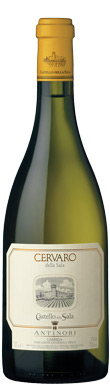
Golden hued, this looks and tastes like a wine that has more extract and heft. 2006 was a warm vintage and this was the first...
2006
Antinori
Antinori, Cervaro della Sala, Umbria, Italy, 2005
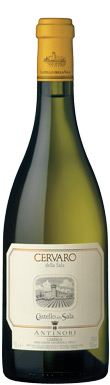
Made in the old, ‘open-air’ winery, the 2005 is now a deep gold colour. It’s big and intense, with an expansive savoury and mineral fatness...
2005
Antinori
