
Château Talbot: St-Julien’s totemic estate
Michael Apstein takes a look at the changes underway at Château Talbot, one of St-Julien's historic and totemic properties.


St-Julien is the quintessential expression of red Bordeaux, displaying grace and power without being overbearing.
It’s also the smallest of the major communes of Bordeaux and the one with the largest percentage of classified growths, as measured by acreage.
Indeed, 90% of the vineyards belong to the classified growths. St-Julien also claims to have the lowest average yield of all the major Médoc appellations, according to noted Bordeaux-authority Jane Anson.
Although Château Talbot is not the most prestigious property in St-Julien – that likely goes to Château Léoville Las Cases – Château Talbot is as characteristic of St-Julien as St-Julien is to Bordeaux.
And, as the tasting notes show, Talbot is an estate that is upping its game.
Scroll down for 14 tasting notes and scores of Château Talbot 2020-1966
Old Talbot
The estate is supposedly named after Sir John Talbot, the 1st Earl of Shrewsbury – Shakespeare’s ‘Old Talbot’, also known as ‘the English Achilles’ and ‘Terror of the French’.
A veteran of the later campaigns of the Hundred Years War and the last English lieutenant of the Duchy of Aquitaine, he was killed at the Battle of Castillon in 1453.
This disaster of English arms effectively ended the century-long conflict, and resulted in the French taking control of Bordeaux after 300 years of English rule.
The estate has passed through only a handful of owners down the centuries. A map of 1785 marks an area of St-Julien as ‘Talbot’ and there is a house (which likely became the château), owned by the Delage family.
Not long afterwards it was bought by Jean-Jacques d’Aux de Lescout and passed down to his son, Henri-Raymond, who did much to expand the property. In 1899 Arnaud d’Aux sold the estate to Albert Claverie, and Désiré Cordier purchased it in 1918.
The Cordier family still owns Château Talbot, with Nancy Cordier-Bignon and her husband Jean-Paul Bignon being the current directors. Eric Boissenot consults.
Château Talbot, classified as a 4th growth in the Médoc Classification of 1855, is one of St-Julien’s largest estates, encompassing about 110ha, in one single block around the estate.
Vines & winemaking

At about 25 metres above sea level, it is ‘high elevation’ for the Médoc. Talbot’s plantings reflect what’s grown in St-Julien in general: roughly 68% Cabernet Sauvignon, 28% Merlot, and 4% Petit Verdot.
There used to be Cabernet Franc in the blend but it was pulled out in 2007 by then-general manager Jean-Pierre Marty. His successor, Jean-Michel Laporte agrees with this move, believing that, unlike on the Right Bank, Petit Verdot is a better ‘complementary variety’ for Cabernet Sauvignon and Merlot than Cabernet Franc.
The grapes for Talbot come from vines that average 40 years old. They are harvested entirely by hand.
The harvesters do an initial sorting in the vineyard, eliminating diseased parts of bunches. In the cellar, the grapes are destemmed.
Then, state-of-the-art optical and densimetric sorting removes single berries that are not up to snuff.
After fermentation, the grand vin ages in oak barrels for about 16 months in an architectural gem of a barrel cellar.
Ahead of the curve
Talbot started producing a second wine, Connétable, beginning with the 1979 vintage, before many other Médoc producers adopted that practice.
Connétable typically comes from younger vines, but still averaging 30 years old, or those situated in less desirable parcels with sandy soils.
In contrast to the grand vin, Connétable is vinified in stainless steel tanks. It usually comprises about 40% of Talbot’s annual 400,000 bottle production.
Five of Talbot’s 110ha are devoted to white grapes, Sauvignon Blanc (80%) and Sémillon, from which it makes Caillou Blanc.
The blend of the wine typically follows the proportion of each in the vineyard. Although the vines lie within the St-Julien appellation, Caillou Blanc carries the Bordeaux Blanc appellation because regulations for St-Julien only permits red grapes.
Flying under the radar

Château Talbot frequently flies under the radar and fails to receive the accolades it deserves, perhaps because it is such a large estate with such a large production.
Whatever the reasons, it is a boon for consumers because the wines are widely available and the prices, at least compared to other cru classé, are reasonable.
As you’ll see from the tasting notes below, the wines of Château Talbot have become more refined and polished over the last two decades.
Jean-Michel Laporte, who ran La Conseillante for nearly a decade and has been the general manager and winemaker at Talbot since 2018, attributes the enhanced refinement to changes that his predecessor, Jean-Pierre Marty, made – starting with the 2006 vintage.
Laporte notes that Talbot was, ‘late to embracing new technology’ and explained that Marty and his team took a more ‘modern and cleaner approach to winemaking’ at Talbot.
Laporte emphasises that when he took over at Talbot he ‘didn’t want to change the style’. He just wanted to add slightly ‘more depth to the mid-palate’.
Laporte adds modestly that he ‘adjusted some details’ in the vineyard and the cellar. His aim in general, whether at Conseillante and now at Talbot, is ‘to preserve balance, have ripe tannins, and avoid astringency’.
In the vineyard, Laporte removed leaves from the vines earlier in the growing season to achieve better maturity of the grapes and reduce the chance of disease.
He notes now that while overall average yields were fine, he found that decreasing yields in a few of the plots improved quality.
Savoury & savoured
In the cellar, he started the pumping over earlier during fermentation, when the alcohol level is low, to extract softer tannins from the skins instead of more astringent ones from the seeds.
He also slightly increased the amount of new oak barrels for ageing, from 50% to 60% to bring softer, more refined tannins to the wine.
In addition to greater refinement of the wines over the last two decades, the tasting notes indicate that the wines from Château Talbot develop beautifully with bottle age.
They deliver an engaging and alluring combination of fruitiness mixed with that illusive ‘not just fruit’, woodsy, savoury character.
Another lesson: even mature wines evolve in the glass, so they should be savoured, not rushed.
Château Talbot: 14 notes from 2020-1966
Wines are listed in order of descending vintages.
Related articles
- Wines of the Year 2024: Bordeaux & Burgundy
- Five Bordeaux vintages to drink now
- Château Cantenac Brown: Margaux’s latest rising star
Château Talbot, Caillou Blanc, Bordeaux Blanc, Bordeaux, France, 2020
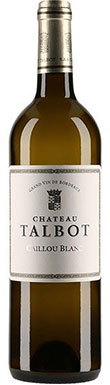

Although Sauvignon Blanc’s distinctive varietal character is readily apparent on the nose, a subtle creaminess appears on the palate, creating a harmonious counterpoint and a...
2020
Château TalbotBordeaux Blanc

Château Talbot, St-Julien, 4ème Cru Classé, Bordeaux, France, 2020
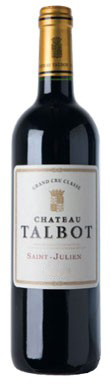
The long and polished 2020 Talbot leads with great fragrance followed by black fruit notes and even a hint of tar. Overall, it is less...
2020
Château TalbotSt-Julien
Château Talbot, St-Julien, 4ème Cru Classé, Bordeaux, France, 2019
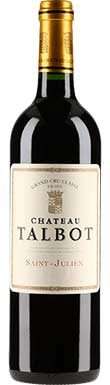
The youthful and energetic 2019 Talbot, a blend of Cabernet Sauvignon, Merlot and Petit Verdot, retains grace despite its ripeness. Still bold for a St-Julien,...
2019
Château TalbotSt-Julien
Château Talbot, St-Julien, 4ème Cru Classé, Bordeaux, France, 2018
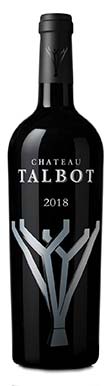
The youthful and sumptuous 2018 comes in a strikingly heavy engraved bottle that celebrates the 100th anniversary of Cordier ownership. It is both delicious and...
2018
Château TalbotSt-Julien
Château Talbot, St-Julien, 4ème Cru Classé, Bordeaux, France, 2015
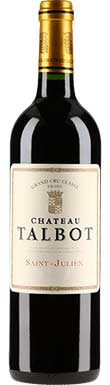
The gentle 2015 Talbot shows the charms of claret. Not a powerhouse, it caresses the palette. Its restraint and elegance are the epitome of Talbot....
2015
Château TalbotSt-Julien
Château Talbot, St-Julien, 4ème Cru Classé, Bordeaux, France, 2014
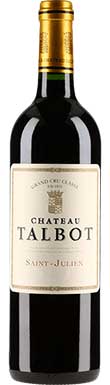
Here the lovely cedar nose draws you in and leads to an elegant combination of dark fruit and mature, leather-like nuances. The tannins are not...
2014
Château TalbotSt-Julien
Château Talbot, St-Julien, 4ème Cru Classé, Bordeaux, France, 2009
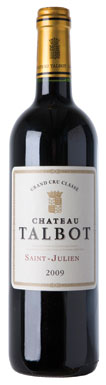
A hint of brick colour at the edge belies the youthfulness of the gorgeous 2009 Talbot. Succulent black fruit sits on a firm but suave...
2009
Château TalbotSt-Julien
Château Talbot, St-Julien, 4ème Cru Classé, Bordeaux, France, 2006
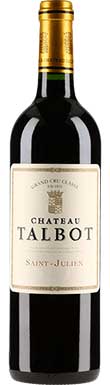
After almost two decades, the dazzling 2006 Talbot is entering its window of maturity. Gorgeous aromatics suck you in and the palate does not disappoint....
2006
Château TalbotSt-Julien
Château Talbot, St-Julien, 4ème Cru Classé, Bordeaux, France, 1995
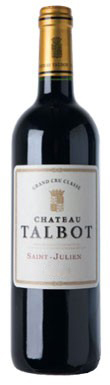
The suave and clearly mature 1995 Talbot, from half-bottle, was still fresh 29 years later. A touch of cedar accented fading fruitiness in this mid-weight...
1995
Château TalbotSt-Julien
Château Talbot, St-Julien, 4ème Cru Classé, Bordeaux, France, 1990
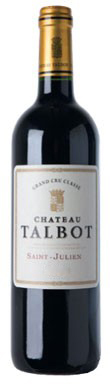
Unsurprisingly given the stature of the vintage, the 1990 Talbot was stunning. A garnet slightly brown tinged rim indicates its age. Rich, certainly, yet refined,...
1990
Château TalbotSt-Julien
Château Talbot, St-Julien, 4ème Cru Classé, Bordeaux, France, 1988
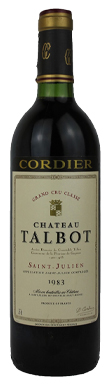
The 1988, from a 6-litre bottle, has turned out splendidly. The hard tannins characteristic of the vintage – and apparent when this wine was young...
1988
Château TalbotSt-Julien
Château Talbot, St-Julien, 4ème Cru Classé, Bordeaux, France, 1986
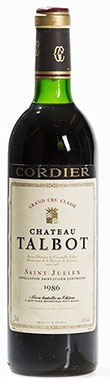
In a word, gorgeous. The ferocious tannins of the vintage have melted away but still linger in the background, providing structure to its plum-like fruitiness....
1986
Château TalbotSt-Julien
Château Talbot, St-Julien, 4ème Cru Classé, Bordeaux, France, 1983
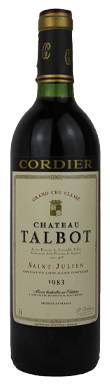
Like the 1990, the mature 1983 Talbot leads with a browning edge and similar subtle balsamic notes. Dark fruits mingle effortlessly with the cedar, coffee,...
1983
Château TalbotSt-Julien
Château Talbot, St-Julien, 4ème Cru Classé, Bordeaux, France, 1966
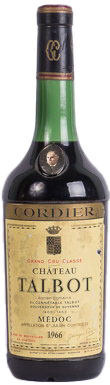
Browning edges proclaim its age. Clearly mature with alluring leathery and cedar nuances, the graceful 1966, even at 58 years old, is still fresh, not...
1966
Château TalbotSt-Julien
