Get our daily fine wine reviews, latest wine ratings, news and travel guides delivered straight to your inbox.
You are now subscribed
Your newsletter sign-up was successful
An account already exists for this email address, please log in.
Château Cantenac Brown: Margaux’s latest rising star
Formerly one of the Médoc's more inconsistent appellations, recent years have seen underperforming estates in Margaux come on in leaps and bounds. Among these is third growth Château Cantenac Brown.
Not that long ago, Margaux seemed an appellation of grab-bag quality. It is the Médoc’s largest communal appellation, that accounts for one-third (21) of all its classified wines, spanning first to fifth growths.
Among their number were previously underperforming estates like fourth growth Château Pouget and second growth Château Rauzan-Gassies, as well as top-notch properties, such as Château Margaux, Château Palmer and Château Rauzan-Ségla.
One such estate is third growth Château Cantenac Brown, one of three classified châteaux with the commune ‘Cantenac’ in its name.
Another is the also much-improved second growth Château Brane Cantenac, which crafts wines of aromatic finesse from vines atop a 12 metre-deep gravel plateau.
And the third is another third growth, Château Boyd Cantenac, which (sadly) still lags behind the other two somewhat.
Tasting notes and scores for Château Cantenac Brown
What has changed
Over the last 40 years, Cantenac Brown has seen no less than four different owners, each introducing changes and modifications, capped most recently with a new cellar first used for the 2023 vintage.
Decanter newsletter
Get our daily fine wine reviews, latest wine ratings, news and travel guides delivered straight to your inbox.
A stable presence over most of these years is José Sanfins, hired in 1989 by then-owner AXA Millésimes as technical director. He’s been there ever since.
In visiting the new cellar this year, Sanfins explains that in the early years this century, there was a tendency to focus ‘more on production rather than selection’, and that more careful selections – starting in 2012 – have contributed to improving precision and depth in the wines.
‘We decided to work harder and began to notice that it was important to select more,’ Sanfins remarks.
‘Starting with the 2012 vintage, we went from producing around 60% of the harvest for the first wine to 50%,’ he explains.
They purchased some 14 hectares of mostly old vine Cabernet Sauvignon that has added more depth to the wine, from the 2020 vintage.
Sanfins continues: ‘In March 2020, the estate decided to add more plateau-based grapes, with the acquisition of vines that had belonged to Margaux estates Château Charmant and Château La Galiane.
‘From that first year, 70% of these vines contributed to our first wine, yielding a more than promising result.’
The results are clear in the wines themselves. The estate’s wine from the otherwise superlative 2010 vintage, for example, seems a little woolly compared to the very impressive 2020.
Château Cantenac Brown: Key facts
Owner: Tristan Le Lous
Director: José Sanfins
Vineyard manager: Hervé Martin
Consultant: Eric Boissenot
Size: 75ha with 64ha in production
Second wine: Brio de Cantenac Brown (launched in 2001)
White wine: Alto de Cantenac Brown (launched in 2011)
(l-r): José Sanfins and Tristan Le Lous
(Image credit: Credit Unknown)
Location, location
The vines are mainly found on the plateau just outside Margaux, extending as far as the commune of Soussans, and, although covering two communes, they are located on the same plateau, ‘thus guaranteeing continuity of terroir,’ Sanfins adds.
Here the 50-year-old Cabernet and Merlot vines planted on gravelly soils have deep roots, making them less sensitive to climate vagaries and yield small, dense and concentrated berries, which, Sanfins stresses, ‘is exactly what we are looking for in our great wines’.
Like many other Médoc estates, Château Cantenac Brown has plans to increase the percentage of Cabernet Sauvignon in its blends, having decided to uproot four hectares from the recent acquisition to replant only Cabernet Sauvignon.
‘This restructuring is necessary to optimise vineyard work and homogeneity of maturity during the harvest,’ explains Sanfins.
The estate has been less intrusive in extracting tannin, as recent vintages have proven richer and riper, requiring less pumping over and other forms of extraction, Sanfins adds.
To more gently extract tannins during fermentation, his team uses a tool that creates an air bubble in a vat by blowing air, or air enriched with carbon dioxide, under the cap to draw wine upwards over it.
It is also possible to not pass the wine over the cap, but simply exchange the juice in contact with the skins.
This allows for gentle extraction, known as ‘infusion’, he says, ‘a technique that we increasingly favour, particularly during particularly concentrated vintages’.
New cellar, more precision
The most recent and drastic change was the construction of a state-of-the-art, €20m cellar.
In 2020, owner Tristan Le Lous and Sanfins called on architect Philippe Madec to create the new cellar, which was needed to complete the final stage of the production overhaul.
Construction lasted from 2021 to 2023, just in time for last year’s harvest.
The new 5,000m² installation more than doubles the number of stainless-steel fermentation vats: from 33 to 70, ranging in size between 50 and 120 hectolitres, which better reflect the parcel-by-parcel selections of the harvest.
The new cellar also contains needed space to age intermediate vintages, ‘so that we will be able to age wines longer than just 16 months, as sometimes you need more time for the oak to integrate into the wine,’ says Sanfins.
This helps ensure that humidity levels are kept stable, meaning barrels are kept in optimal conditions without the need for air conditioning.
He also points out how the building design ensures that the grapes follow a gravity flow into the vats, for utmost care in the winemaking process.
‘We now are also better able to emphasise preservation of fruit.’
(Image credit: Credit Unknown)
Timeline
1754 – Nobleman Jacques Boyd acquires land in Cantenac.
1806 – John Lewis Brown, a Frenchman of Scottish origin, who has owned vines in Cantenac since 1803, acquires the estate at an auction.
1843 – John Lewis Brown declares bankruptcy with the estate ‘Brown of Cantenac’ split into two parts: the largest part (58 hectares) is acquired by a banker named Gromard and the rest (8ha) is taken over by Jean Verrière, future mayor of Margaux, under the name Château Boyd.
1855 – The Bordeaux Classification ranks both estates as third growths.
1860 – The larger estate definitively becomes Château Cantenac Brown after Gromard sells it to Bordeaux merchant Armand Lalande (1820-1894), deputy mayor of Bordeaux.
1866 – The Tudor-style château design is finalised.
1968 – Purchased by the Du Vivier family after a long, challenging period, spanning phylloxera, war and depression.
1987 – The Compagnie du Midi acquires the estate, and begins to renovate the cellars
1989 – AXA Millésimes acquires the estate, and continues cellar renovation work and invests in a new drainage system, also hiring José Sanfins as technical director.
1997 – Vat room renovated with stainless steel vats.
2005 – Simon Halabi, a British investor of Syrian origin acquires the estate, and José Sanfins takes over as manager.
2019 – The Le Lous family acquires the estate.
2021 – Construction of new cellar space.
2023 – First vintage using the new cellar space.
Making the original estate more visible
In addition to the new cellar, whose colours and style echo the original estate, the owners are now renovating the interior of the old château, beyond just coats of paint.
‘We were less visible as part of AXA, which counted a galaxy of wines, such as Pichon Baron (among its portfolio),’ Sanfins says.
Guiding me through the high-ceilinged château rooms with balconies that offer beautiful views, Sanfins spoke of the need for higher visibility, with plans for future events to be held once renovation work is completed.
The estate’s spectacular Tudor-style architecture, with its four-centre arch, decorative half-timbering, a steeply pitched roof, high and narrow doors and windows and towering chimneys, already makes it a rare and memorable must-see among Bordeaux’s parade of more classical façades.
Furthermore, tucked away behind the estate is a small garden and meadow and a forested area, which is all being maintained in a manner that promotes biodiversity.
Efforts paying off
(Image credit: Credit Unknown)
Jeff Zacharia of Zachy’s in New York City says: ‘I have been very happy and excited to see the quality of Cantenac Brown increase significantly over the past 10 years.
‘It is wonderful to see producers really make significant efforts, and those efforts paying off.’
With the new cellar set to further improve quality, the future looks bright for Château Cantenac Brown, which means that Bordeaux fans have yet another excellent Margaux to discover – or rediscover – in a unique setting.
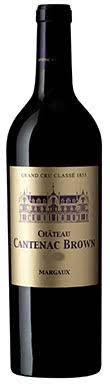
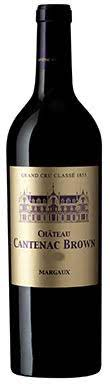
Château Cantenac Brown, Margaux, 3ème Cru Classé, Bordeaux, France, 2019
My wines
Engaging aromas of crisp, clean blue fruit and cassis with distinct Cabernet driven graphite and iodine freshness make this wine quite appealing. It lacks the...
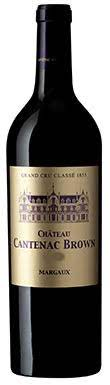
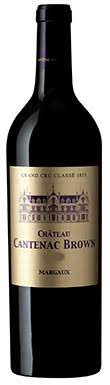
Château Cantenac Brown, Margaux, 3ème Cru Classé, Bordeaux, France, 2016
My wines
A wine of delicate elegance, having opened up a bit since last experienced in April 2022. Impressive fruit palate persistence, more red than black, again...
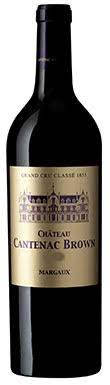
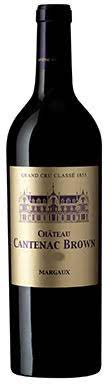
Château Cantenac Brown, Margaux, 3ème Cru Classé, Bordeaux, France, 2010
My wines
What a fascinating impression that this vintage offers, compared to more recent vintages assessed for this article. While it conveys clean and pure fruit expressions,...
Decanter Magazine, Wine Writer and DWWA Judge 2019
Panos Kakaviatos has been a published wine writer since 2001, writing in internationally recognized media including Decanter, but also Harpers Wine & Spirit, Meiningers Wine Business International and The World of Fine Wine.