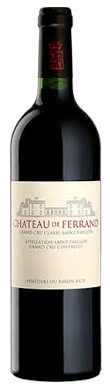
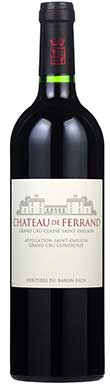
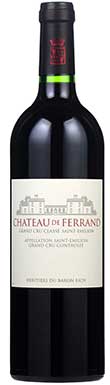
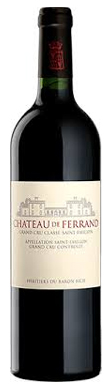
Château de Ferrand
Château de Ferrand
(Image credit: Château de Ferrand)

The next time you use a Bic pen to write a heartfelt letter, Bordeaux should come to mind.

The family that invented the bestselling ink pen in the world also owns a beautiful estate in St-Émilion that you can visit – and stay in.

In 1977, Baron Marcel Bich – an Italian-born, French industrialist who co-founded the company bearing his name – announced that he would ‘turn water into wine’, by selling shares in a mineral water brand to purchase Château de Ferrand in St-Émilion.

But for many years, the wines from the sprawling 42 hectare estate were rather average, not obtaining major critical acclaim.

Starting earlier this century, however, Château de Ferrand – currently owned by Baron Bich’s daughter Pauline Bich Chandon-Moët and husband Philippe Chandon-Moët – embarked on a programme to renovate the early 18th century manor and improve the wine.


Scroll down for notes and scores of wines from Château de Ferrand


Making improvements

They started by replanting the vines to better match the château’s different soil types, which range from brown sandy-clay limestone and compacted marl, to sandy-clay and calcareous.

Planted on the clay-limestone plateau and hillsides of St-Hippolyte peaking at 100m above sea level, Château de Ferrand has one of the highest vineyards in the appellation.

The estate has 32ha planted with vines – all in a single plot. From their high vantage point, they look down on a curve in the Dordogne valley.

The vines are also on slight slopes, which keeps them well-drained in times of high rainfall. They enjoy ideal exposure to light and warmth, and rising air currents keep the site ventilated and healthy.

Promotion

Thanks to the replanting programme and other improvements, such as increased planting density to 8,300 vines per hectare, Château de Ferrand was promoted to Grand Cru Classé in the 2012 St-Émilion classification.

To better understand its vineyard parcels, the estate also launched a multi-year, in-depth ampelographic soil study in 2012, which ran until 2022.

But it was not until the 2017 vintage, with the arrival of Gonzague de Lambert as director, that the wine markedly improved.

Before that vintage, the wine too often reflected a heavier style that had been in fashion earlier this century, made from grapes harvested late and reflecting excessive oak extraction during vinification.

Recent vintages however stress fruit purity, ripe – not overripe – fruit and judicious extraction with less new oak for ageing.

De Lambert, who is co-owner of Chateau de Sales in Pomerol, has been leading a talented team that has transformed Château de Ferrand into a hidden gem.

‘We are doing less extraction as compared to prior vintages, less pumping over,’ de Lambert explained to me while tasting the 2023 vintage from barrel earlier this year.

‘Five years ago, we pumped over much more, but now we speak of infusion in the vats rather than active extraction of tannins.’

The team keeps winemaking temperatures on the cooler side to maintain freshness. The excellent 2023 vintage is part of a string of fine vintages starting with the 2017.

Another reason the wines have gained in fruit purity is a commitment to organic viticulture. The 2024 vintage will mark the first year that Château de Ferrand will make certified organic wines, after a three-year transition period.


Château de Ferrand timeline

1702: Estate built by Elie de Bétoulaud

1702-1978: Elie de Bétoulaud bequeathed the estate to his great-grandnephews who then passed it down through the generations until 1978

1978-1994: Estate bought and run by Baron Marcel Bich

2005-today: Pauline Bich Chandon-Moët and husband Philippe Chandon-Moët take over the running of the estate

2012: Promotion to Grand Cru Classé

2017: Gonzague de Lambert becomes winemaking director

2019: Major estate renovations


Beautiful setting

The owners not only committed to making and selling excellent St-Émilion Grand Cru Classé wine but also to creating a sumptuous setting for wine tourism in Bordeaux linked to art, cuisine and high-end lodging.

The owners invested in a substantial renovation in 2019 of the original estate, which had been built by Élie de Bétoulaud, a prominent local lawyer and poet, in the early 18th Century.

Take for example the renovated tasting room, which boasts a mural depicting the estate’s forest and vineyard landscape across the four seasons of the year – all done in ballpoint pen.

It took seven blue coloured Bic Cristal ballpoint pens for artist Alexandre Doucin to decorate the white walls of the room, creating a suitably artistic ambiance.

The renovation includes an Orangery reception room that can hold up to 300 guests at a time. At one end is a revolving tasting room, which allows guests to either taste wines in full view of the room or in privacy at the touch of a button. A very James Bond-esque touch.

Three suites for overnight stays are accessible via the sweeping 17th century stone staircase, adorned by period tapestries – though with much more modern lighting.

Weather permitting, one can explore the estate’s 10ha of woodland and meadows, with a protected park home to deer, boar, migratory birds, hares, and cranes.

There are oak trees on the estate that date back at least two centuries. One of my favourite trees is a 300-year-old Lebanese Cedar, near the rear entrance to the château.

The finer things

The wine tourism profile includes several culinary experiences, with multiple-course dinners prepared by talented chef Marilyn Madray and her team.

These are served on a long wooden table surrounded by nearly 30 Bic pen-inspired sketches, sculptures and paintings from both established and emerging international artists.

The estate offers tasting workshops, such as the art of blending, where participants can taste different grape varieties and make their own blends.

Pauline Chandon-Moët also supports the young artists of the Bordeaux National Opera Academy, and has been hosting concerts for the public at the estate since 2023.

In June this year, for example, Château de Ferrand hosted a classical music concert featuring Louise Jégou, Deborah Salazar & Jan Myslikovjan – young Bordeaux National Opera Academy musicians.

Despite such bells and whistles, Château de Ferrand is a St-Émilion estate with one of the best price-to-quality ratios in the market today.

Re-entering the En Primeur system in 2017 proved important for both its commercial distribution and notoriety

The wines have been attracting increasingly positive critical scores. Released en primeur at just over £20 per bottle, the 2023 is one of the best deals for Grand Cru Classé St-Émilion you’re likely to find.


Key facts:

Area under vines: 32ha

Vineyard: 70% Merlot, 29% Cabernet Franc and 1% Cabernet Sauvignon

2021: ISO 14 001 certification

2021: First organic-conversion vintage for the entire vineyard

2024: First certified organic vintage

Average age of vines: 30 years

Winemaking method: The team sorts the grapes in three steps at harvest time: by hand at the vine, by hand upon arrival, and then optical sorting. The fruit is then transferred to vats. Wines age in fine-grained French oak barrels between 12 to 16 months depending on the vintage.


Château de Ferrand: 2014-2022

The wines are listed in vintage order (excluding the 2021 vintage)


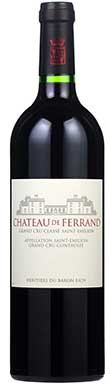
Château de Ferrand, St-Émilion, Grand Cru Classé, Bordeaux, France, 2022

My wines
Locked score

From a uniquely opulent vintage, Château de Ferrand strikes gold with vivid violet, mint, liquorice and juicy plum and blackberry aromas. Almost like a barrel sample, when tasted in September 2024, this full-bodied wine packs tannic punch, akin to the 2010 vintage, which means buyers should cellar it at least three to five years before serving. Here we see the benefits of the vineyard’s natural ventilation, having escaped frost that affected vineyards in 2022. The clays retained needed moisture to prevent hydric stress and the month-long harvest ensured long, even ripening, with an excellent expression of cooler Cabernet Franc to balance the richness of the Merlots.

2022

BordeauxFrance

Château de FerrandSt-Émilion

Decanter Premium logo

Join Decanter Premium to unlock all our wines tastings and notes

Join Now

Château de Ferrand, St-Émilion, Grand Cru Classé, Bordeaux, France, 2020

My wines
Locked score

An enchanting bouquet includes crushed mint, bright blueberry, juicy blackberry and damson. When tasted at the estate last year, the 2020 showed more structure than the 2019 and 2018, but this year, it is blossoming into a magnificent wine of polish, class and refinement. Decanting is essential for this, my favourite recent vintage of Château de Ferrand, combining cool and warm fruit, leading to a long, lingering finish echoing black cherry and violets. The prominence of the (ripe) tannins is good news for cellaring, even if the suave palate texture is hard to resist today. Starting with this vintage, 5% amphorae ageing (and 30% new oak) has helped raise the freshness level. The price for the quality is a no brainer!

2020

BordeauxFrance

Château de FerrandSt-Émilion

Decanter Premium logo

Join Decanter Premium to unlock all our wines tastings and notes

Join Now

Château de Ferrand, St-Émilion, Grand Cru Classé, Bordeaux, France, 2019

My wines
Locked score

A wine that comes off just a bit closed compared to the 2018. With more cool mint and blue fruit than blackberry or plum, the 2019 has a slightly lower pH that accentuates the structure of the tannin, lacking the velvety appeal of the 2018, which, at this early stage, conveys superior charm. While I prefer the overall balance of the 2018, the 2019 earns just as high a score as a more cerebral wine, and I place my bets that cellar ageing will make it complex and appealing. For now, do not touch.

2019

BordeauxFrance

Château de FerrandSt-Émilion

Decanter Premium logo

Join Decanter Premium to unlock all our wines tastings and notes

Join Now

Château de Ferrand, St-Émilion, Grand Cru Classé, Bordeaux, France, 2018

My wines
Locked score

The estate truly hits its stride in 2018, with a wine reflecting ripe plum, blackberry, and black cherry aromas. With the high alcohol of earlier vintages, this wine fully succeeds with balancing freshness and nuance – compared to the similarly solar 2015 vintage, for example. With even less new wood (and less extraction) than in 2017 – only 30% new oak – the freshness and bright fruit balance the vintage opulence (as if it had a dollop of Port) leading to a long finish. Ideal on its own or with a gourmet meal. Bravo!

2018

BordeauxFrance

Château de FerrandSt-Émilion

Decanter Premium logo

Join Decanter Premium to unlock all our wines tastings and notes

Join Now

Château de Ferrand, St-Émilion, Grand Cru Classé, Bordeaux, France, 2017

My wines
Locked score

Forest strawberry and autumnal fruit aromas are purer than in the comparable 2014 vintage, with a cleaner and crisper palate in this transitional vintage. The team not only reduced new oak for ageing from 60% to 40%, but also the ageing itself from 16 to 12 months, resulting in a fresher – and not drying – finish as compared to prior vintages. Indeed, friends who joined me on a trip to the estate last year purchased six-bottle cases of the 2017 vintage, which also costs less than the 2016. Over a two-day period, the wine develops wonderfully, with spring floral aromas reflecting a smooth, medium finish. Although it will not cellar as long as fuller-bodied wines like the 2018 or 2020, this wine punches above the vintage rating.

2017

BordeauxFrance

Château de FerrandSt-Émilion

Decanter Premium logo

Join Decanter Premium to unlock all our wines tastings and notes

Join Now

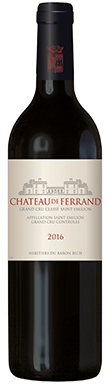
Château de Ferrand, St-Émilion, Grand Cru Classé, Bordeaux, France, 2016

My wines
Locked score

A bouquet of roasted plum, blueberry, shaved almond and vanilla reflect the richness and coolness of the 2016 vintage. With a broad attack, the palate is larger-scaled and more nuanced than the 2015 vintage, albeit still recalling on the finish especially the extraction of 'garage style' Right Bank wines earlier this century with overripe and jammy notes, along with oak-derived tannin. Considering what one expects from a grand cru classé from the magnificent 2016 vintage, this wine lacks needed complexity to get a higher score. On the plus side, it has noteworthy palate depth and body compared to the 2015 and (especially) the 2014 vintages, leading to more confidence that cellaring will result in more nuance with a possible higher score, even if you can enjoy it today, either on its own or with risotto and mushrooms.

2016

BordeauxFrance

Château de FerrandSt-Émilion

Decanter Premium logo

Join Decanter Premium to unlock all our wines tastings and notes

Join Now

Château de Ferrand, St-Émilion, Grand Cru Classé, Bordeaux, France, 2015

My wines
Locked score

Ripe plum, blackberry and chopped mint as well as vaguely buttery vanilla aromas reflect the sunny, hot vintage – and the winemaking. There is much initial ripe fruit pleasure – certainly more body than the 2014 – making this wine pleasant. But it leaves an overall simple, straightforward expression, with drying, oak-derived tannins that detract from the initial fun and joy. Cellaring could add complexity, but I am not that sure. Double decanted and tasted over a two-day period.

2015

BordeauxFrance

Château de FerrandSt-Émilion

Decanter Premium logo

Join Decanter Premium to unlock all our wines tastings and notes

Join Now

Château de Ferrand, St-Émilion, Grand Cru Classé, Bordeaux, France, 2014

My wines
Locked score

Pleasing aromas of autumnal strawberry and pomegranate, creosote and even some rhubarb introduce a somewhat light-bodied wine whose brisk attack denotes the high acidity of the vintage. Its 'high-toned' nature should work well with grilled steak, mushroom-filled ravioli or a pizza quattro formaggi. While I like the opening brightness, the palate gives way to drying, oak-derived tannins that perturb balance, contributing to a somewhat astringent (and shortish) finish. Drink up.

2014

BordeauxFrance

Château de FerrandSt-Émilion

Decanter Premium logo

Join Decanter Premium to unlock all our wines tastings and notes

Join Now
Panos Kakaviatos
Decanter Magazine, Wine Writer and DWWA Judge 2019
Panos Kakaviatos has been a published wine writer since 2001, writing in internationally recognized media including Decanter, but also Harpers Wine & Spirit, Meiningers Wine Business International and The World of Fine Wine.