
Tasting Col d’Orcia Poggio al Vento wines: 1990 – 2010
Italian wine expert Aldo Fiordelli reports on the history and winemaking techniques behind this celebrated Brunello di Montalcino Riserva, and tastes several vintages spanning two decades.


In front of his most important wine, Poggio al Vento Riserva, Count Francesco Marone Cinzano confesses his sole regret: ‘I never asked my father what he saw in Montalcino and why he decided to invest here.’
Marone Cinzano is one of the oldest families in Italy involved in wine, yet the counts arrived in Montalcino in 1973, ‘when it was an extremely poor village’. Col d’Orcia and Poggione were born at that time, effectively dividing Fattoria Sant’Angelo.
Scroll down to see tasting notes and scores for seven Poggio al Vento wines
Today, Count Francesco’s son, Santiago Marone Cinzano, is stepping into the management of the estate. ‘We have a very long history in the Italian wine business with Cinzano,’ he says. ‘However, we have the intention to write more pages of history.
‘We have always been committed to research and development and have upheld quality above fashions or trends; a winning strategy in the long run.’
A common declaration, but in this case one that is backed by eight vintages of Poggio al Vento that prove the stunning consistency of this Brunello di Montalcino Riserva over 20 years.
According to Giuliano Dragoni, agronomist of the estate, ‘Poggio al Vento is the oldest single-vineyard wine of Col d’Orcia.’
Location
The vineyard spans 5.5 hectares, two of which remain from the original planting in 1974 – with 3.5 hectares replanted since then.
It is located close to the forest of Sant’Angelo in Colle, which dates back millions of years to the Eocene period. The texture of the soil results from primary rock that has broken up into galestro schist, ‘alberese’ limestone and tufaceous material. This is the highest vineyard close to the village of Sant’Angelo.
Vines were planted following a massal selection of the estate’s old vines from the 1930s.
Up until the 1970s, there was no clonal selection, although today Sangiovese clones such as CDO4 (Col d’Orcia 4), CDO6, CDO8 are widely appreciated by a lot of wineries.
However, Dragoni says ‘we are convinced that only from massal viticulture can we achieve biodiversity’, which he believes also carries benefits for wine.
Viticulture and vinification practices
The evolution to a more conscious and refined viticulture began in 1990. ‘We started with dramatic cutting, reducing from 12 to six clusters per vine, and that green harvest [led to] more alcohol and more phenolic concentration, increasing the quality.
‘Then, after careful observation, we were able to conclude that today eight to 10 clusters per vine are the optimum, equalling 2.5 kilos of grapes, approximately 60q/ha (600kg/ha or 60hl/ha).’
Another big change in Montalcino has been the use of cover crop. In the 1970s it was used to absorb excessive rainfall, so as so contain the vigour of the vines. ‘Today, we use it to harbour more nutrients for the vine and promote the activity of bacteria, which increases the overall complexity of the wine,’ says Dragoni.
Col d’Orcia is also experimenting with zeolite in order to preserve humidity within the soil, although count Francesco Marone Cinzano says practices are carried out with careful attention.
He says Poggio al Vento is not an example of a stroke of luck or a void filled where others didn’t take root. ‘It comes out of the specific idea to produce a quality wine,’ he says.
In the winery, the timeless concrete has never been replaced by other materials like stainless steel. Malolactic fermentation is carried out spontaneously in concrete ‘as soon as we can’, says winemaker Antonio Tranchida. The wine then ages in big oak vessels for four years and in bottle for another three. ‘In our opinion this is fundamental in developing complexity,’ Tranchida says.
Ancient soils, old vines, altitude, diversity in the vineyard and long ageing are the critical factors of Poggio al Vento’s quality.
This is the gem among 150 hectares of the estate in Col d’Orcia, all managed officially under organic viticultural practices, a feat that the team says ‘quite challenging for an estate of this dimension’.
Santiago Marone Cinzano adds that he hopes that ‘Montalcino as a whole will become organic in the future’.
Consistency
Tasting the wines, from 2004 to 2010 there is evidence of greater and more precise extraction with more elegant tannins.
But what is most impressive is the consistency in quality and integrity of this Brunello di Montalcino Riserva year after year, with a stunning ability to age.
This southern portion of Montalcino typically shows a sweetness of fruit, like raspberry, with a ripeness of the tannins and softer acidity among its other signature qualities. But here the fruit character seems to be fresher, often darker and more restrained, with enough acidity to maintain tension over the years.
A serious wine which well represents Count Francesco Marone Cinzano, a fascinating producer having proved his ability to invest in the New World while holding strong as one of the most respected, leading players in Montalcino – not to mention his position as one of the last true Italian wine gentlemen.
And surely today his son, Santiago, could answer the never-before-asked questions about what the old Marone Cinzano originally saw in Montalcino – simply by opening an old bottle of Poggio al Vento.
See tasting notes and scores for seven Poggio al Vento wines
Related content
Brunello di Montalcino 2015: panel tasting resultsBrunello di Montalcino Riserva 2015: vintage report and top winesRosso di Montalcino: Brunello’s charming little brother
Col d'Orcia, Poggio al Vento, Brunello di Montalcino, Tuscany, Italy, 2010
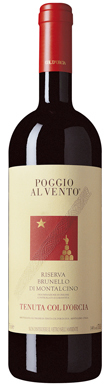

The celebrated 2010 vintage in Montalcino registered good levels of rainfall in spring followed by a warm and dry summer with no temperature extremes. September...
2010
Col d'OrciaBrunello di Montalcino

Col d'Orcia, Poggio al Vento, Brunello di Montalcino, Tuscany, Italy, 2007
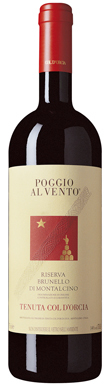
The 2007 vintage was characterised by extremely hot and dry weather following winter which was more mild and less rainy than usual. A hot spring...
2007
Col d'OrciaBrunello di Montalcino
Col d'Orcia, Poggio al Vento, Brunello di Montalcino, Tuscany, Italy, 2006
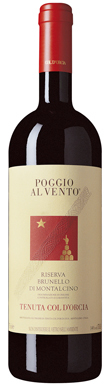
This is one of the greatest Poggio al Vento wines ever made in my opinion. A late bud burst and rainy spring prepared a long...
2006
Col d'OrciaBrunello di Montalcino
Col d'Orcia, Poggio al Vento, Brunello di Montalcino, Tuscany, Italy, 2004
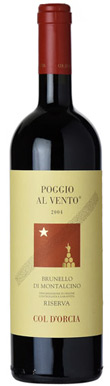
The analytical data of this vintage harks back to the past when Sangiovese was harvested nervous and acidic. 'After some early-harvested vintages, in 2004 we...
2004
Col d'OrciaBrunello di Montalcino
Col d'Orcia, Poggio al Vento, Brunello di Montalcino, Tuscany, Italy, 1999
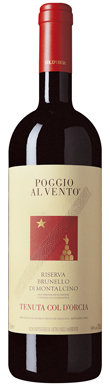
The 1999 was a very classic vintage and one for the long haul in Tuscany. The season was regular with a mild autumn giving optimal...
1999
Col d'OrciaBrunello di Montalcino
Col d'Orcia, Poggio al Vento, Brunello di Montalcino, Tuscany, Italy, 1995
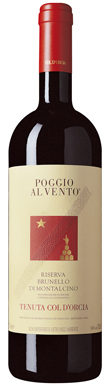
Good climatic conditions at budburst, regular rainfall in spring, then quite a rainy August meant that 1995 could have been a difficult vintage. However, one...
1995
Col d'OrciaBrunello di Montalcino
Col d'Orcia, Poggio al Vento, Brunello di Montalcino, Tuscany, Italy, 1990
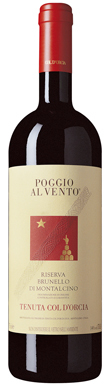
Meaty and Marmite aromas on the nose, with camphor whiffs and touches of coffee powder that suggest the evolution of this wine. Its complexity is...
1990
Col d'OrciaBrunello di Montalcino
