
The Decanter Interview – Christophe Roumier


His acclaimed wines command stratospheric prices on the secondary market, but the man in the driving seat at Domaine G Roumier is more concerned with looking after the land for the next generation, discovers Stephen Brook.
The day before going to visit Christophe Roumier, I asked some of his neighbours what questions I should pose. The reply came as a chorus: ‘Ask him why he doesn’t reply to emails!’ Indeed, I too have long experienced the same problem.
He exudes modesty, but not false modesty, and seems genuinely bewildered by the soaring prices obtained by his wines on the secondary market.
‘Frankly, I’m puzzled by the stratospheric prices some of my wines have been fetching, as I’m not convinced they’re so much better than those from many of my neighbours.’
Yet bottles of his Chambolle-Musigny 1er Cru Amoureuses and Bonnes-Mares have been known to sell for between £1,400 and £1,800 each. Of course, such prices reflect scarcity as well as quality, not to mention the feeding frenzy of international collectors.
Chambolle-Musigny is his heartland, with holdings in all the major sites. In addition he owns the premier cru Clos de la Bussière, located around his parental home in Morey-St-Denis; a tiny amount of Corton-Charlemagne; and grand cru Gevrey-Chambertin vineyards, which are farmed en métayage – a sharecropping arrangement which means he only receives a proportion of the crop.
The Gevrey wines are bottled under the Christophe Roumier label. And the latest addition is 0.13ha of Echézeaux, first produced in 2016.
Roumier at a glance
- Born 1958
- Education Dijon University, graduated in oenology in 1980
- Vineyard area 12.6ha
- Hobbies Has a house and olive groves in France’s Alpes-Maritimes; cycling and travel
- Favourite wines Northern Rhône, Barolo, German Riesling
In the beginning
The domaine was established by Roumier’s grandfather Georges in 1924, enlarged in the 1950s and then run by his father Jean-Marie from 1961 until 1990, by which time Christophe was firmly installed as the winemaker. His background was conventional enough: growing up among the vines and barrels, studies at Dijon University, and winemaking experience at the domaine from 1981. Quite tall and angular, he combines affability and reserve, and there is no sign whatsoever that he craves celebrity status.
Yields are famously but not exaggeratedly low, averaging around 30hl/ha. He controls them by pruning hard and removing excess buds, and is no fan of green-harvesting, which he regards as a correction of excess vigour.
‘I wish yields were a bit higher, but we’ve had many dry winters that inhibit growth and vigour over the following season. It’s a problem shared by many estates in the Côte de Nuits.’
Twenty-five years ago he began farming organically, but attacks of mildew in 1993 persuaded him to stop. Today he is essentially organic, though he doesn’t seek certification. ‘My concern is that large doses of copper sulphate are permitted under organic regimes, and I want to reduce that to the absolute minimum, as copper is toxic. I don’t want those who come after me to accuse me, as my generation accused our predecessors, of having polluted our vineyards. I haven’t used herbicides for almost 30 years, but I did use a chemical treatment once in 2012 because of heavy mildew.’
In short, he’s pragmatic, while doing all he can to eschew chemical treatments. He is equally pragmatic in his choice of rootstocks and clones when replanting. ‘I do plant massal selections, but I also believe in clonal diversity. In the 1960s, growers wanted productive and early-ripening clones – the exact reverse of what we’re looking for today. I’m after a long growing season, and late-ripening vines that will give us phenolic maturity and typicity.’
‘I don’t want those who come after to accuse me, as my generation accused our predecessors, of having polluted our vineyards’ Christophe Roumier
Extracting the best
The Roumier vineyards contain many old vines: his Musigny parcel has vines from 1905, as well as many later plantings. ‘For me that’s ideal: a mix of old and new. The oldest vines aren’t necessarily the best. They can excel, giving regularity in style, small berries and less juice, thus more concentration. But I had a 1934 parcel in Charmes-Chambertin that wasn’t that good and has since been replaced, although there were some outstanding vines among them that still survive.’
Roumier’s winemaking is unremarkable. Grapes used to be sorted in the vineyard only, but with a growing use of whole-cluster fermentation it’s become essential to sort at the winery too. It was in the notoriously low-acid 2003 vintage that Roumier began retaining more stems, though he had always done so for his Musigny. ‘I needed to give the wines more nervosité and verve. With climate change our wines have become richer and fatter, and I want them to have the backbone for long ageing. Whole clusters also give more elegant, floral aromas, and diminish the overt fruitiness of fully destemmed berries.’ Today he retains about 50% whole clusters.
In the cellar there is a cold soak at around 15°C, and fermentation takes place in steel or concrete tanks with natural yeasts. He uses punchdowns to extract, but less forcefully than was done in the past, and likes a warm fermentation as it encourages a multiplication of those yeasts and ensures the must ferments to complete dryness. The maceration period is quite long, in order to continue the extraction. Chaptalisation is only practised in cool years, such as 2013, and then only for certain lots. The wines are aged for a maximum of 18 months in a modest proportion of new oak: about 20% for village wines, one-third for premier cru, and 50% for Bonnes-Mares. Only Musigny can sometimes be aged entirely in new oak, because the volumes are so small.
If the Roumier wines have a stylistic signature, it would be finesse rather than power. ‘What I aim for in my wines is texture and finesse, which one could define as harmony and balance. I’m not keen on heavy tannins, so it helps that we are in Chambolle, where the tannins are naturally fine. When I’m working out how to proceed with making a particular wine, I tend to use texture rather than aromas as my reference, although I don’t deny that with Pinot Noir aroma is important too. Power isn’t essential for longevity, and it’s important that our great vineyards give us wines that age well and become more complex. You can produce simple, fruity wines just about anywhere, but in Chambolle we have to validate our terroir.’
So what, I wondered, is the typicity of Chambolle? ‘It varies, of course. From the poorer, higher slopes you get the finest wines. Where there is more clay, lower down and near Morey-St-Denis, the wines are more weighty. But whatever the source, the wines should have silky tannins, fine aroma (more so than in Vosne), and a lighter structure. That’s what should define Chambolle.’
The real deal?
With rising prices come growing problems. Fraud, for one. Like other prestigious estates, Roumier attaches coded aluminium strips that can be scanned to ensure the bottle has not been tampered with. Even so, Roumier is not complacent: ‘It’s hard to fake the band, but I suppose one could create one that looks convincing even if it doesn’t actually work. Unfortunately, the fraudsters tend to be one step ahead of us when it comes to technology.’
Strong demand for his wines must be gratifying, even though middlemen tend to snaffle up the profits, but Roumier is aware of the dangers in putting most fine Burgundy beyond the reach of so many consumers. ‘There’s no such thing as good Burgundy that’s cheap. Yields are low, the area is small, and demand for the best wines very high. But I agree that escalating prices, often driven by intermediaries rather than producers, could damage our reputation long-term. It’s becoming a market of collectors rather than drinkers, which is not that desirable.’
Christophe Roumier keeps a level head, seems without pretensions, and is focused on the central task of producing, year in, year out, a range of impeccably made wines, with finesse and longevity. He is not alone in Burgundy, but few can match his consistency. And he still doesn’t answer his emails.
Brook’s view: a rare taste of Domaine G Roumier
With one exception, these wines were tasted at the domaine in July 2017, having just completed their malolactic fermentation. For information on pricing and availability, please contact UK importer Domaine Direct.
Domaine Georges Roumier: Profile and wine ratings – Clive Coates MW
Domaine Georges Roumier, Musigny Grand Cru, Burgundy, France, 2016
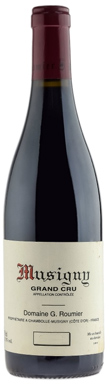

New oak barrel sample. Deep red. Voluptuous raspberry nose, vibrant and seductive. Fresh attack, lean and intense, with fine-grained tannins supporting the mouthwatering fruit. Lifted...
2016
Domaine Georges RoumierMusigny Grand Cru

Domaine Georges Roumier, Chambolle-Musigny, 1er Cru Les Amoureuses, Burgundy, France, 2016
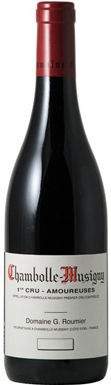
Barrel sample. Airy, ethereal nose, poised and pure, showing lovely raspberry fruit and incomparable charm. Fresh, limpid, and airy on the palate, yet very concentrated,...
2016
Domaine Georges RoumierChambolle-Musigny
Christophe Roumier, Aux Mazoyères, Charmes-Chambertin Grand Cru, Burgundy, France, 2009
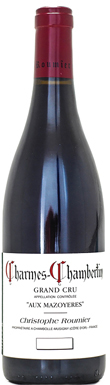
Tasted from magnum in November 2016. Fairly deep red. Vibrant raspberry nose, lean and pure. Very ripe, pungent and intense on the palate, showing terrific...
2009
Christophe RoumierCharmes-Chambertin Grand Cru
Christophe Roumier, Ruchottes-Chambertin Grand Cru, Burgundy, France, 2016
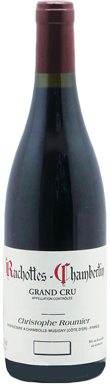
Barrel sample. Very ripe raspberry nose, exquisitely aromatic. Rich and concentrated but limpid, with elegant tannins, and a precise but firm finish, with good acidity...
2016
Christophe RoumierRuchottes-Chambertin Grand Cru
Domaine Georges Roumier, Echézeaux Grand Cru, Burgundy, France, 2016
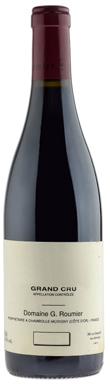
Barrel sample. A new wine for Roumier, vinified but not farmed by him, as the vineyard was purchased just days before the vintage. Deep red....
2016
Domaine Georges RoumierEchézeaux Grand Cru
