With increasingly unpredictable weather, organic farming in France isn’t getting any easier. To make matters worse, a French government agency has recently restricted the use of most copper fungicides – organic winemakers’ main defence against downy mildew, which can destroy entire crops if left unchecked.
But one winemaker in the southern Rhône believes he has an alternative. What’s more, the treatment is adaptable to vineyards around the world and he’s willing to share his findings for free.
Could this signal the end of winemakers’ reliance on this potentially toxic chemical?
‘A commercial estate using essential oils to treat downy mildew successfully at this scale is something quite extraordinary’
Scroll down for five wine reviews for Château l’Ermite d’Auzan
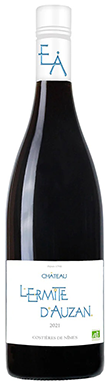
Château l’Ermite d’Auzan
Located in the southern part of Costières de Nîmes, l’Ermite d’Auzan is a 100ha estate, 75ha of which is planted with 10 different grape varieties. Established in 1973, it’s currently in the hands of Jérôme Castillon and his son Tanguy, the fourth generation.
Tanguy has been developing a natural remedy to fight against downy mildew, with encouraging results: essential oils.
Just a stone’s throw from the Mediterranean Sea, the pebbly zone of Costières de Nîmes is the Rhône’s most southerly growing area. It’s also one of the region’s most dynamic appellations, and Château l’Ermite d’Auzan’s work on essential oils is just one example.
When I visited in January this year, we drove to their higher vineyards in a vintage Jeep.
Decanter newsletter
Get our daily fine wine reviews, latest wine ratings, news and travel guides delivered straight to your inbox.
Though not particularly elevated, you can see for miles across the fairly flat landscape surrounded by loftier landmarks in the distance: Pic St Loup to the west, the town of Uzès to the north, Les Baux de Provence to the east.
To the south, you can see vast saltwater ponds and the glittering Mediterranean beyond.
Herbal remedy
Aromatic plants grown on the estate, and the essential oils made from them.
(Image credit: Matt Walls)
‘The idea was to find something to burn the fungus,’ says Tanguy.
‘At the very beginning, the idea of working with essential oils came from their well-known effects on the human body, since the active molecules involved are exactly the same ones we use. When a molecule such as thymol has antifungal and antibacterial properties for the human body, its effect on the vine is almost identical.’
Essential oils have been used in traditional medicines to treat people for hundreds of years. Thymol, for example, is extracted from thyme and is still used today in products such as Listerine mouthwash.
Tanguy is not the first person to come up with this idea; there have been successful experiments in treating downy mildew with essential oils in the past.
But a commercial estate using essential oils successfully at this scale, and the ability to remove copper use, is something quite extraordinary.
L’Ermite d’Auzan now sprays its whole vineyard with essential oils instead of copper.
Copper: A blessing and a curse
The estate was certified organic in 2020, then biodynamic in 2024. Like other producers working without synthetic chemicals, their armoury against diseases is severely limited.
Two of the most serious fungal threats that growers face are powdery mildew and downy mildew; if working organically, the first is typically treated with sulphur, the second with copper.
If used moderately, most winemakers agree that sulphur is relatively benign when sprayed in the vineyard. Copper, however, is more problematic. It’s a heavy metal that doesn’t break down, and accumulates in the topsoil.
It can be harmful to earthworms and soil microorganisms, and in large quantities can pose a threat to animals, birds and vineyard workers. And, according to Tanguy, ‘it burns the hairs of the roots of the plant and blocks [the uptake of] potassium and other trace elements’.
In July 2025, France’s National Agency for Food, Environment and Occupational Health & Safety (ANSES) decided to restrict the sale of most copper-based fungicides.
According to its website, ‘while copper is of great value in agriculture, its toxic effects are of increasing concern’. But with no obvious alternatives, some winemakers have been left wondering if they can continue to work organically.
Natural methods
The estate makes its own essential oils from aromatic plants distilled in its own alembic still.
(Image credit: Matt Walls)
He makes the oils himself. On the long driveway towards the winery are neat rows of 15 different types of aromatic plants, including thyme, rosemary, lavender, oregano, mint and curry plant (immortelle). He tried growing sage but it was eaten by rabbits.
Each contains a different active chemical compound, and Tanguy says he uses five different types of plant over the course of a growing season to prevent the mildew from building up a resistance.
After picking and drying a batch of herbs, he uses an alambic still to distil the oil. It’s a simple process: steam passes through the herbs, releasing volatile components, and when the steam cools the oils rise to the surface of the captured liquid.
‘It took time to find the right concentrations,’ he says, and a lot of trial and error. He uses 80ml-100ml of oregano essential oil per hectare of vines, whereas lavender essential oil requires 280ml-300ml per hectare.
To get the right strength before spraying, he had to mix the oils with water – not an easy task. The answer was to mix the oils into milk first, then to mix the milk with water. It’s a curative, rather than preventative, treatment, and it needs reapplying after it rains.
A testing vintage
The 2024 vintage featured regular rains during spring, and many estates throughout the Rhône Valley suffered from attacks of downy mildew.
Jérôme says that certain neighbouring estates were badly affected, with some vineyards completely destroyed. But L’Ermite d’Auzan suffered barely any mildew on its grapes, and saw no decrease in production. A result, the family says, of spraying with essential oils.
No longer spraying with copper has led to additional benefits in the vineyard. Since a first analysis in 2019, the soil pH has dropped from 8.3 to 7.7, which is beneficial to the microbiome. Over the same period, the percentage of organic matter in the soil has risen from 1.8% to 2.5%.
Tanguy has also noticed that there is now less of a gap between sugar and tannin ripeness in his grapes, which means lower alcohol levels in their wines.
Working with essential oils instead of copper does have one disadvantage however – it’s more labour intensive. He has to spray 15-17 times per year; the maximum before using the oils was 13.
I wondered if the aromatic oils might transfer their flavour to the resulting wine, but Tanguy reassured me that, ‘it doesn’t go into the plant, just on the leaves, then it’s burnt off by the sun’. In any case, the last treatment is in mid-July, long before harvest.
Spreading knowledge
Rosemary grown on the estate.
(Image credit: Matt Walls)
Though sceptical to begin with, Jérôme is now convinced of the oils’ effectiveness. ‘I’m a student again,’ he says, ‘and my son is the teacher!’
They have since received visits from wineries as far afield as Lebanon and Greece, curious to replicate the Castillons’ success. Tanguy says that they don’t have to grow the same plants that he does; they can use other aromatic plants that are indigenous to their respective regions.
He has so many visitors, he says, because, ‘I’m not selling anything’ – he’s just happy to share his knowledge.
Next for Tanguy is a meeting with INRAE, the French agricultural research institute, to further develop this approach. He’s confident that if this method works for him, it can work for others.
If he’s right, this could be a turning point for organic viticulture – and not a moment too soon.
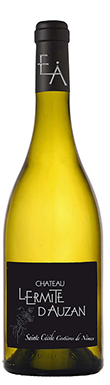
Château l'Ermite d'Auzan, Sainte-Cécile Blanc, Costières de Nîmes, Rhône, France 2024
My wines
Macadamia and preserved lemon aromas introduce this a proudly barrel-fermented style of white Rhône. It's medium- to full-bodied, with good freshness and energy. The oak...
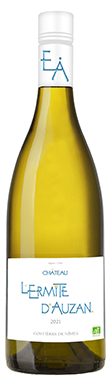
Château l'Ermite d'Auzan, Blanc, Costières de Nîmes, Rhône, France 2025
My wines
A fresh, vibrant, zesty style with a touch of lemon verbena. Rounded in texture, but only light- to medium-bodied, with well-balanced acidity. Fairly persistent finish....
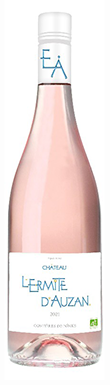
Château l'Ermite d'Auzan, Rosé, Costières de Nîmes, Rhône, France 2025
My wines
Pale pink in colour, with red cherry and watermelon aromas. A light-bodied, fresh style that's very drinkable, with lively acidity. A fresh, straight and well-balanced...
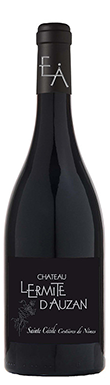
Château l'Ermite d'Auzan, Sainte-Cécile Rouge, Costières de Nîmes, Rhône, France 2023
My wines
Deep ruby, transparent colour. Only medium-bodied, with balanced alcohol. There's a touch of the wild side of Mourvèdre, and a hint of farmyard but not...
Decanter's Rhône correspondent, and DWWA Regional Chair for the Rhône.
Matt Walls is an award-winning freelance wine writer and consultant, contributing regular articles to various print and online titles including Decanter, where he is a contributing editor. He has particular interest in the Rhône Valley; he is chair of the Rhône panel at the Decanter World Wine Awards and is the owner of travel and events company www.rhoneroots.com.