
First taste: Dom Ruinart 2010
Marking a turning point for Dom Ruinart, 2010 is the first vintage to have been aged under cork. Yohan Castaing tastes the newest release.


‘In 2010, nothing, or almost nothing, indicated that this could be a great vintage for our Dom Ruinart.’
This is the frank assessment from Frédéric Panaiotis, Ruinart’s chef de cave since 2007, as we begin our online tasting of Dom Ruinart 2010.
It was a challenging year, described by Panaiotis as: ‘A very cold winter, a very dry spring and early summer, a rainy August followed by an outbreak of rot in the autumn, which is why we were unable to make any red wines that year and why there will be no Dom Ruinart rosé in 2010.’
Scroll down for Yohan Castaing’s tasting note and score for Dom Ruinart 2010
Climate data
Still, as they say, the proof is in the pudding. The vintage has in fact turned out to be a very fine one for the best Chardonnay-based Champagnes. To understand why this is, Panaiotis believes we need to take into consideration some of the climate data.
‘The average temperature in 2010 was 10.2°C, but the ten-year average was 11.8°C.’
‘As for rainfall, there was 169mm in 2010, while the ten-year average was 255mm. Another significant figure concerns the number of days between flowering and harvest: only 89 days in 2010 but 93 for the ten-year average. Just a few years ago, such a figure would have established a new record,’ says Panaiotis.

All this data provides important perspective for our assessment of 2010. It shows that 2010 was a relatively cool year resulting in varying degrees of grape ripeness. What’s more, looking at the length of time between flowering and harvest, this ripening occurred over a short period of time. According to Panaiotis, ‘this had a big impact on the aromatic complexity provided by the grapes,’ and thus on the style of Dom Ruinart.
A new era – ageing under cork
The stylistic difference between the 2009 and 2010 vintages of Dom Ruinart is evident, but it is also attributable to how this particular Champagne was aged in Ruinart’s cellars prior to its release.
Ruinart had already been experimenting with the cellaring of its Champagnes under cork rather than the usual crown caps for a number of years.
Initial tests were carried out by former cellar master Jean-François Barot, starting with the 1998 vintage. Tasting these after his arrival in 2007, Panaiotis noted that they expressed smoky elements associated with reduction, but that they also seemed to have some oak characters, despite having never seen the inside of a barrel.

Ruinart therefore decided to cellar the Dom Ruinart wines under cork from the 2010 vintage onwards, so this recent release represents the start of a new era for its flagship Champagne.
This slight yet significant shift in style augurs well for the future. Cellaring under cork enhances the reductive element that is so conducive to vinous longevity, giving Dom Ruinart a greater capacity for long-term ageing.
New packaging
After releasing the ‘second skin’ in 2020 to replace heavy gift boxes for all bottles across its range, Ruinart have revealed a new ‘chalk wrap’ for the Dom Ruinart cuvée.
Similar to the second skin, the chalk wrap is made entirely from paper. It is apparently 11 times lighter than previous gift boxes, reducing the carbon footprint by 62%, according to Ruinart.

Designed to look as if it’s been carved from chalk, it feels textural and soft to the touch and is easy to recycle.
Yohan Castaing’s tasting note and score for Dom Ruinart 2010
Related content:
First Taste: Champagne Palmer & Co’s Grands Terroirs 2015 and 2012
Perrier-Jouët Belle Epoque Blanc de Blancs: 2012 release and vertical tasting
First taste: Henriot L’Inattendue 2016
Ruinart, Dom Ruinart Blanc de Blancs, Champagne, France, 2010
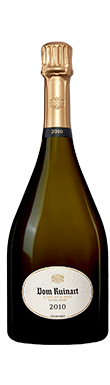

White pepper and roasted espresso top notes ride a beautifully serene and silky mousse. Subtle in build, but full of details of green mango, apricot...
2010
Ruinart

