
Gaja Barbaresco crus: Costa Russi & Sorì San Lorenzo verticals


Stephen Brook recently visited Gaja's estate in Barbaresco, where he tasted verticals of their Costa Russi and Sorì San Lorenzo crus...
Angelo Gaja has never had much time for conventional wisdom. He introduced barriques to age part of his Barbaresco in 1978, some years before a group of Barolo modernists followed his example.
Scroll down to see Stephen’s tasting notes & scores from two vertical tastings at the estate
Angelo bought the three vineyards that would become his cru Barbarescos in the mid-1960s, when single vineyard wines were a fairly novel concept. It’s worth noting that at this time Gaja was already the best known estate in Barbaresco, charging higher prices than neighbouring properties, so Angelo felt he could experiment and innovate without too much risk.
Derestricted
What really took the wine world by surprise was his decision with the 1996 vintage to downgrade his three crus to the simple Langhe appellation. Having shaken off the DOCG rulebook, he was free to add about 5% of Barbera to give the wines a tad more colour, acidity and staying power.
When I asked him about this decision in 2007, he insisted his main motivation was not the freedom to blend in other varieties but to elevate the status of his blended Barbaresco, which came from 14 different vineyards. A wine of exceptional quality, it was being slighted as wine critics and importers showered praise on the scarcer and more expensive cru wines.
Restoration
However, with the 2013 vintage his daughter Gaia, increasingly in charge of the business by now, took the decision to restore the crus as Barbaresco bottlings, thereby eliminating any varieties other than Nebbiolo from the blend. Her father appears to have accepted and respected her decision.
The crus
Gaja produce three single vineyard Barbarescos: Sorì Tildin, Costa Russi and Sorì San Lorenzo. In May 2018, Gaia Gaja presented verticals of the latter two at their estate.
Costa Russi consists of 4.3ha at an altitude of 230 metres, facing southwest on relatively heavy clay-limestone soils. By 2017 the vines were 75 years old, so they were replanted horizontally at a density of 5,700 vines per hectare in preference to the previous 4,200 vines per hectare. This vineyard has always been the estate’s primary source of Nebbiolo massal selections. Gaia considers Costa Russi to be the most fresh and floral of their Barbaresco crus.
Sorì San Lorenzo produces more tannic wines, and Angelo once told me that it was the most austere of his crus. It’s a site of 3.4ha, and the vines have an average age of some forty years. Only the top part of the vineyard is destined to be bottled as a cru wine.
Until 2008 the crus were partly aged in 120hl casks, but subsequent vintages were aged for 12 months in one-third new barriques, followed by a further 12 months in smaller casks.
Like all the Gaja Barbarescos, they combine force with elegance, and generally show a bit more richness and power than equivalent wines from other producers. They age superbly, and while some vintages can be broached young, these are structured wines intended to be cellared.
Gaja Barbaresco crus: two verticals
You might also like:
Barbaresco 2015 & Riserva 2013: Latest releases
An interview with Gaia Gaja
Great value Nebbiolo wines from Piedmont – Under the radar
Gaja, Sorì San Lorenzo, Barbaresco, Barbaresco, Piedmont, Italy, 2014
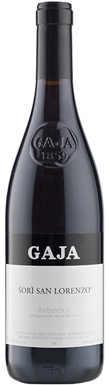

Although lush and smoky on the nose, this is more gawky on the palate and probably needs time to settle down. It initially seems medium-bodied...
2014
GajaBarbaresco

Gaja, Sorì San Lorenzo, Barbaresco, Barbaresco, Piedmont, Italy, 2013
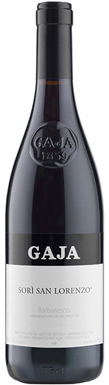
Under the ethereal nose is an imposing structure supported by mighty, yet elegant tannins. Beguiling aromas of oolong tea, spiced plums, cloves and potpourri. Needs...
2013
GajaBarbaresco
Gaja, Sorì San Lorenzo, Langhe, Piedmont, Italy, 2006
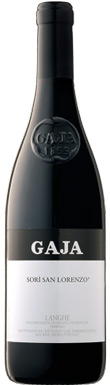
2006 was a severe but potentially great vintage that's been slow to evolve. It's unusually deep in colour, with a rich, savoury nose showing great...
2006
GajaLanghe
Gaja, Sorì San Lorenzo, Langhe, Piedmont, Italy, 1999
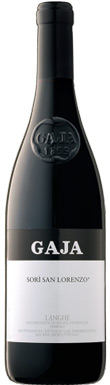
The opulence of 1997 combined with the backbone of 1996,' says Gaia Gaja of this vintage, and that seems about right. It's surprisingly closed and...
1999
GajaLanghe
Gaja, Sorì San Lorenzo, Barbaresco, Barbaresco, Piedmont, Italy, 1995
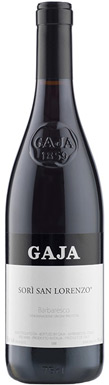
1995 was the best vintage for Barbaresco since 1990, but this bottle did not shine. The nose is slightly meaty as well as leathery, and...
1995
GajaBarbaresco
Gaja, Sorì San Lorenzo, Barbaresco, Barbaresco, Piedmont, Italy, 1988
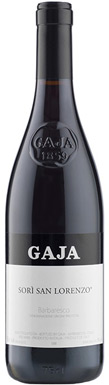
Angelo and Gaia described the 1980s as a moment of transformation in Piedmont, when many growers tried their hands at winemaking. ‘This is an important...
1988
GajaBarbaresco
Gaja, Costa Russi, Barbaresco, Barbaresco, Piedmont, Italy, 2014
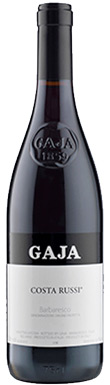
2014 offered a tricky growing season, and some estates produced no single vineyard wines, instead choosing to blend what they had. Barbaresco in general fared...
2014
GajaBarbaresco
Gaja, Costa Russi, Barbaresco, Barbaresco, Piedmont, Italy, 2013
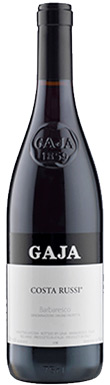
A glorious Nebbiolo nose of cascading damask roses straight from the garden after a heavy rain. On the palate, red plums and mulberry juice are...
2013
GajaBarbaresco
Gaja, Costa Russi, Langhe, Piedmont, Italy, 2005
Although overshadowed by the succulent 2004s, 2005 was nonetheless a fine vintage. The nose is surprisingly dense, even closed, and while the richness is evident...
2005
GajaLanghe
Gaja, Costa Russi, Langhe, Piedmont, Italy, 1996
Despite a generous crop in 1996 that threatened a lack of concentration, good acidity has given the best wines staying power. This is certainly in...
1996
GajaLanghe
Gaja, Costa Russi, Barbaresco, Barbaresco, Piedmont, Italy, 1990
This great vintage delivered a wine of fabulous complexity. There's little primary fruit on the nose, which instead is a concoction of woodsmoke, leather and...
1990
GajaBarbaresco
Gaja, Costa Russi, Barbaresco, Barbaresco, Piedmont, Italy, 1989
Another great and structured vintage with amazing ageing potential. It's perhaps a touch less complex on the nose than the 1989, but it nonetheless exhibits...
1989
GajaBarbaresco
